
Want to buy this lovingly curated collection of classic computers?
Around age 12, Benj Edwards began to lament the short-lived nature of technology — how his cherished Atari games got shoved aside by Nintendo, how the stylish Apple computers of his childhood lost ground to boxy PC clones.
He decided, as a sixth-grader in Raleigh, to preserve his favorites as artifacts: the Atari 800 his older brother used for programming in BASIC, the Apple II Plus his father bought for him at a flea market. From there came a flood of Commodores, TRS-80s, Intellivisions, the first Hewlett Packard touch-screen.
As curator of his own computer museum, he could provide context for future generations seeking to understand his era. To Edwards, any analysis of the 1980s and early 1990s would be incomplete without knowing that Mario originated as a Donkey Kong character called Jumpman or that Compaq Portable computers could fold into a suitcase.
These were relics worthy of care.
"It's been my mission to get video games and computers analyzed on the same level as film or photography," he said. "I think I've succeeded."
Flash ahead to two weeks ago when, at age 37, Edwards asked the world if it might want to buy his collection. As a father approaching middle age, free time and space were growing scarce.
He posted a picture to Twitter showing less than half the total, which includes roughly 300 vintage computers and 145 classic video game consoles. The Internet exploded.
"I think there's some kind of a civil responsibility on our society to keep this collection together and protected," tweeted @dPlaxco, to Edwards' delight.
By his count, Edwards received more than 6,000 retweets, 800 comments and 150 email inquiries ranging from a computer museum in Greece to a housewife in Texas. So the torch, should it be passed, might go to any number of eager hands.
"These are incredible machines that played an important role," Edwards said. "These machines are part of the recipe that makes a person, like your favorite sports team or where you grew up. What you do. What you see. The media you use. The games you play. It's not feeling nostalgic. I want people in the future to understand what made my generation the way it is."
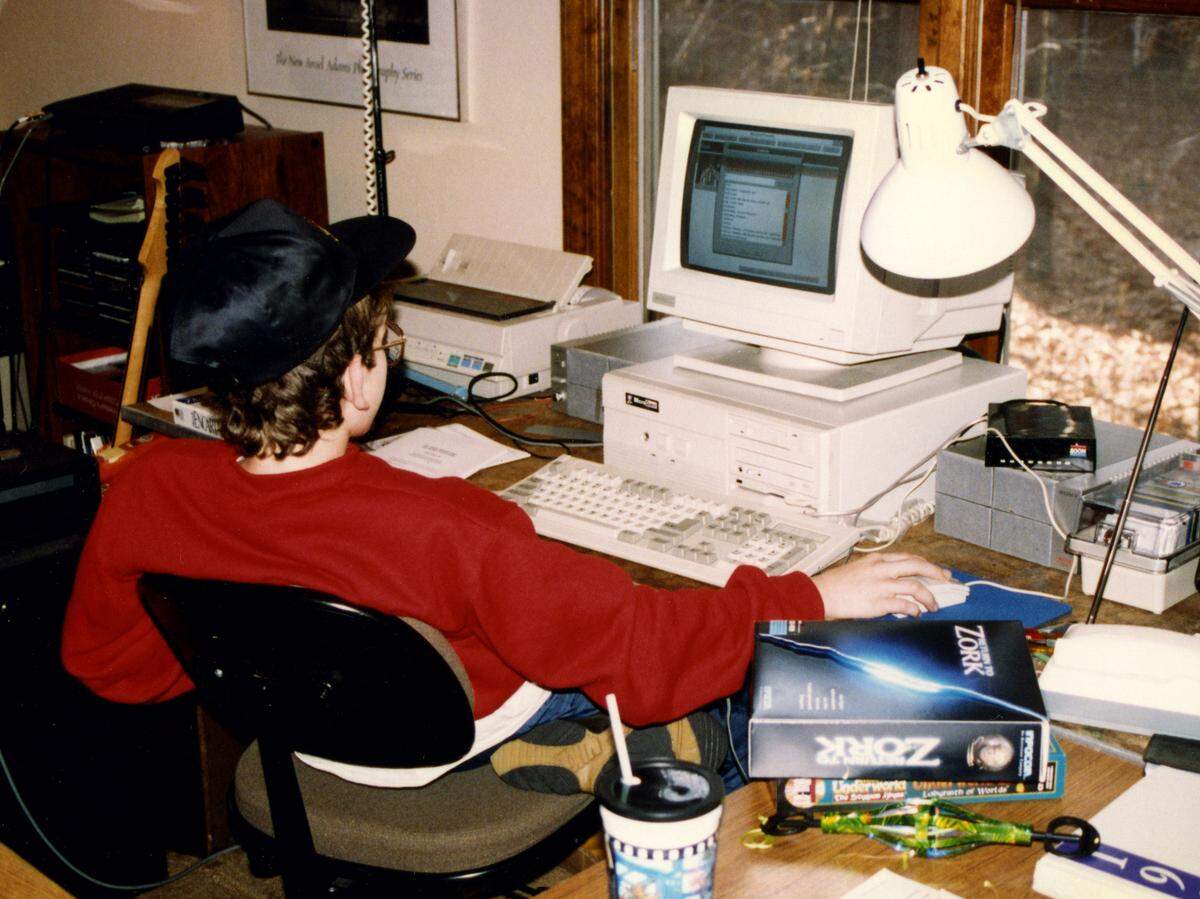
For anyone born after 1970, a first computer shares space with a first car on the sentimental trophy shelf. For me, the gateway to a lifetime of screen-staring began on an Epson QX-10, an indistinct beige rectangle that nonetheless introduced me to cutting, pasting and a game called Zork.
But the attention paid to antiquated technology has shot past pleasant remembrances of Pong games in the basement. The history of computing gets Smithsonian-level treatment in Mountain View, Calif., where the largest museum of its kind shows off more than 90,000 objects and charges $17.50 in admission.
While Silicon Valley's Computer History Museum can match every item in Edwards' collection, dozens of rival museums have sprung up worldwide and sent inquiries his way. Some tech-related businesses also asked to lease a few of his treasures for lobby display.
"Something to show off," Edwards explained. "These are like the holy tablets of computing."
For Edwards, the collection traces back to happy times in his Raleigh childhood and triggers memories of his father, a born tinkerer who built one of the first digitally tuned radios. For decades, Edwards and his dad would scour Raleigh's RARSfest at the State Fairgrounds, an amateur ham radio gathering, looking for discarded gems.
When he was 9, that trip netted an Apple II, which Edwards kept in his bedroom and learned to program. A quarter century later, a four-leaf clover is still Scotch Taped to the keyboard, and the brown covering still fits.
"I love this dust cover," Edwards sighed.
His pair of daughters, 8 and 5, enjoy playing Pac Man on computers three times their age, and they make for an eager audience when Edwards shows off dinosaurs such as the Sears Total Video Monitor, which can toggle between games and broadcast TV. To demonstrate, he flicked a button and created a field of black and white static.
"You don't see static anymore," Edwards said. "I show it to the kids. It blows their mind."
Two days after his initial tweet, Edwards updated the situation with this quote from his daughter: "Daddy, if you sell your computers, you will be sad."
But Edwards doesn't consider the electronic boxes his greatest contribution to posterity. The interviews he has conducted as a freelance tech journalist carry far more weight: the creators of Microsoft Word, the man who developed the first computerized in-car navigation system — anonymous innovators whose words Edwards enshrined.
His podcast The Culture of Tech started with an interview with Apple co-founder Steve Wozniak, and his writings on vintagecomputing.com unite is, in my admittedly novice opinion, the finest collection of geekdom available anywhere. Consider his review of Microsoft Solitaire cards or his account of how the game China Warrior ruined his childhood.
Regarding his collection, Edwards stresses that he isn't desperate. He won't sell all or parts of his collection today. But he did promise his wife the garage would be able to hold one car if needed.
It pleases him that his Twitter query drew such a huge response, and that the world holds so many others who shudder at the thought of throwing out a generation's worth of electronic loot — the product of so many brain cells.
Whatever happens, Edwards can rest comfortably knowing that he is not a lonely torch bearer, and thanks in least in part to his efforts, society can no longer write off his riches as just a game.
Josh Shaffer: 919-829-4818, @joshshaffer08
This story was originally published March 15, 2018 at 3:44 PM with the headline "Want to buy this lovingly curated collection of classic computers?."