
One of the world’s largest, smelliest flowers is set to bloom this week at NC State
It smells like rotten meat. It can grow up to 8 feet tall. And many people can’t wait to see it.
N.C. State University’s corpse plant — also known as titan arum or by the unwieldy Latin name Amorphophallus titanum — is about to bloom for the first time since 2016.
Brandon Huber, the plant’s owner, estimates the flower will start to open Wednesday night with prime viewing (and smelling) on Thursday.
Visitors can sign up to see it at go.ncsu.edu/flower, though there is limited space.
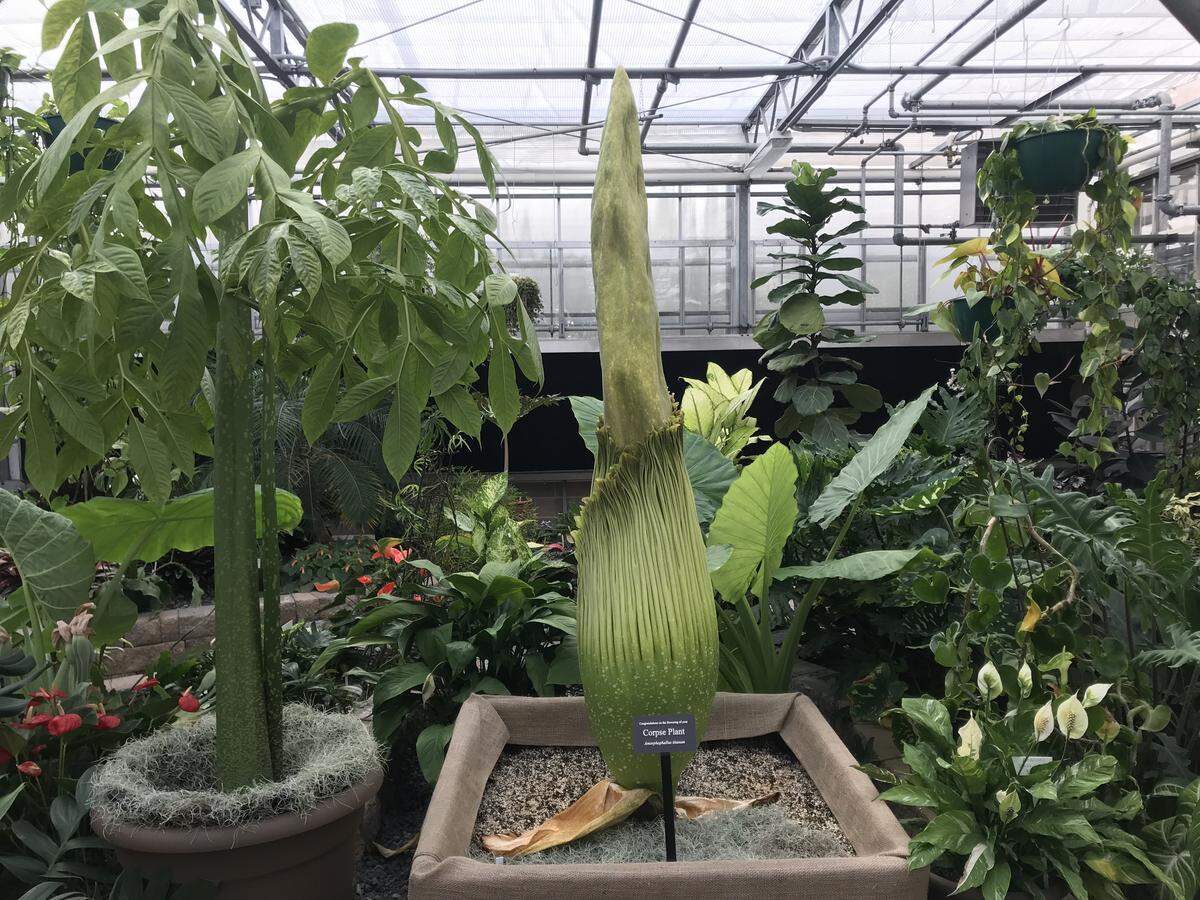
Corpse plants are native to Indonesia, where they live on rain forest edges and are famous for being one of the largest flowering structures in the world, according to N.C. State’s College of Agriculture and Life Sciences. They weigh in not far behind the giant parasitic Indonesian corpse lily, the world’s largest flower as reported by the Library of Congress.
The International Union for Conservation of Nature lists the corpse flower as an endangered species due to rapid deforestation.
Lupin the arum
Huber got his corpse flower from the Huntington Botanical Gardens in California, when it was just a small corm — an underground stem like a crocus “bulb,” according to the N.C. State Extension. Huber’s plant is tiny no longer; he said the corm is now 2 feet across by 1 1/2 feet tall, weighs 120 pounds and is shaped sort of like a doughnut pool float with a solid bottom. The plant is named Lupin, both in honor of the NC State Wolfpack football team and the Harry Potter character, Remus Lupin.
“Lupin is the first one I ever saw flower, which was extra special to me because I have always wanted to see one bloom and it turned out it was my own I got to see,” said Huber. He’s now a doctoral student of Horticultural Sciences at N.C. State, and said really unusual plants like the titan arum got him into horticulture.
Titan arums are stinky for a reason: BBC reported they are pollinated by carrion beetles seeking dead animals in which to lay their eggs. Huber explained that even though both male and female flowers are found on each arum, the female flowers mature before the males. The females need beetles and flies to bring pollen from other corpse plants in order to produce fruits.
The arum flower has to smell like dead things, and has to spread that stench as far as possible. To do that, Huber said that the huge spike of flowers, called a spadix, heats up 10 or 15 degrees more than ambient air temperature at the base. Heat spreads the chemicals responsible for attracting insects.
‘Smells like roadkill’
Researchers found the corpse plant emits chemicals such as trimethylamine, which causes a rotten fish smell, and dimethyl trisulfide, which smells like cooked cabbage and decomposing meat to humans.
“I would say it smells like roadkill or rotting seafood,” said Huber. “It’s not a pleasant smell.”
What’s even more interesting is that the enormous spike, which people travel to see, is just a landing pad for insects, Huber said. The real action is behind the showy maroon fringe that surrounds the spadix.
Beetles and flies head to the base of the spadix, hopefully covered with pollen from another arum, and wallow around in slippery fluids secreted by the plant, as reported by the BBC. They pollinate the female flowers. As the spathe starts to dry out and the odor of rotting flesh subsides, the insects head out and are hit with pollen from the newly developing male flowers. The stinky cycle continues.
The flower stalk only lasts a few days, but Huber won’t be pollinating it this time since the arum could expend too much energy making seed and die.
Once the flowering is over, he said the tall spadix will fall over, turn brown and dry out. He suggested checking online for pictures of berries from a pollinated plant, which look like rows of bright red beads atop a short green stalk.
N.C. State has a live stream to follow the flower’s bloom.
Cultivated arums tend to flower about every seven years, though Huber credits Lupin’s health for bringing about another flower so quickly after the 2016 flowering.
People who miss Lupin’s viewing might still be in luck. Huber said another N.C. State corpse plant looks like it should be flowering soon.
This story was originally published July 30, 2019 at 4:08 PM.