He tries to return dog tags found at former World War II camp; this week he succeeded
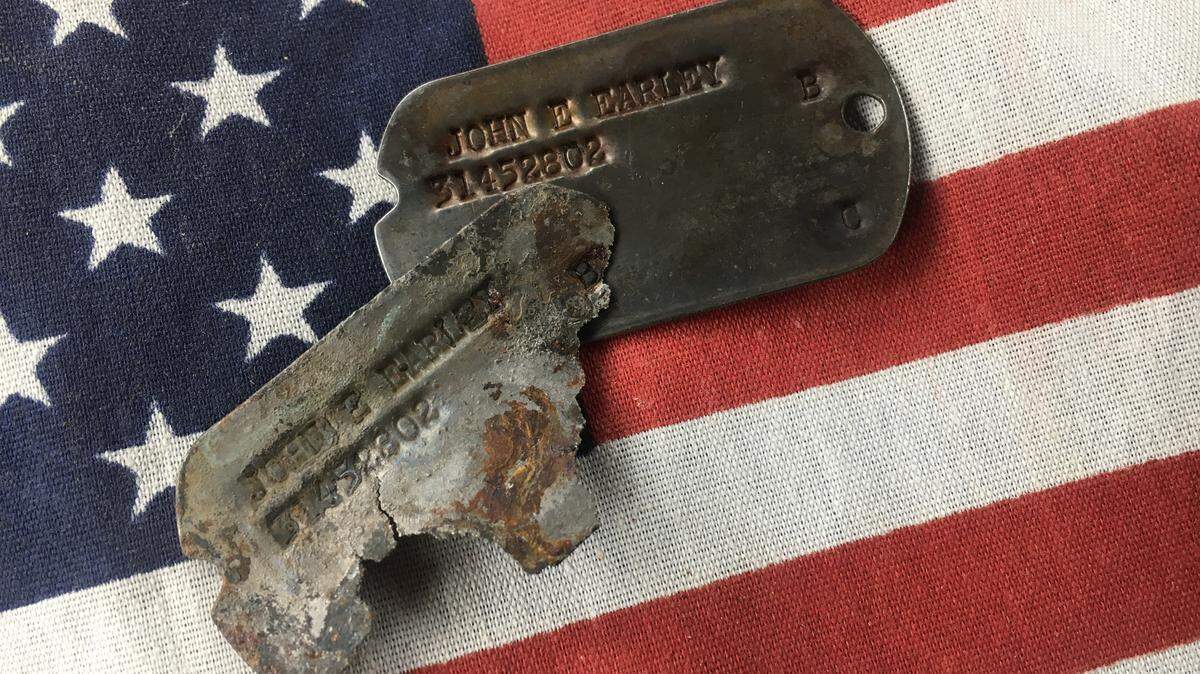
Sometime while he was at Camp Butner, the sprawling base north of Durham where the Army trained soldiers for combat during World War II, John E. Earley either lost or discarded a pair of dog tags.
Earley, who recently turned 94 and lives in Georgia, got them back the week of Thanksgiving.
Earley’s dog tags are among the more than 850 found on the grounds of the former training camp over the years that have ended up in the collection of the Camp Butner Museum. Mike Mercier, the museum’s curator, has cataloged them all and tried to track down the veterans or their survivors, whose names are stamped in the small, rectangular sheets of metal.
So far, Mercier has returned 11 tags and an ID bracelet; other family members have told him they’d be happier knowing the tags are in the museum. Twenty-one tags of soldiers who were later killed in action are on display there.
Earley is the first tag holder Mercier has found who is still alive. It happened after Mercier posted an item on the Camp Butner Society’s Facebook page just before Veterans Day about his efforts to return the tags and how he had tracked down a veteran this fall only to learn he had died in September.
Earley’s daughter saw the post and asked if by any chance Mercier had a tag belonging to him in the collection. Mercier recognized the name.
“I think you need to send me an email,” he wrote. “I am speechless.”
100,000 soldiers
Camp Butner opened in August 1942 and covered 40,000 acres, mostly in southeastern Granville County. On what had been mostly farm land, the Army built row upon row of two-story wooden barracks, as well as three swimming pools, several theaters and five all-faith chapels. There were rifle and artillery ranges as well as an Army hospital and a prisoner of war camp for German and Italian soldiers.
Mercier says about 100,000 Army soldiers passed through Butner for training before the camp officially closed in January 1947. The museum’s collection of dog tags numbers 856, which, including duplicates, comes out to 740 soldiers.
About three-quarters of the tags came from the collection of a relic hunter who searched the former camp with a metal detector over the years. After the man died, his collection, hundreds of dog tags strung on chains, was donated to the museum.
Mercier says no doubt some soldiers lost their dog tags while at Butner. But he says many probably threw them away or left them behind when they got a new, updated set. He said prisoners of war were put to work cleaning barracks after units shipped out and were forbidden to keep anything they found, so everything got swept up and sent to the base incinerator.
The incinerator’s dump site has been a rich source of metal artifacts that survived in the ash, including buttons, razors, coins and insignia. Twice in the last two years, Mercier has invited members of Triangle Relic Recovery, a historic preservation club, to search the old ash piles to see what they could find. Among the treasures were 56 more dog tags.
Doug Hardy, the group’s president, said its members usually search for artifacts with metal detectors, but the weathered piles are so full of bits of metal that the detectors were overwhelmed. So they sifted through the sandy, white ash by hand and with small tools.
Hardy said the dog tags were in rough shape but all but a handful were still readable.
“They’re steel, so generally speaking they survive reasonably well,” he said. “But being in the ground 75 years hasn’t done them any good.”
Hardy described the process of unearthing the tags as moving, particularly given how quickly the World War II generation is disappearing.
“To be able to connect with these people that did so much to allow us to have a life we have today, it really is hard to describe the good feeling that it gives you to be part of an activity like this,” he said.
A son honors his father
Two of the dog tags Triangle Relic Recovery members found belonged to George B. Vasey of Camden, New Jersey. Mercier was able to track down Vasey’s son, Glenn, in Lancaster, Pennsylvania, and send the tags to him.
Glenn Vasey had never heard of Camp Butner. He said his father joined the Army before Pearl Harbor, at age 19, and was stationed in Panama when the war broke out. George Vasey eventually ended up in Europe, setting up telegraph wires, but like a lot of World War II veterans rarely talked about his time in the service, said Glenn, who was born 11 years after the war ended.
“I remember as a kid once asking him, ‘Did you ever kill anyone when you were in the Army in World War II?’” Vasey said. “He just said, ‘There was a lot of shooting going on, nobody knows,’ in a way that said that’s the end of that conversation.”
Vasey said he was thrilled to get the dog tags and that he plans to put them in a shadow box to honor his father’s service. They will take their place alongside other artifacts, including the Bronze Star that George Vasey received for running communications lines under enemy fire.
Mercier knows that old dog tags may be just as prized by the children and grandchildren of the soldiers they once belonged to, perhaps even more so.
But he still relishes the idea of returning tags to veterans while they’re still alive, as increasingly unlikely as that is. Only 2% of the 16 million men and women who served in World War II are still alive, which makes hearing from John Earley’s daughter and being able to return his tags all the more remarkable, he said.
“That’s hard to imagine the odds of that,” he said. “I guess it was meant to be, to be able to find her, and find him, in time.”
As for Earley, he says he was surprised to receive the dog tags. He says he was at Camp Butner from May 1944 until the 89th Infantry Division shipped out to France the following winter and doesn’t recall getting a new set of tags.
“I didn’t remember ever exchanging them or anything, but apparently so,” he said in an interview. “I must have had a set on when we went overseas.”
The tags have become the only ones Earley has. He assumes he had a set when he was discharged from the Army but hasn’t been able to find them.
This story was originally published December 3, 2019 at 12:00 PM.