‘Gentleman Pirate’ was inept at sea, but it still got him hanged 301 years ago in SC
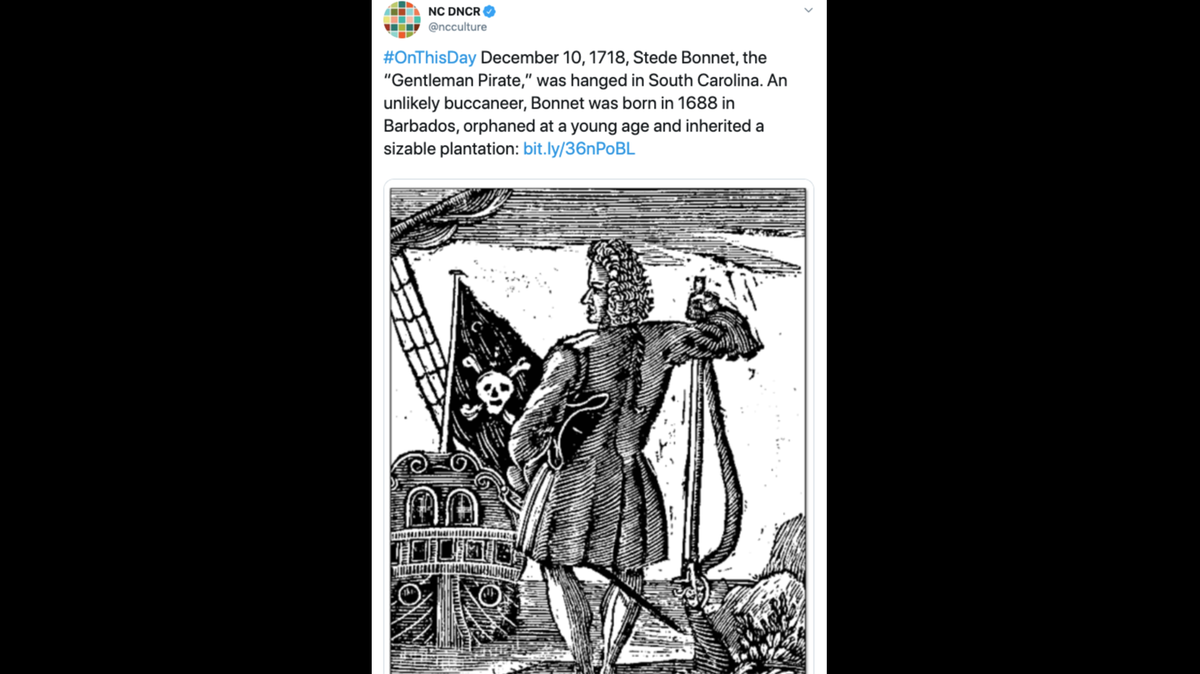
Stede Bonnet’s spontaneous decision to become a pirate at age 29 could be “the worst midlife crisis on record,” according to Smithsonian Magazine.
But his jaunt into the world of seafaring criminals didn’t last long.
Bonnet, more commonly referred to as the “Gentleman Pirate,” was hanged in Charleston, South Carolina, on this day in 1718 — less than two years after he bought a ship and abandoned his family in Barbados to join the likes of Blackbeard.
“Some in the crowd reportedly felt pity as the once proud man, with drooping head, walked up to the gallows, with shackled hands holding a bouquet,” the North Carolina History Project said of his execution.
Bonnet had an unconventional background for a pirate.
He was born in Barbados, then a British Colony, in 1688. According to the N.C. Department of Natural and Cultural Resources, Bonnet accumulated a plantation, served in the military and was married with children by 1717.
Then he gave it all up.
Unlike most pirates accustomed to plundering, Bonnet bought a ship, armed it and hired a crew, according to the N.C. DNCR.
The Smithsonian attributed his sudden change of heart to “some kind of mental break.”
David Moore, an archaeologist and historian with the N.C. Maritime Museum in Beaufort, told the magazine that legal records from that time point to some financial problems for Bonnet. One of his children had also reportedly recently died.
Bonnet left port in the middle of the night with his hired crew and left no word with his family, capturing his first few vessels in the Virginia capes, according to the Town of Southport, North Carolina — where the famed pirate was eventually caught.
But he was reportedly “a landlubber with virtually no knowledge of the sea” and his ineptitude as a pirate infuriated the crew.
Bonnet later befriended Edward Teach — the pirate known as Blackbeard.
Historical sources differ as to the nature of their relationship but, according to the N.C. DNCR, “Bonnet was known to have been in league with Blackbeard on occasion.”
The Town of Southport said Blackbeard took advantage of the crew’s disgruntlement and eventually seized control of Bonnet’s ship, the “Revenge,” while Bonnet himself remained somewhat of a prisoner.
But according to the South Carolina Encyclopedia, Bonnet brought Blackbeard aboard to take control while he recovered from “a clash with a Spanish man-of-war.”
The pair eventually parted ways, and North Carolina Gov. Charles Eden pardoned Bonnet when he turned himself in, the Town of Southport said.
The “reformed pirate” didn’t last long, and Bonnet resumed his nefarious activities on the Atlantic coastline.
When the Gentleman Pirate was finally captured, the N.C. DNCR said it was part of the “piratical threat to the colony” authorities in South Carolina sought to quash.
His defeat was reportedly one of the “largest and bloodiest of the pirate conflicts in the colony’s waters.”
Bonnet’s trial lasted much longer than his crew’s, the Smithsonian reported. “(He) tried to take advantage of his upper-class background in appealing to the governor for mercy and blaming everything on Blackbeard.”
It was to no avail — Bonnet was sent to the gallows on Dec. 10, 1718.
This story was originally published December 10, 2019 at 5:03 PM with the headline "‘Gentleman Pirate’ was inept at sea, but it still got him hanged 301 years ago in SC."