
Baby dinosaur skull held ‘evidence of DNA’ from 75 million years ago, NC State says
“Evidence of DNA” and cartilage have been pulled from the skull of a 75-million-year-old baby dinosaur found in northwest Montana, according to a joint report by N.C. State University and the Chinese Academy of Sciences.
The discovery is getting international attention, in part because the idea is reminiscent of the plot of the “Jurassic Park” films and book.
However, the research is nowhere near what’s needed to clone a dinosaur, National Geographic pointed out Tuesday.
The “evidence of DNA” was found in the form of “exquisitely preserved cells within preserved calcified cartilage tissues,” the Chinese Academy of Sciences reported in a March 2 press release.
The fragments had a structure “consistent with chromosomes,” the release said.
Alida Bailleul of the Chinese Academy of Sciences said her “heart almost stopped beating” when she saw the evidence, the release said.
“These new exciting results add to growing evidence that cells and some of their biomolecules can persist in deep-time,” she was quoted saying in the release.
“They suggest DNA can preserve for tens of millions of years, and we hope that this study will encourage scientists working on ancient DNA to push current limits and ... reveal all the unknown molecular secrets that ancient tissues have,” the release said.
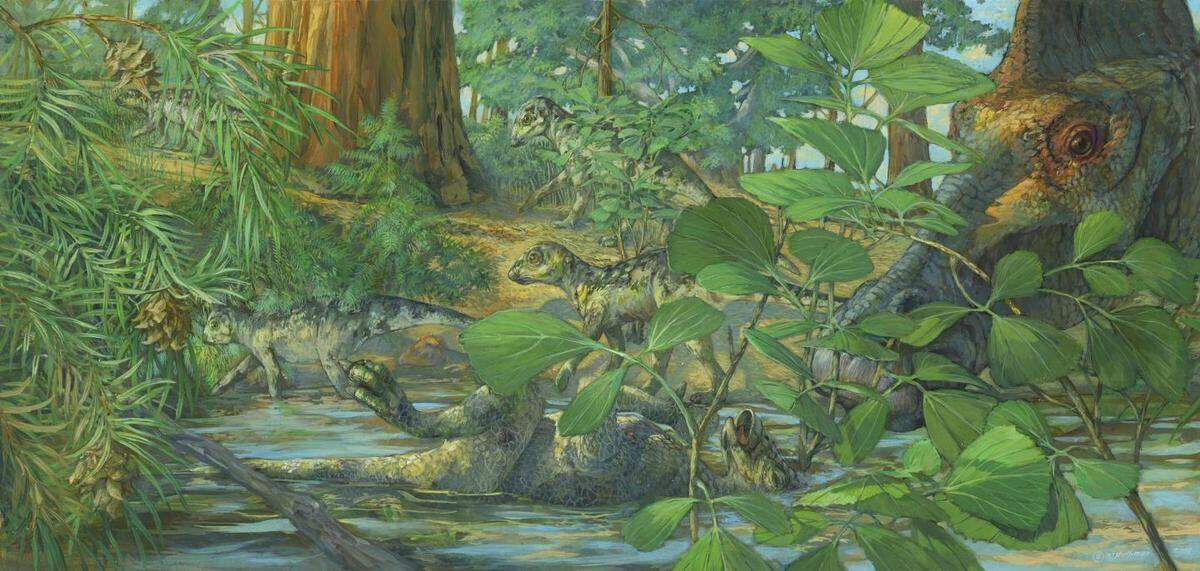
The baby dinosaur involved was a “Hypacrosaurus — a type of duck-billed dinosaur that lived in what is now Montana during the late Cretaceous period,” according to the N.C. State press release.
Mary Schweitzer, a professor of biology at N.C. State, was part of the international team that worked on the project and has been defending the study from skeptics.
She says the researchers did tests with chemical marks on the “preserved fragments” and the results supported “the idea that some fragmentary DNA may remain within the cells,” the N.C. State release said.
“We do not say that it is dinosaur DNA, although that would be a reasonable interpretation,” Schweitzer told Gizmodo, which reported Monday that some paleontologists say the data is “insufficient, inaccurate, and unconvincing.”
In defense of the study, National Geographic quoted Bailleul as saying: “We’re not doing the ‘Jurassic Park’ thing.”
David Evans, a paleontologist at the Royal Ontario Museum, told National Geographic the “research is still very much in its infancy, but the possibilities are absolutely thrilling if we suspend our disbelief, dig into the data, and continue to test and refine our ideas.”
This story was originally published March 3, 2020 at 12:48 PM.