
The week that changed lives: For one Garner family, sanitizer shortage puts a life at risk
Bethany Reeves knew this week would be different after a Tuesday phone call to her pharmacist.
“Hey, when I pick up the meds, do you have any hand sanitizer?” Bethany asked.
“Ma’am we don’t have any,” the pharmacist on the other end of the line replied, “and I don’t think we’ll have any for a month.”
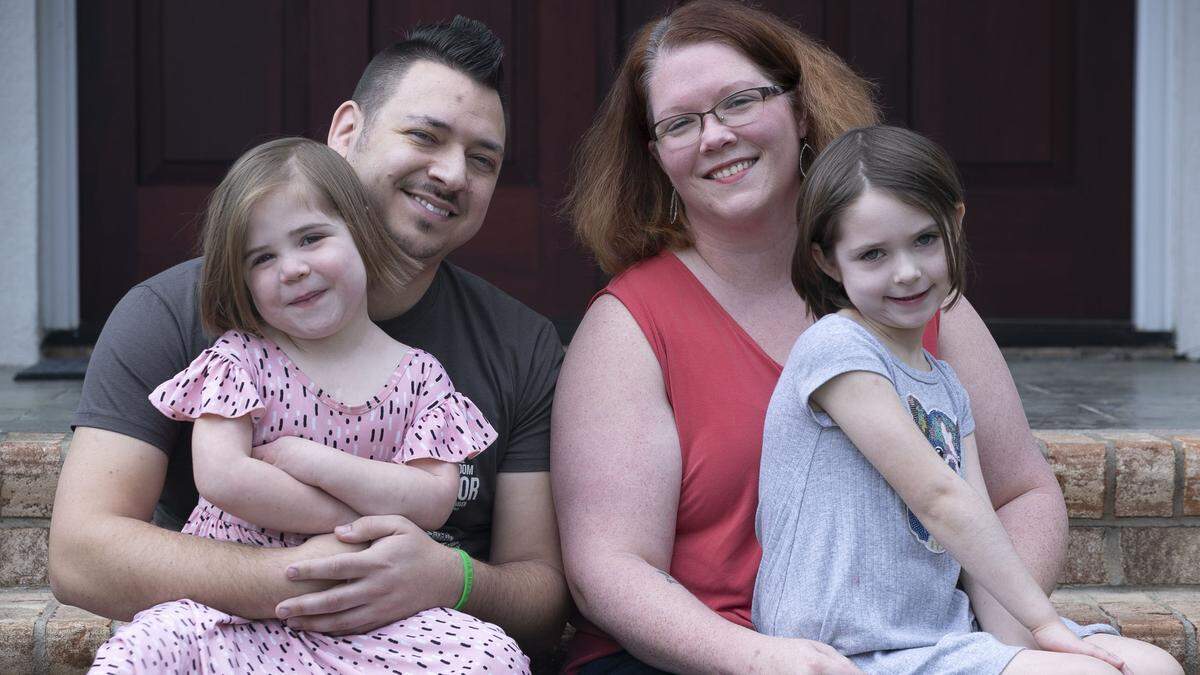
Bethany and Jared Reeves’ 3-year-old daughter, Naomi, received a heart transplant when she was four months old. Naomi’s immune system is suppressed to keep her body from rejecting the heart, leaving her highly susceptible to colds, the flu and COVID-19, the illness caused by the new coronavirus. They need the hand sanitizer so they and their older daughter, Kathryn, can protect Naomi.
The product is important enough to Naomi’s heath that the Reeveses installed a dispenser just inside the family’s front door; visitors must use it before entering the two-story home. So when Bethany learned the sanitizer would be missing from their local pharmacy for at least a month, the hunt was on.
North Carolina identified its first case of COVID-19 on March 3. But it was this past week that the virus began unraveling the thread of daily life throughout the Triangle, whether it was the number of people working from home casting an eerie silence over downtown or the many grocery shoppers emptying shelves with an urgency more typically associated with an approaching hurricane.
And, yes, it was the week that some residents were able to let out a sigh of relief at their decision to grab an extra pack of Lysol wipes while others, staring at an empty shelf, rued the decision to not stock up on cleaning supplies earlier.
Coronavirus comes closer
Bethany Reeves had been carefully tracking the progress of the new coronavirus. She followed reports about the virus in Wuhan, China, remembering her and her husband’s own visits to Chinese wet markets nearly a decade ago.
She watched as it made its way through Europe, shutting down Italy before eventually, landing in the United States, in North Carolina, in Wake County.
“It is as if a category 5 hurricane is barreling down on us, but we don’t know when or where it’s going to hit. And honestly we didn’t even figure out it did until a week after it did,” Bethany Reeves said. “Because when people do test positive, we’re only seeing echoes of what happened a full week ago....”
The first Wake County case rang alarm bells in the Reeves household. The North Carolina resident had traveled to a Washington state nursing home that was the site of a COVID-19 outbreak.
There is something different about knowing the case is in your community, Jared Reeves acknowledged, something that causes people to look for just a little longer at anyone who sneezes, with just a little more alarm.
“Now we’re in the target zone,” Jared Reeves remembers thinking, “because it’s not Washington, it’s not Europe, it’s 30 minutes away.”
As North Carolina saw its number of cases mount, the Reeves family grew more concerned. Monday brought news that five North Carolina residents had tested presumptive positive, all linked to a biotech company’s conference in Boston.
Tuesday, Gov. Roy Cooper declared a state of emergency for North Carolina, including urging employers to let people work from home if they could and urging the cancellation or postponement of church services and other social gatherings.
Also Tuesday, Bethany Reeves called her local pharmacy and learned about the hand sanitizer shortage.
“That was my, ‘Oh, maybe I should go (shopping),’ moment,” Bethany said.
Looking for Lysol
Bethany underwent a search for the supplies on Wednesday. She started at Staples because, she said, she was hoping people would have overlooked it. That hope was quickly dashed by a sign hanging in the door saying the store was out of sanitizer, Lysol and Clorox.
The Dollar Store was next, with Bethany hoping that also might be out of people’s normal shopping routines. That was picked over, too.
Next, she tried Target.
“I should have known better,” Bethany said.
It was there, looking at the gaps on the shelves, that the situation began to feel overwhelming.
“You feel helpless standing there in an empty aisle of Target knowing that these are almost medically necessary items for your child and all the people who don’t actually have them need them,” Bethany said.
The nearby Food Lion was the fourth stop. There, in addition to cleaning supplies being gone, the water and toilet paper had also vanished. When Bethany found an employee to ask when a truck would come in and if she could get on a call list, they told her it could be as long as three weeks.
Late that night, Bethany posted on Facebook: “Local friends: if you’re out and find hand sanitizer gel/wipes, or Clorox/Lysol wipes/spray, will you pick one up for us too? I’ll be glad to pay you back. It’s been difficult for us to find any.” She made a similar post on the neighborhood’s Nextdoor web page.
Over the next two days, neighbors dropped off supplies on the family’s doorstep or let Bethany know where to pick them up. By Friday evening, they’d collected seven containers of antibacterial wipes, seven bottles of disinfectant spray, several bottles of Purell sanitizer and a baggie containing assorted disinfecting products, including a container of alcohol.
Those friends and neighbors, Bethany said, could be saving Naomi’s life.
“She doesn’t have the immune system to be able to fight anything right now,” she said.
The Reeves family, already cautious, has learned to think in the long-term. Bethany hopes the virus’ peak will happen by late April or early May, while Jared believes it will last until the summer.
Bethany is reaching out to other families who have children with compromised immune systems to offer some of the cleaning supplies they received. But, she said, “We definitely are going to hang on to a lot of it because I foresee us living like this for a while.”
Two emails about COVID-19
This was also the week the nation became familiar with terms like “flattening the curve” and “social distancing” and prepared itself to go without familiar pastimes like St. Patrick’s Day parades and March Madness.
With each headline, the Reeves family grew a little more nervous. Finally, on Friday, Jared and Bethany each wrote an email.
Jared wrote to his parents, his sister and Bethany’s parents. In it, he described how he and Bethany are considering limiting the family’s exposure and urged everyone to wash their hands frequently and avoid crowds whenever possible.
Then, he listed a series of the week’s events: His working from home indefinitely, North Carolina’s state of emergency, Disney theme parks closing and the Make-A-Wish Foundation suspending all trips for four weeks.
“Naomi is HIGHLY likely to contract the virus and die from it, as she is seriously (immunosuppressed),” Jared wrote. “More suppressed than normal, as they basically had to kill (her immune system) in January to bring her heart back from a state of rejection. Please take the virus seriously and protect yourself.”
Bethany’s worry reached a tipping point Friday, also, brought on by three days of breaking news alerts, each one bringing another layer of bad news.
She wrote an email to Kathryn’s elementary school principal noting that the N.C. Department of Health and Human Services had said that in certain circumstances, e-learning should be considered. With Kathryn’s frequent exposure to Naomi, Bethany wondered if it would be possible for Kathryn to do her first grade coursework at home instead of attending her Johnston County elementary school.
“I don’t know that I’m fully comfortable with her continuing to go, but I’m not sure that being at home is going to be an option,” Bethany said. “It really depends on the school.”
By Saturday afternoon, Johnston County Schools had made a decision: School is canceled until at least March 30. It is possible, the district said, that the closure will extend beyond that date, and it will use the next week to explore how students can continue learning at home.
As of Friday evening, the Reeves family was comfortable with Naomi continuing to attend daycare in nearby Clayton, at least for now. It is a small program where many parents and all of the teachers are aware of the heightened risks that come with a heart transplant.
“Everyone at the daycare is very cautious for Naomi’s sake, so I feel like if people took that microcosm and expanded it out as a city, as a state, as a nation we’d be OK,” Jared said. “But people don’t really consider the people that are fragile that they live with or sit near or go to the movies with.”
For instance, when Bethany was picking Naomi up on Friday, there was a crowd of dozens of people in a reception area that they would typically walk through.
“I just had this sort of visceral reaction to seeing them,” Bethany said. “Like, I’ve got to find another way out of this building.”
The coming weeks
Kathryn and Naomi are active.
While their parents discuss how the virus is changing their lives, the girls play. In the span of about an hour: They build a fort together and abandon it; Kathryn fills a glass bowl with rocks and then water, creating a kind of multi-colored fish bowl; Naomi fetches some strawberries from the fridge for a snack; they go outside to a playhouse where they have several dolls stored; they disappear and come back changed into bathing suits; Naomi’s suit is on backward, so they go back upstairs where Kathryn helps her fix it; and then they go outside where one girl holds a Batman umbrella while the other splashes water from a bucket — make-believe rain.
Naomi has already asked her parents several times if the family can go to Marbles or Bungalow Bounce. Each time, she’s been told no, not right now.
“Do not go to Marbles, do not go to the movies, do not go to the food court or to the mall,” Bethany said. “Stay home because that’s really our only chance to keep this down enough to where she just might be safe. These are real, live people that are being affected by the general public’s choices, and I don’t think people get that.”
To help her girls handle more time at home in the coming weeks, Bethany is considering some new toys from Amazon, larger ones that they can play with in the fenced-in backyard.
The family has already canceled a series of weekend plans for the coming month, including attending the St. Patrick’s Day Parade and Elon University’s dance marathon fundraiser for the Children’s Miracle Network. Both events have been canceled.
The toughest one to talk about, though, is Naomi’s fourth birthday party, which was supposed to happen next weekend at Smithfield’s Splash Park.
“We haven’t really explained to her about her party yet. We don’t know how to explain that to a 3-year-old,” Jared said.
Naomi wants to swim for her birthday. So while Bethany has rescheduled the splash pad day for the end of April, they’re going to check into a nearby hotel with an indoor pool for a night. They’ll call ahead, like always, to make sure the room has received a deep cleaning, but this time they’ll bring an extra bottle of hand sanitizer.
Noting that only about 40% of children with heart transplants live to 15, Bethany said, “We’re going to let her swim as much as she wants and eat as many waffles as she wants. I don’t know what else I can do.”
This reporting is financially supported by Report for America/GroundTruth Project and The North Carolina Local News Lab Fund, a component fund of the North Carolina Community Foundation. The News & Observer maintains full editorial control of the work. To support the future of this reporting, subscribe or donate.
This story was originally published March 15, 2020 at 5:30 AM.