Special needs teachers have to be ‘patient, flexible and creative’ with online classes
Melissa Barry sits at her computer around 10 hours every day, waiting on calls for help from parents or for a student to pop into her Google Hangout to chat.
She’s afraid to step away from the computer for more than a minute or two.
What if a student joins the hangout and she’s not there to help?
On a weekday like this, Barry would normally have been in constant interaction with students. She’d walk around 10,000 steps through the halls of Smith Middle School, helping special needs students in general education classes.
“None of us selected teaching because we were office people,” Barry said. “So this is something we’re all really struggling with.”
Special needs teachers across the Triangle and the state have had to adapt to the pandemic keeping all of their students at home. But with EC classes, there are unique challenges to teaching online courses.
Maddy Stewart, who teaches at Timber Drive Elementary School said she and her peers have had to be “patient, flexible and creative.”
Students and their families have had to adapt as well, learning how to use online classrooms and technology that is normally handled in the school. Laura Branan and her son Joe, an 18-year-old diagnosed with autism, do his school work every morning from 9:30 to 12:00 from the kitchen table in their Chapel Hill home.
Where Joe is used to having a head teacher and two assistants, it’s just him and Laura every morning, one-on-one. There’s some positive in that, she said, “but I’ve had to relearn this stuff just to teach him.”
“Make sure they know they aren’t alone’
Chapel Hill-Carrboro Schools gave all students access to a computer this year and Barry said it’s helped position students and teachers to handle the pandemic better. Still, the transition wasn’t easy.
“One of the things that is crucial is the parent tie-in,” Barry said. Her first move was to make sure she had an email contact with the families of all the students she’s in charge of, so she could send them every way to get in touch with her.
Families who have a child with an intellectual or developmental disability already often struggle with getting access to resources, Barry said, so having to do classes online from home just adds another obstacle. If a parent can reach her, she can get them the resources they need.
She also began offering twice-weekly parent support groups, on topics like how to structure a child’s day.
“Parents now have to juggle so many jobs, I mean they already did and now they’ve also got to do school at home,” Barry said. “So it’s just trying to help them and make sure they know they aren’t alone in this.”
On Tuesday morning, April 14, Laura and Joe Branan were working on his English assignment for the day. He had to watch and compare speeches by Martin Luther King Jr. and Richard Nixon, and try to pick apart their techniques. But he wasn’t doing too well with the abstract parts of their speeches.
“It’s hard for him to notice what’s going on with these speakers,” Laura said. “I don’t know if he sees their passion and their tone.”
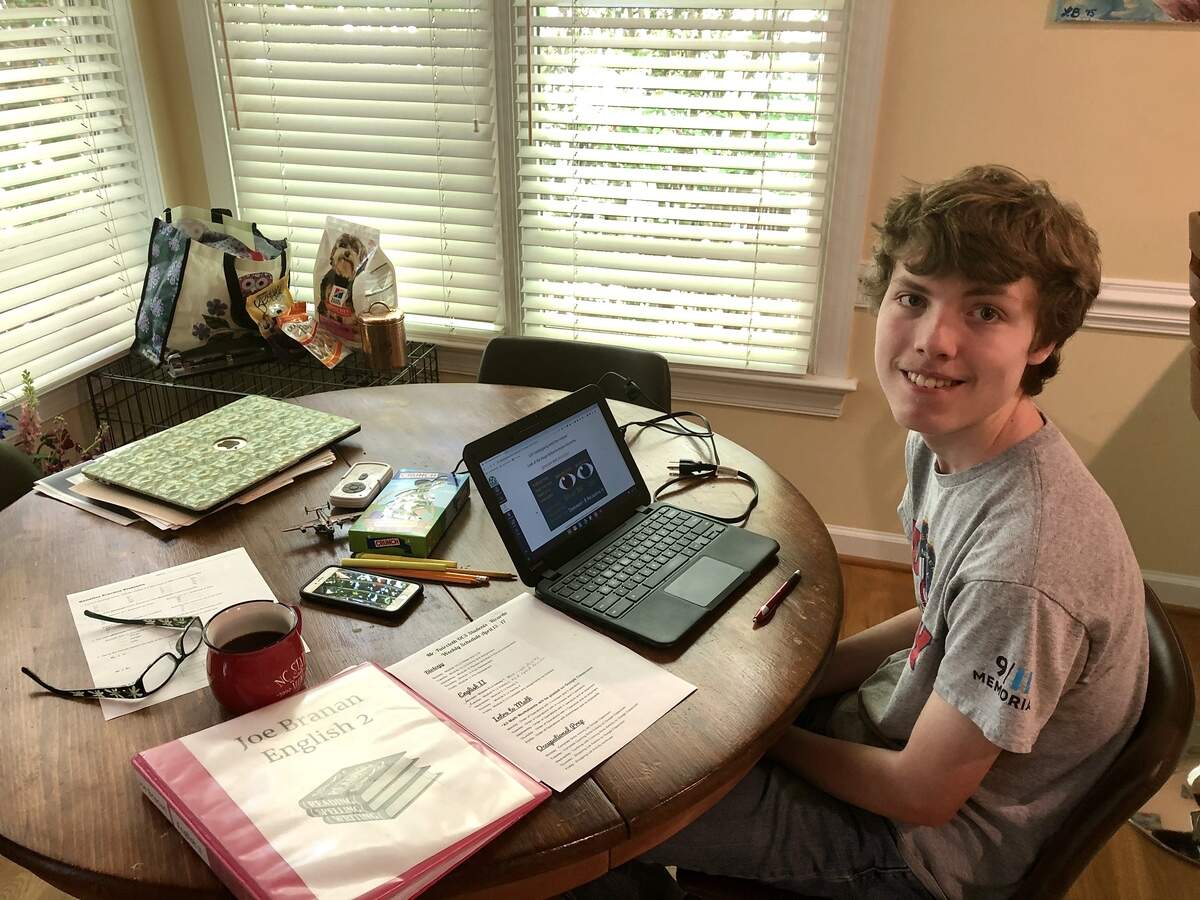
Joe, a student at Carrboro High School, has eight more questions before they can start biology, which he likes a bit more. His favorite assignments are learning games and videos where he has to do things like match definitions with words. Laura said it holds his attention more.
Upstairs and out on the porch, Laura’s daughter Caroline and husband, Andrew, are doing their own work — one is an N.C. State student, the other an N.C. State professor. The family’s broadband is stretched and until recently, Laura had been printing out Joe’s assignments, then turning in photos of them. His teacher helped them learn how to use online forms for assignments.
Barry, who used to teach Joe, said the most important thing she’s tried to get across to families is to reach out to a teacher if they’re stuck on a problem for 20 minutes. Parents are often hesitant to call teachers when they have a problem, but she said it’s not an intrusion to ask for help and 20 minutes is the longest they should try to figure something out.
Most of her Google Hangout calls with students have been for social support — she said students just sometimes need a teacher with them while they work.
“We’ve got an entire system of teachers that just want to teach,” she said.
Adapting learning materials
Maddy Stewart and some of the other EC teachers at Timber Drive in Garner, where Stewart is in her second year, created a YouTube channel shortly after schools were closed to offer visual lessons for their students with disabilities.
She said their thinking was: “How can we make lessons that kids will enjoy?”
Parents have been supportive, she said, and are communicating with teachers more than ever. She’s even gotten videos of students interacting with the YouTube lessons.
“It was so heart-warming,” she said.
In the videos, Stewart and her peers use lots of colors and visuals to engage students in activities like folding towels, setting a place mat for a meal and working on an online assignment on counting. In some of the videos, she talks directly to students and in others she gives instructions on activities for parents.
Stewart echoed Barry’s sentiment about making sure she has open communication with parents, even if it’s just to say, “Hey, we’re here for you.”
“We’re building the ship together and setting the sails together,” she said.
It takes a lot of work, and especially a lot of sitting at a computer. Stewart said she’s had some incredibly long nights setting up her online classroom. But she said it’s worth it, and repeated an old adage — “if you love your job, you never work a day in your life.”
This story was originally published April 21, 2020 at 12:17 PM.