Riot gear and tear gas: How well did Raleigh police handle last weekend’s protests?
The protesters who chanted and marched through downtown Raleigh this weekend encountered Raleigh police officers as few of the city’s residents ever have.
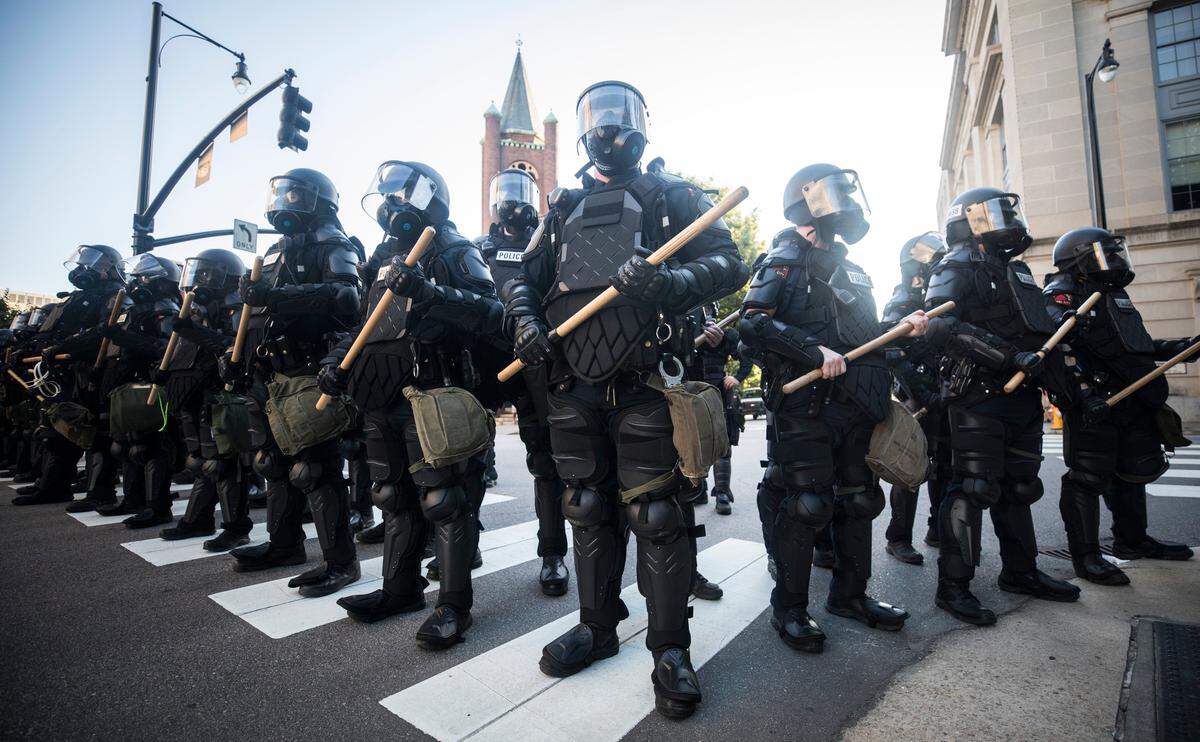
Instead of the familiar light blue uniforms, many of the officers who confronted and pursued protesters Saturday and Sunday wore black riot gear, with helmets, face shields and gas masks that obscured all but their eyes. Most held yellow batons or guns that could fire foam bullets an inch and a half around.
As North Carolina’s capital city, Raleigh sees more marches and protests than most, including the recent demonstrations urging Gov. Roy Cooper to lift restrictions meant to curb the spread of coronavirus. The protests over police violence against African-Americans, in response to the death of George Floyd in Minneapolis, attracted thousands over two nights.
Protesters and critics say the appearance of police in riot gear antagonized the crowds and helped create an atmosphere that led police to disperse people with gas and flash grenades both nights. The ACLU of North Carolina condemned the use of “violent and militarized tactics” by law enforcement agencies in the state over the weekend, and two Raleigh City Council members criticized what they considered police mishandling of the protests.
“It is my firm belief that at various points throughout the evening, the Raleigh Police Department escalated the situation during the protests instead of using de-escalation tools and best practices,” Saige Martin, who represents District D in Southwest Raleigh, wrote on social media.
The Raleigh Police Department did not respond to questions about its handling of the protests and the equipment it used; during a press conference Sunday, Chief Cassandra Deck-Brown said only that police had a strategy before Saturday’s protest began.
“If you know much about the police department, we don’t go into a lot of details in terms of the tactics,” Deck-Brown said. “But there was a plan, and there was communication with the individuals who put this together.”
The unrest that erupted last week in other cities after demonstrations over Floyd’s death meant police in Raleigh had to prepare for the potential for violence, says Brian Higgins, former chief of police in Bergen County, New Jersey, who teaches a course on crowd management at John Jay College of Criminal Justice in New York. That would include having officers dressed and equipped to confront and disperse unruly crowds, Higgins said.
But law enforcement agencies generally don’t want to show themselves wearing riot gear before they have to, Higgins said in an interview.
“It’s not standard protocol to recommend officers come to a scene already equipped with that equipment, because you’re sending a message,” he said. “Some might see it as, ‘We’ve come looking for a fight.’”
Pros and cons of ‘Robocop’ officers
The use of officers in riot gear can deter people from making trouble and make the public feel that police are in control, according to a report on police management of demonstrations published by the Police Executive Research Forum in 2006. But the appearance of what the report calls “Robocop” officers at peaceful demonstrations can also “lead to a public perception that the police are being heavy handed and overreacting.”
Some people involved with Durham’s demonstrations say they remained peaceful in part because police gave them space and mostly directed traffic around them. Some Durham officers did don riot gear, but they remained inside the department’s headquarters, out of sight, even as protesters chanted just outside.
Deck-Brown said Sunday that the first officers seen wearing riot gear in Raleigh were Wake County sheriff’s deputies who were inside a vehicle entrance of the public safety center that includes the county jail. She said dozens of protesters began ascending the ramp into the building where they were met by deputies.
Sheriff’s spokesman Eric Curry said the deputies ordered protesters to back down the ramp and used tear gas when they did not comply. As deputies walked down toward McDowell Street, Curry said, they were pelted by rocks and bricks.
From there, the clashes between protesters and police moved through downtown, and the first of Raleigh’s officers in riot gear joined the effort to control the crowds with smoke bombs, pepper spray and more tear gas.
Clashes flared up again Sunday
The following night, the Raleigh Police Department did not wait for clashes to begin to bring out officers in riot gear. As protesters chanted on the south lawn of the State Capitol, the black-clad police tactical team arrived from the west on Morgan Street.
The first tear gas canister was thrown after a few protesters faced off with officers at the intersection of Morgan and Salisbury streets. “Get out of the road,” one shouted at two protesters lying in the street. “Move.”
One of the protesters jumped up and moved toward police with his arms in the air, shouting “I’m doing nothing but having a peaceful protest.” A few seconds later, the canister flew past him, and the protesters scattered.
The Raleigh Police Department’s written directives say officers must give adequate warning before taking “crowd control actions” such as removing agitators, breaking up the crowd or using chemical agents like tear gas. A law enforcement training manual, developed by the N.C. Justice Academy, says gas should be used only under certain circumstances.
“Chemical munitions should only be used when the crowd is disorderly to the extent of throwing objects, physically attacking officers, or there is imminent threat of either,” according to the manual, which is used to train new officers.
In a statement on Twitter on Sunday, the Raleigh Police Department wrote, “We utilized tear gas to move protestors out of the path of an EMS vehicle on its way to an emergency medical call after they refused to move.”
But instead of opening Morgan Street, which the protesters were blocking, the police in riot gear lined up across the street for a standoff that lasted more than a half hour.
Police clear the area near the governor’s house
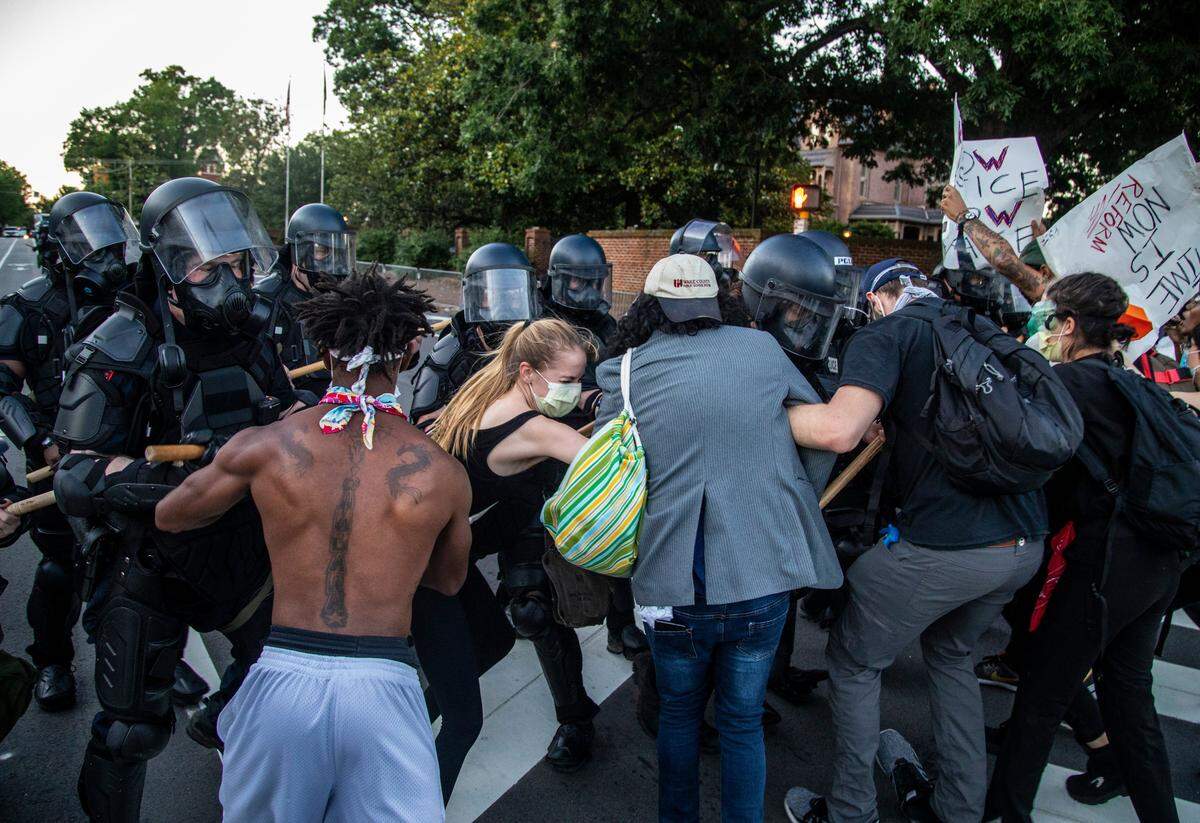
The protesters then made their way to the Executive Mansion, where they chanted and some breached a temporary metal barricade to throw paper airplanes over the brick wall. The Raleigh officers in riot gear showed up a few minutes later and pushed protesters down the street, away from the mansion.
When someone tossed a water bottle at a row of black-clad officers, they responded with the first of several gas canisters, and then foam bullets, as they cleared the intersection of Blount and Jones streets.
The Justice Academy’s training manual says rubber and foam bullets should be used to control a crowd only when there is an imminent threat to officer safety. “They must only be used against hostile crowds and when other dispersal options are not effective or safe to use,” it says.
Higgins said the goal of tools like tear gas is to disperse a crowd, but added that scattered protesters can be harder to manage or can simply reform elsewhere, as happened several times Sunday night. He said the technique should be used at a time and place where police feel compelled to stop protesters, such as at the gates of a governor’s mansion.
“This is where police say, ‘This is our perimeter where we can’t allow it to move any further,’” he said. “’This is the place that this has to stop.’”
The demonstrations in Raleigh and around the country are more difficult for police to manage in large part because the anger is directed at them. Even if protesters were peaceful, their message to surrounding police officers was often full of fury and expletives.
It is situations like these where a police officer’s training and experience with crowd control must come into play, said Geoffrey Alpert, a professor of criminology at the University of South Carolina. An unruly crowd should never cause police to make decisions on a whim, Alpert said.
Alpert said he has seen many images and videos of police across the country using tear gas, pepper spray and foam bullets against protesters.
“That’s a lot of power and force they’re using,” Alpert said in an interview. “If there’s a threat, then sure. But if he or she is just protesting or in your face, just take it.”
This story was originally published June 2, 2020 at 4:55 PM.