Police in downtown Raleigh took a dramatically different posture Tuesday toward the protesters who filled the city’s downtown streets for the fourth evening in a row with demonstrations against police brutality.
Officers in riot gear and National Guard troops in fatigues were relatively rare sightings. Officers put more distance between themselves and demonstrators than on previous nights, some of which were marked by repeated use of tear gas, pepper spray and rubber bullets. And protesters were more focused on sharing personal stories of injustice and presenting demands than directly confronting police.
“To be black in America is to live a traumatic experience every single day,” said Patrice Graham, 32, addressing a crowd Tuesday night. “Why is this happening? Why has this anger welled up? Because we have to deal with it every single day.”
Most of the more than 1,000 protesters who came out Tuesday went home around 8 p.m., when a citywide curfew took effect for the second night.
But about 45 minutes later, about 100 sat in Lane Street in front of the Governor’s Mansion. Police cars circulated, periodically playing a recorded message telling protesters that they were violating curfew.
The Raleigh Police Department did not make any arrests, according to a news release sent shortly after midnight.
Over the course of the afternoon and evening, protesters urged people to remember George Floyd — the man who was killed by police last week in Minneapolis — and proposed ways that government could constructively respond to complaints about the many injustices faced by black Americans.
Police acknowledged protesters’ effort. After demonstrators at the State Capitol shouted, “kneel with us” in the afternoon, officers took a knee and were greeted with hugs. The gesture was a reference to Colin Kaepernick’s protests against police brutality when he played football in the NFL.
State Capitol Police Chief Chip Hawley said officers took a knee to “show our deep and abiding respect for the value of all human lives.”
“We hear you, and we understand your frustration,” Hawley said in an emailed statement. “We want you to know your voices and your message has not fallen on deaf ears. We understand we should be and want to be part of the solution to this problem.”
Raleigh police waiting in a line in front of the Raleigh Municipal Building did the same later in the afternoon. A group of protesters asked officers to kneel with them. Each officer took a knee for a few seconds. Some protesters shook hands with the officers. Others considered the act a publicity stunt and shouted insults.
National Guard troops were visible near the State Capitol, and police in riot gear could be seen in buses, but police and protesters never clashed. Raleigh police said they told protesters several times that they were in violation of the curfew but gave them an opportunity to voluntarily leave.
When the final group remained in the streets past the curfew, white protesters were asked to move to the front row facing Blount Street, and an organizer offered tips on escape routes, medical treatment and the number for a lawyer. At 9:05 p.m., the group ended the sit-in and began an impromptu march through the Historic Oakwood neighborhood.
The 100 or so protesters in their teens and 20s wound a circuitous path past the well-maintained Queen Anne, neoclassical and Craftsman homes for an hour before disbanding near Nash Square — across from Raleigh’s Municipal Building. Officers on bicycles rode at the front and the back of the procession.
“By the time the group returned from that location, they had begun to disperse,” according to RPD’s news release. “At that point, RPD utilized its discretion and allowed the group to go home rather than confronting them to make arrests.”
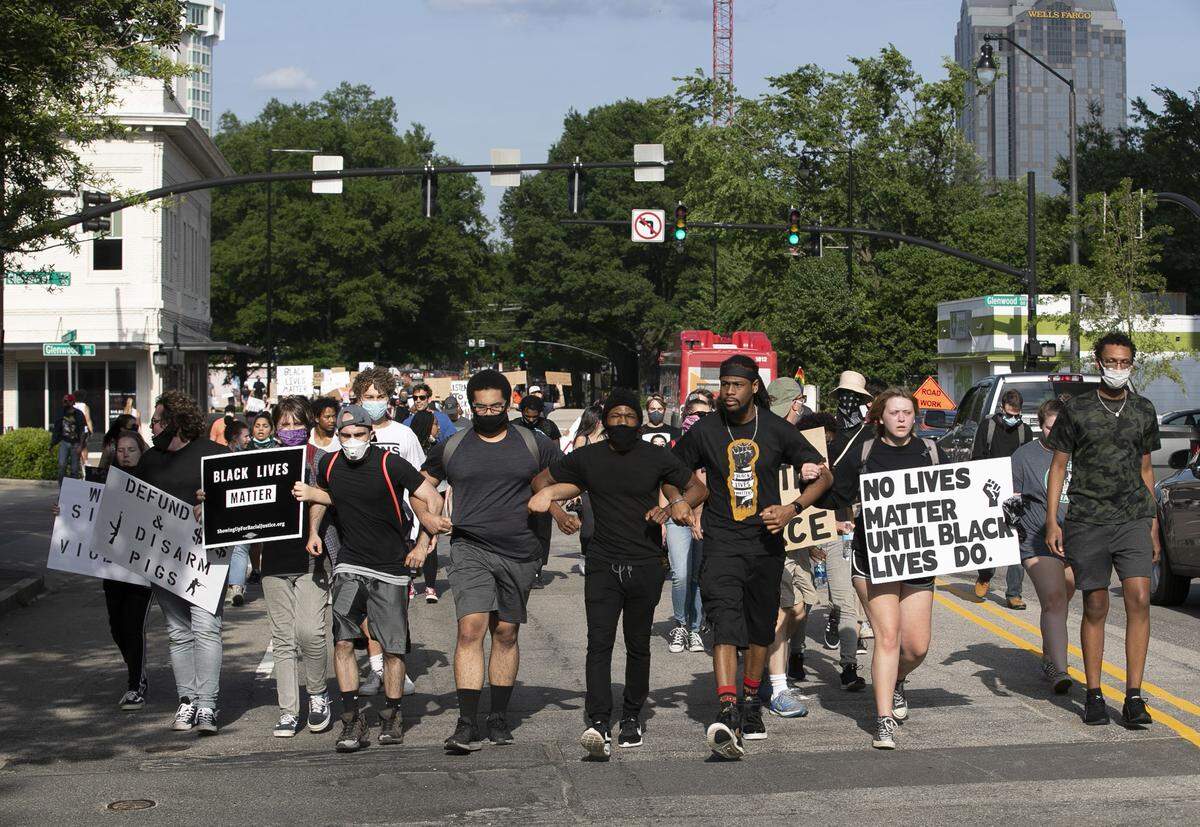
Protesters march on Hillsborough Street from the Capitol to the North Carolina GOP headquarters for a rally on Tuesday, June 2, 2020 in Raleigh, N.C. Robert Willett rwillett@newsobserver.com
Different approaches to sharing message
At least three different protest groups marched around downtown throughout the afternoon and night.
In the evening, hundreds of protesters walked along Hillsborough Street, ending up at the North Carolina GOP headquarters, where they left lists of demands under the doormat.
Another group formed at the corner of Hillsborough and Salisbury streets, where demonstrators laid down in the street and had outlines of their bodies drawn in chalk in front of a Confederate monument. They wrote the names of people who had been killed in encounters with police inside the chalked shapes.
Raleigh Mayor Mary-Ann Baldwin said in a statement Tuesday that the city’s curfew would continue.
“I fully understand the challenges that a curfew can cause,” she said. “However, the threat of violence is not something I am willing to ignore. We must remain focused on taking every step we can to protect our families, our businesses, and our city.”
Protests on Saturday and Sunday nights involved injuries to protesters and police as well as stolen and damaged property in downtown and at Triangle Town Center and North Hills shopping centers.
The curfew will remain until Baldwin declares it’s over. A violation is a class two misdemeanor, which can carry a maximum of 60 days in jail and a fine up to $1,000.
At the start of Tuesday’s City Council meeting, held virtually, Baldwin said this past weekend was one of the “most painful moments” in Raleigh’s modern history, The News & Observer reported.
“The murder of George Floyd was an unspeakable, racist act of violence,” she said. “Over the past few days, people have come together peacefully to demand justice for George Floyd and the countless victims of violent systemic racism all over the country. I want to echo their call for justice, and I want all those who worked for peaceful demonstrations to know Raleigh sees you, hears you and is committed to creating changes in our community. Black lives matter. And George Floyd’s life matters.”
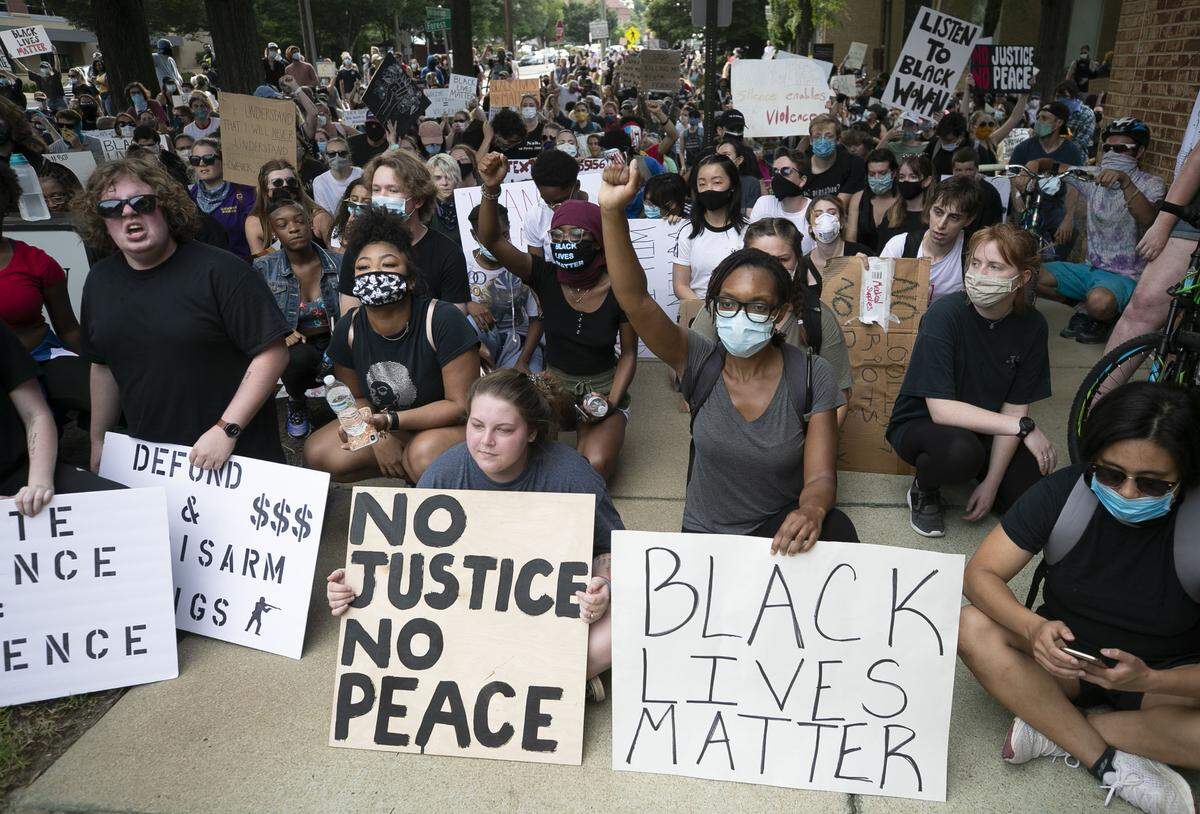
Protesters hold a rally outside the North Carolina GOP headquarters on Hillsborough Street on Tuesday, June 2, 2020 in Raleigh, N.C. Robert Willett rwillett@newsobserver.com
A list of demands
At the state GOP headquarters on Hillsborough Street, protest organizers distributed paper on which protesters could write out their demands.
At least one person called for legalization of recreational marijuana. The creation of a police oversight board with the power to review use-of-force complaints and assign discipline to officers was also on the list.
“Lift Every Voice and Sing” — often referred to as the black national anthem — played from a speaker and the crowd, seated on the grass, lifted their fists.
One organizer said she intended to meet with leaders like Gov. Roy Cooper and Sen. Phil Berger. Of Cooper, she said, “My mission is to get this man out of the mansion that we pay for and out on the streets to talk to us.”
Protesters left their demands under the door mat, where Chairman of the North Carolina Republican Party Michael Whatley picked them up. Whatley told an organizer he would read the letters and that he appreciated how peaceful the protest was.
That group made their way to Raleigh’s City Hall, where they converged with other protesters. The audio from a virtual City Council meeting was broadcast live.
“The message to City Council was we’re putting you on notice,” said Wanda Hunter, a leader with the Police Accountability Community Taskforce, known as PACT. “The reason we are doing that is because the mayor and police chief have not been the leaders that we’ve needed at this point. We needed them to be standing up for the people.
“PACT has been coming since 2016 asking for change,” Hunter said. “Now we are tired of asking. We are demanding. If they are not willing to implement the policies that we are demanding, we are willing to pull them out of their seats. That’s what we want.”
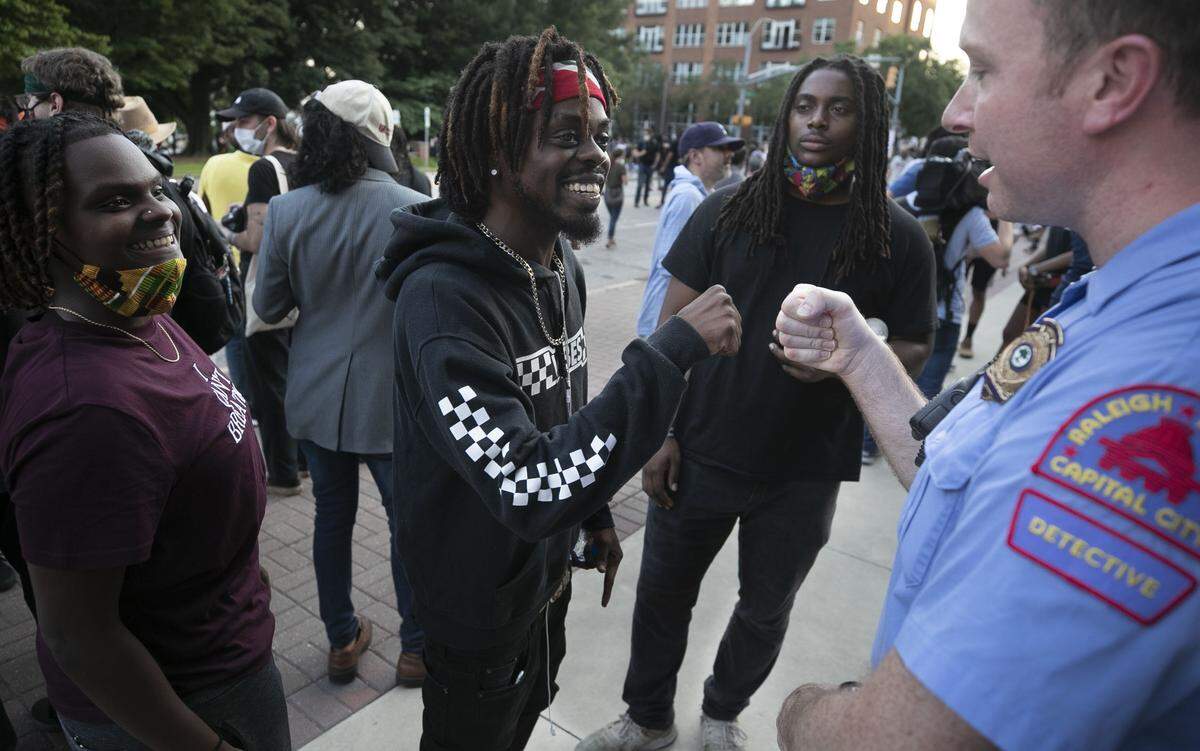
Raleigh Police Detective B.H. Winston, a veteran of 16 years, fist bumps Albert Fervily after having a conversation with Keesh Ormond, left and Dante Robinson following a rally at the Raleigh Municipal Building on Tuesday, June 2, 2020 in Raleigh, N.C. Robert Willett rwillett@newsobserver.com
Council member Saige Martin said the city should prepare a report that includes the types and degrees of force used by law enforcement. But Patrick Buffkin, another council member, objected.
“The current mood of this city will not facilitate a productive conversation,” Buffkin said. “To be blunt, we can’t address our race-equity problems while our city is burning.”
Joshua Thomas, one of the protesters, said his mother didn’t let him attend protests against police killings in the past. He calls her justifiably protective. But he’s 19 now, and he said his voice needs to be heard.
So Thomas marched to the Executive Mansion on Tuesday evening, holding a sign with a clenched black fist surrounded by the words “son,” “father,” daughter,” “mother,” “brother” and “sister” written in red. “All gone.”
“They’re not just a number, they’re somebody’s family,” Thomas said. “To me, that’s one of my biggest fears is not being able to come back to my family.”
Thomas said he wants police killings to stop and racism to cease.
“I want to be able to walk in my own neighborhood without getting mean looks. I want to be able to eat in a restaurant with my mom and be able to feel comfortable and that’s something we can’t do,” Thomas said.
State Capitol grounds
During an afternoon protest, people chanted by the Confederate monument on the State Capitol grounds and made their way to the center of the Capitol lawn where they kneeled for nine minutes. . That’s how long a Minneapolis police officer pressed his knee into Floyd’s neck. The officer has since been fired and arrested.
The protest at the State Capitol featured speakers, followed by the crowd chanting, “We will get justice, we will get peace.”
At one point, the speaker asked police to kneel again to show unity. Two officers, both black, took a knee while others did not.
Gracie Staser, a 17-year-old from Apex, told the police officers standing by and looking at their phones that they have the privilege to look away and asked them to pay attention to the crowd.
“Try to listen. Please try to understand where we’re coming from,” Staser said at the protest. “We’re afraid we’re going to get shot in the streets.”
Staser talked about being followed through stores with the assumption she might steal something. Or, she said she might be questioned by police while walking in her own neighborhood, because the color of her skin says she might not belong there.
“We’re tired and we just want justice,” Staser told The News & Observer.
For Staser, justice means equality, so when she walks down the street, officers don’t look at her as a threat, but they don’t think the same of her white friends.
“It just hurts,” Staser said. “I know at the end of the day I’m not doing anything wrong. To be looked at like that is diminishing to me.”
Leah Morris, 17, said the protest Tuesday afternoon at the Capitol is both peaceful and productive. People are handing out voter registration papers and educating each other about white privilege and how to advocate for changes to police practices.
“We’re learning,” Morris said.
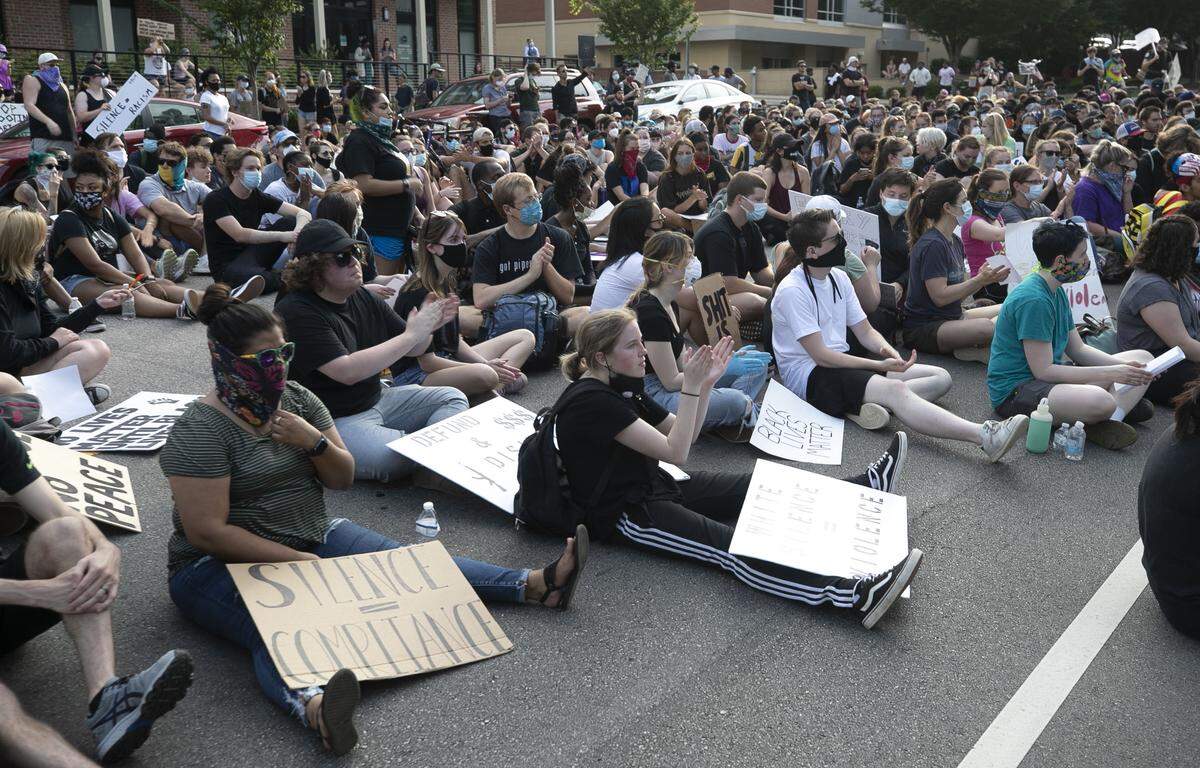
Protesters fill in Hillsborough Street near the North Carolina GOP headquarters during a rally on Tuesday, June 2, 2020 in Raleigh, N.C. Robert Willett rwillett@newsobserver.com
Curfew violations
On Monday night, Raleigh police arrested six people for violating the city’s curfew and one for carrying a gun during the demonstration.
The streets cleared by 9 p.m., an hour past the city’s deadline, and marchers said they hoped to confront police violence nationwide in an orderly way.
The curfew violation charges all came after 11 p.m. in or near downtown. Police made their lone gun arrest on Wilmington Street at 10:30 p.m., charging Kevin Andrew Linn II, 32, for carrying a weapon to a demonstration.
About 1,000 people marched through Durham Monday night, a similarly nonviolent protest that saw Sheriff Clarence Birkhead pledge to meet with demonstrators. Earlier Monday, about 60 people blocked the Durham Freeway, asking for their voices to be heard in the wake of the death of George Floyd, who was killed by police in Minneapolis on May 25. A sheriff’s spokesman had no update Tuesday.
A spokesman for Gov. Roy Cooper said Monday that about 450 National Guardsmen had been deployed statewide. Roughly a dozen were posted at Cameron Village in Raleigh Monday night.
Danielle Battaglia, Anna Johnson and Josh Shaffer contributed to this report.
This story was originally published June 2, 2020 at 11:59 AM.
Follow More of Our Reporting on George Floyd Protests