
Hundreds gather peacefully on UNC campus, then march to protest George Floyd death
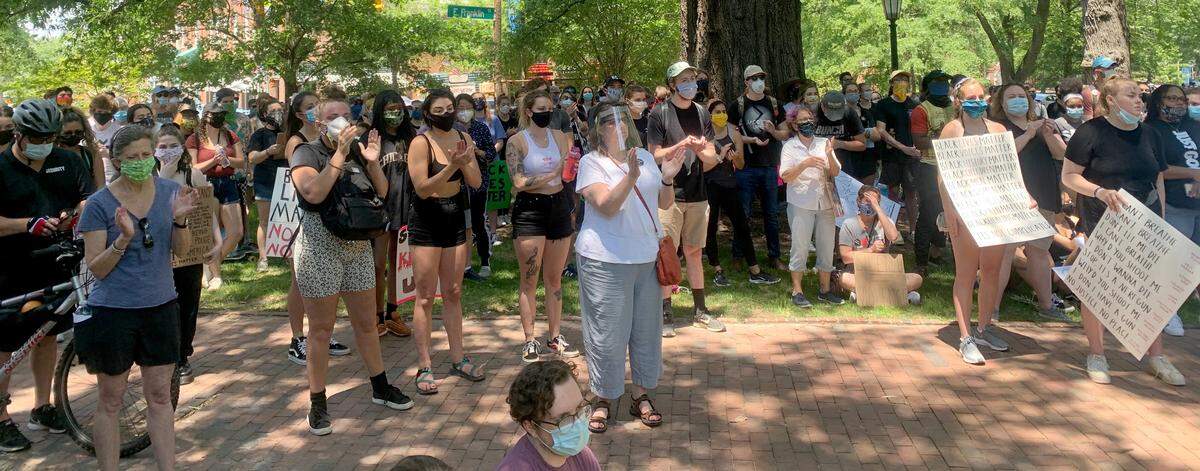
Hundreds of people gathered on the UNC-Chapel Hill campus Wednesday afternoon for a peaceful Black Lives Matter protest before then marching through town.
The protest took place on McCorkle Place, where the Confederate monument known as Silent Sam stood for just over a century until protesters toppled the bronze statue of the young soldier in 2018.
The gathering included college students, young children and grandparents.
Jamal Rise Rashid, 35, spoke to the crowd with his 8-year-old son, Taj, standing next to him. He talked about the impact George Floyd’s death and other events have had on his son and how he appreciates people standing with them to fight for a change.
“Stay with us,” he said to the crowd. “Don’t join us now and then leave next week.”
Rashid also performed a song he wrote as a spoken-word rap about living in America as a black man.
“Taking a knee makes more sense than pledging my allegiance to a country that’s acting like they don’t want me,” Rashid said in the rap.
Tai Huynh, who just graduated from UNC and is a member of the Chapel Hill Town Council, spoke to the crowd about how the United States is now fighting two viruses: COVID-19 and institutional racism. Both are disproportionately affecting black people, he said, and neither has a long-lasting cure yet.
In a statement Wednesday, Chapel Hill Mayor Pam Hemminger called the death of Floyd and the racial inequities the COVID-19 crisis has again exposed “gut-wrenching.”
The Town Council plans to issue a statement during a meeting Wednesday night that cites Floyd’s death and “too many black lives unjustly taken at the hands of police officers, including Breonna Taylor, Terence Crutcher, Michael Brown, Eric Garner and Tamir Rice.”
“These are not disconnected, isolated incidents of senseless violence against black and brown Americans,” the statement says in part. “Rather, they are connected by racism and the on-going devaluation of black and brown bodies and lives. In recognition of history repeating itself yet again and the need to redress the systems of power, positions of authority and the treatment of people of color, we highlight the need to critically examine the role of racial bias and institutional racism in our community. We stand for justice and for the equitable treatment of black and brown people.”
‘Commit to the difficult daily work’
Huynh said protests like Wednesday’s are not just exhibits of rage, hurt and anger but are a place to mobilize to commit to long-lasting change.
“It won’t change tomorrow,” Huynh said. “We cannot afford to stop fighting. ... We must commit to the difficult daily work of fighting this oppression.”
People need to recognize and amplify the voices of people of color that are missing in companies and other spaces, he said. He asked people to support black-owned businesses and black-led organizations.
“We need to commit where we celebrate black successes instead of mourning black deaths,” Huynh said.
He also encouraged the crowd to vote and get more people registered, particularly in communities that have been disenfranchised, because that “informed, intentional voting” is what changes government.
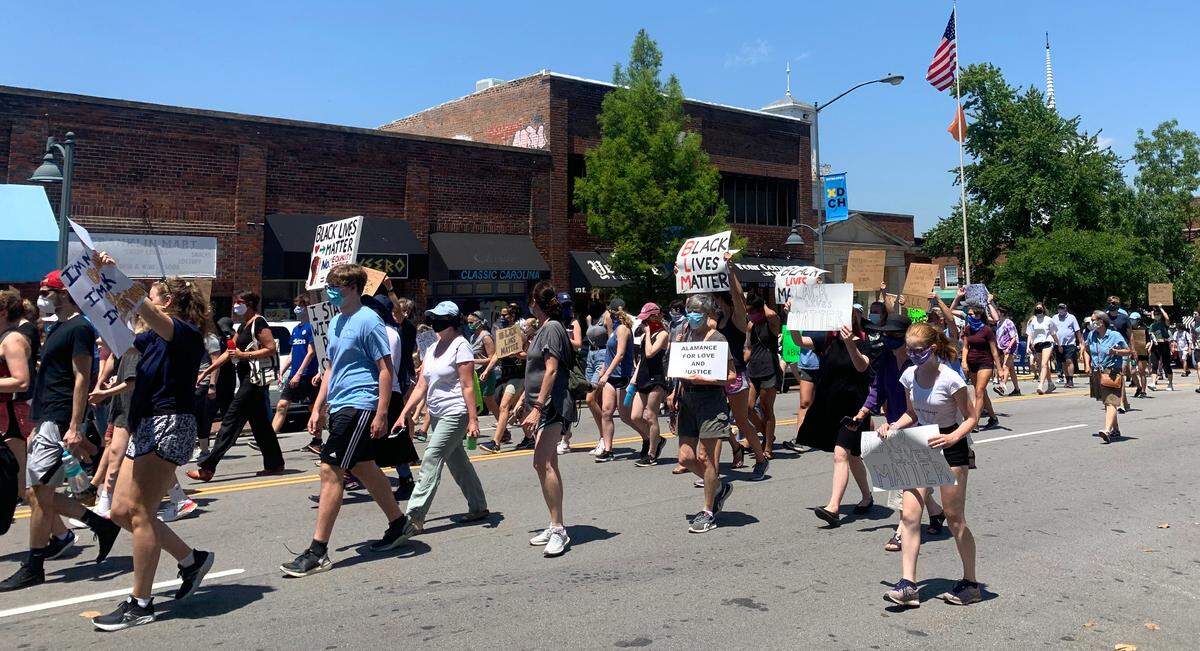
Grandparents, college students and young children attended the protest and held hand-made signs. Almost every person wore a mask, and people passed out water bottles in the heat.
As they began marching, the crowd chanted, “George Floyd!” “This is what democracy looks like!” and “Hands up, don’t shoot!”
The protesters marched on Franklin Street, through campus by the Old Well and past the president’s residence. They returned to McCorkle Place and continued chanting and having participants come up to speak.
UNC and Chapel Hill police blocked off streets and gave the crowd space to protest. UNC Police Chief David Perry stood just outside the crowd on McCorkle Place and shook hands with a protester as the march began.
Emile Charles, an incoming first-year UNC student from Chapel Hill, organized the event and reached out to police before the march.
In an email about the event, Charles said he also planned to organize discussions with Chapel Hill and UNC Police Departments and local leaders on how to “abolish the oppressive systems that be” and engage the community in improving issues, including police brutality and white supremacy.
First George Floyd protest in Chapel Hill
This was the first protest in Chapel Hill since Floyd was killed by police officers in Minneapolis last week.
Protesters have gathered nightly in Raleigh and Durham since Saturday. Though the protests in Durham have been peaceful, the Saturday and Sunday night protests in downtown Raleigh were followed by vandalism, looting and clashes with police.
Tuesday night’s protest in Durham drew about 60 people outside the Durham County jail downtown. They chanted, ‘Hey, hey, ho, ho, racist cops have got to go.” A majority of the drivers passing the protesters either honked their car horns in support or raised their fists out their window as a sign of solidarity, drawing cheers from the crowd.
People inside the jail beat on the windows in unison with the protesters’ chants of “Black Lives Matter.”
Davida Douglass, 24, said Tuesday was the first time she had demonstrated in public since Floyd was killed. She said she drove from Creedmoor to Durham to protest in front of the jail.
“I think they are doing a good job in Durham of being heard, and they are being peaceful,” she said.
This story was originally published June 3, 2020 at 2:39 PM.