Raleigh protesters return to keep focus on police brutality as council hears complaints
Protesters were in downtown Raleigh Thursday for a sixth night of demonstrations as the Raleigh City Council faced sharp criticism about how the city handled demonstrations over the weekend that ended with violence and destruction.
The protests follow the death of George Floyd, a black man who died while being held down by a white police officer in Minneapolis, Minn. Thursday’s nationwide protests happened as Floyd’s family held the first memorial services for the 46-year-old man.
Floyd’s death became a catalyst for protests against police violence toward blacks in dozens of cities across the country, including Raleigh and Durham.
There have been peaceful demonstrations since Monday, a marked contrast to the weekend in Raleigh where downtown businesses and government buildings were vandalized and looted. Police officers fired tear gas on the crowds and shot people with rubber bullets, and several people were arrested.
Thursday evening, the Raleigh City Council held a special virtual meeting to take public comments on the protests, the vandalism and the city’s response to both.
Speakers in the first 30 minutes of the meeting railed against the local police response to last weekend’s protests. Many condemned the police’s use of tear gas in particular. Several members of Raleigh Police Accountability Community Taskforce spoke out, demanding again the formation of a police oversight board with subpoena power.
Several called for the police department’s budget to be cut. Several speakers harshly criticized Raleigh Police Chief Cassandra Deck-Brown and Mayor Mary-Ann Baldwin, and some called for both to resign.
The meeting opened with a moment of silence in honor of Floyd. About 300 speakers, who signed up in advance, were given one minute each to address the council. But about 200 people who had signed up still had not spoken when the meeting adjourned just before 10 p.m.
Meanwhile, hundreds of people made their way through downtown — including to the Governor’s Mansion and the State Capitol — to call attention to Floyd’s life; racism; police brutality; and the need for change. As they walked, they frequently chanted “Black lives matter,” “Hands up, Don’t shoot,” and “No Justice, No Peace.”
They also called out the names of George Floyd and chanted, “Say her name: Breonna Taylor.” Taylor was fatally shot by police who used a battering ram to break into her Louisville, Ky., home in March.
A few dozen people continued marching until curfew, with everyone dispersing about 10:10 p.m.
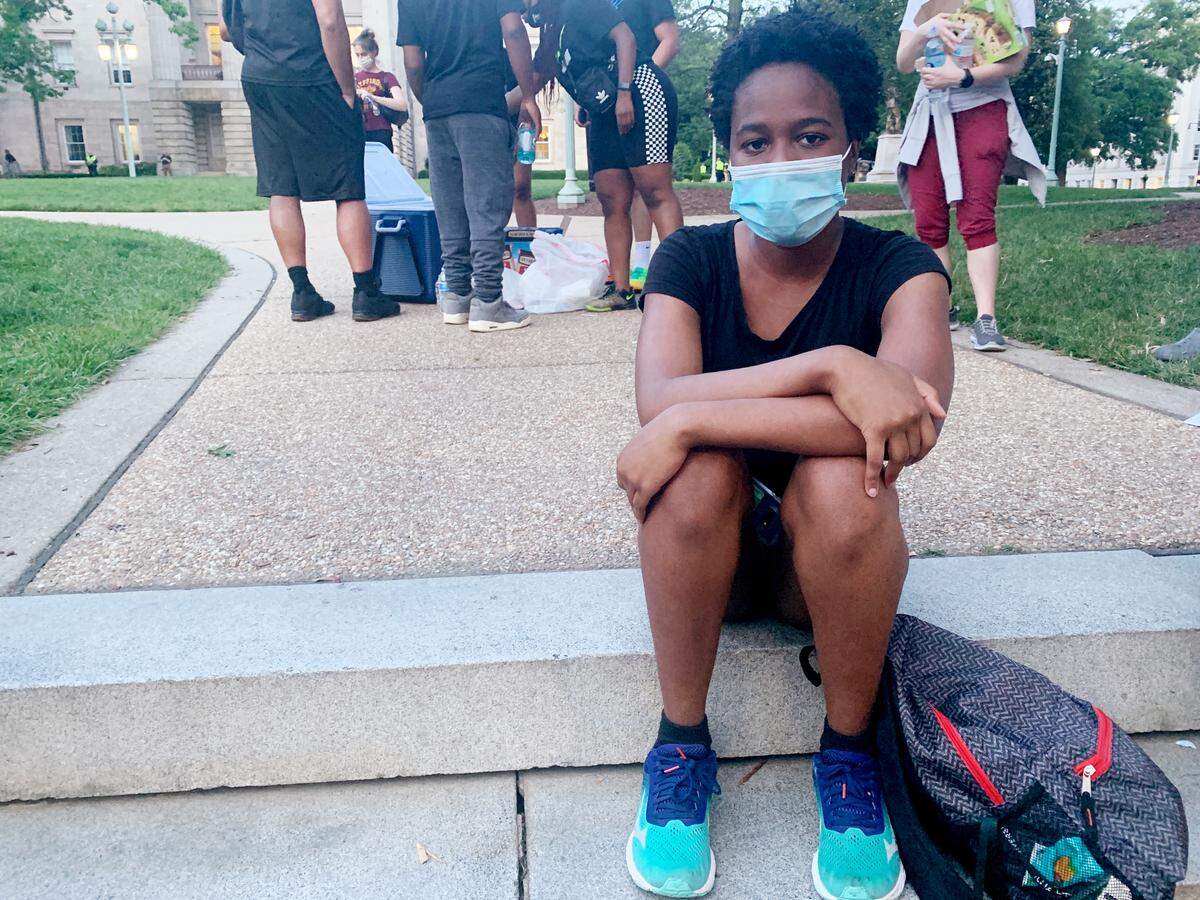
Jordan Sample, 20, sat on the steps at the State Capitol Thursday evening, next to the Confederate statue. She said she hopes Floyd’s death isn’t the only thing that brings people together to protest.
“I’m very tired of seeing every day on the news that innocent black people are getting killed for no reason,” Sample said. “There are tons of George Floyds and Breonna Taylors that are unknown right now,” she said.
“This isn’t mending,” Sample said. “And until I see justice I’m going to keep walking.”
Peaceful protests
Thursday’s events were peaceful. Baldwin set a curfew beginning Monday night. By Thursday, Baldwin pushed the curfew back, starting two hours later at 10 p.m., The News & Observer reported. The mayor has not said when the curfew will end.
“I want our progress to continue,” Baldwin said. “We need to continue to grow together peacefully with respect and compassion. I am hopeful that we can continue to learn from this experience and emerge as a better city.”
As they had on previous nights, groups of protesters gathered in different places and walked from one site to another.
Late Thursday afternoon, a group of protesters met near the Governor’s Mansion on the east side of downtown. Shortly before 5 p.m., they moved toward the Capitol. Police officers stood near the Capitol but did not approach.
One group walked up tree-lined West Johnson Street chanting. As they passed by, a few residents watched or clapped along with their chant.
Members of the group trekked to Cameron Village, north of the center of town, saying they wanted to take their message beyond downtown and into the mostly-white neighborhood near the shopping center.
Ny Williams, 17, said she worries about her four younger brothers. She was nine years old when a man shot and killed Trayvon Martin, a black teen fatally shot in Florida while in his neighborhood, and she remembers when Tamir Rice was killed playing with a toy gun on a Cleveland playground.
“We don’t buy water guns because we don’t want someone to feel that and feel threatened. Although we know we’re not threatening anyone we know they will be able to justify the murder of my younger brothers and it’s horrifying, it’s horrifying,” Williams said.
Williams said she is angry that North Carolina has monuments to the Confederacy but none commemorating the state’s lynching victims.
It’s important that protesters make their message heard in primarily white neighborhoods like Glenwood South and Cameron Village, Williams said.
“I feel uncomfortable every single day. I feel uncomfortable walking past police officers, I feel uncomfortable when I’m walking on the sidewalk and white people won’t move to let me walk,” Williams said. “I want you to feel uncomfortable, I want you to feel how I feel.”
Marching to Cameron Village was particularly poignant, Williams said, because of the Cameron family’s history. The land where Cameron Village sits was once owned by Duncan Cameron, a politician, banker and planter who, in the early 19th century, owned large numbers of slaves and wide swaths of land. Historical records indicate Cameron profited from buying and selling slaves, and also allowed them to learn to read and protected some from execution by shipping them to the North if they were accused of crimes.
After walking to Cameron Village and back, the group returned to the Confederate monument, on the west side of the Capitol. There, an organizer talked about the importance of contacting elected officials and making sure the movement results in real policy changes.
“I want to make sure we’re actually getting things done and not just out here in the streets,” said Amari Yasmine. She gave her Instagram account and said anyone who didn’t know how to contact elected officials should speak with her.
Christian group brings prayer to the protest
Blocks away, a few dozen people gathered Thursday afternoon in Moore Square Park for a Christian worship service in response to the recent events. It came about organically, 25-year-old Sam Blinson said, and more than 20 churches were represented.
“We’re out here to lift up the name of Jesus. We believe he is the solution to racism and the hate in our nation,” Blinson said. “We believe that black lives matter and we are going to fight for that truth in our nation and make the wrong things right.”
The group prayed together and sang worship songs, including “How Great Is Our God.” The group has gathered at the site every afternoon since Tuesday and plans to come back on Monday.
Jasmine Lovell, 35, prayed with the crowd, saying they should be thankful to be born in this generation and be part of the solution to the problems in this world.
“We will not be silent,” Lovell said. “We will not shut our mouths, we will not look the other way.”
She prayed for each person to have a deeper compassion for “brothers and sisters who don’t look like us,” and to ask God how they can reach out to others during this time. Another speaker also prayed for police officers, legislators, Gov. Roy Cooper and other Christians to help bring change.
The group then joined protesters who gathered at the Governor’s Mansion. They passed out duct tape and a few people put it over their mouths with handwritten prayers for their “black brothers and sisters,” using words such as hope and reconciliation.
There, one speaker prayed for equality, unity, hope, healing and an “increased value on human life.” Another asked for every white person to say “I’m sorry” to a black person in the crowd.
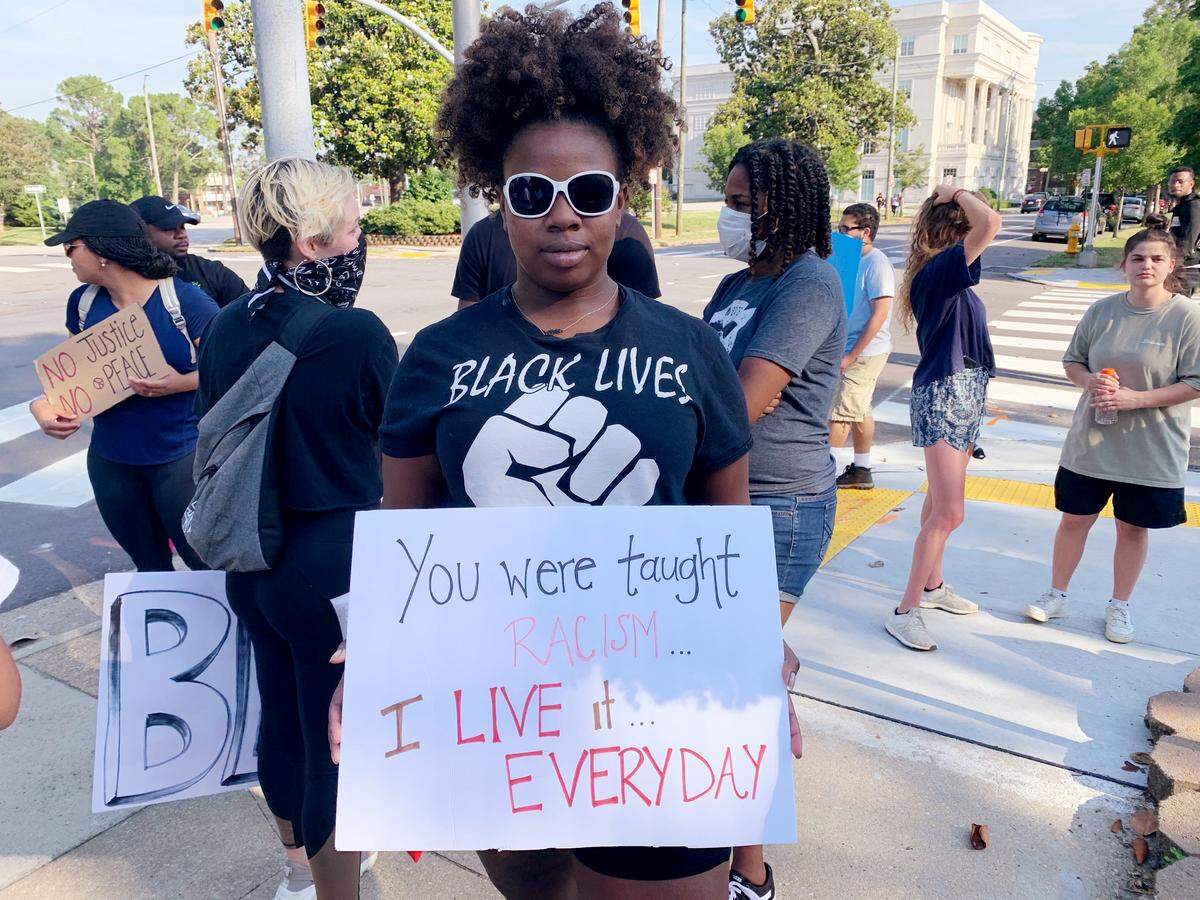
Kayla Beasley, a 20-year-old NC State student, came to protest for the first time on Thursday.
“History keeps repeating itself and it’s time for change,” Beasley said. “I wouldn’t be myself if I didn’t try to help be part of the change. Sitting around doesn’t make me feel good.”
The sign she held read “You were taught racism... I live it... everyday.”
“I want change not only for myself but for future generations,” Beasley said. Beasley said she want to see better treatment of African American people and no police brutality.
“Why are we getting killed for being black?” she said. “Not even doing anything, just literally being black.”
Later, a different group, a few dozen people, gathered outside First Presbyterian Church on Salisbury Street, holding signs bearing Bible verses and “Black Lives Matter.”
“We know we have neighbors who are in pain and feel like they haven’t been heard,” Pastor Ed McLeod said. “We want to be good neighbors and stand with people in pain and are hoping that people will hear them.”
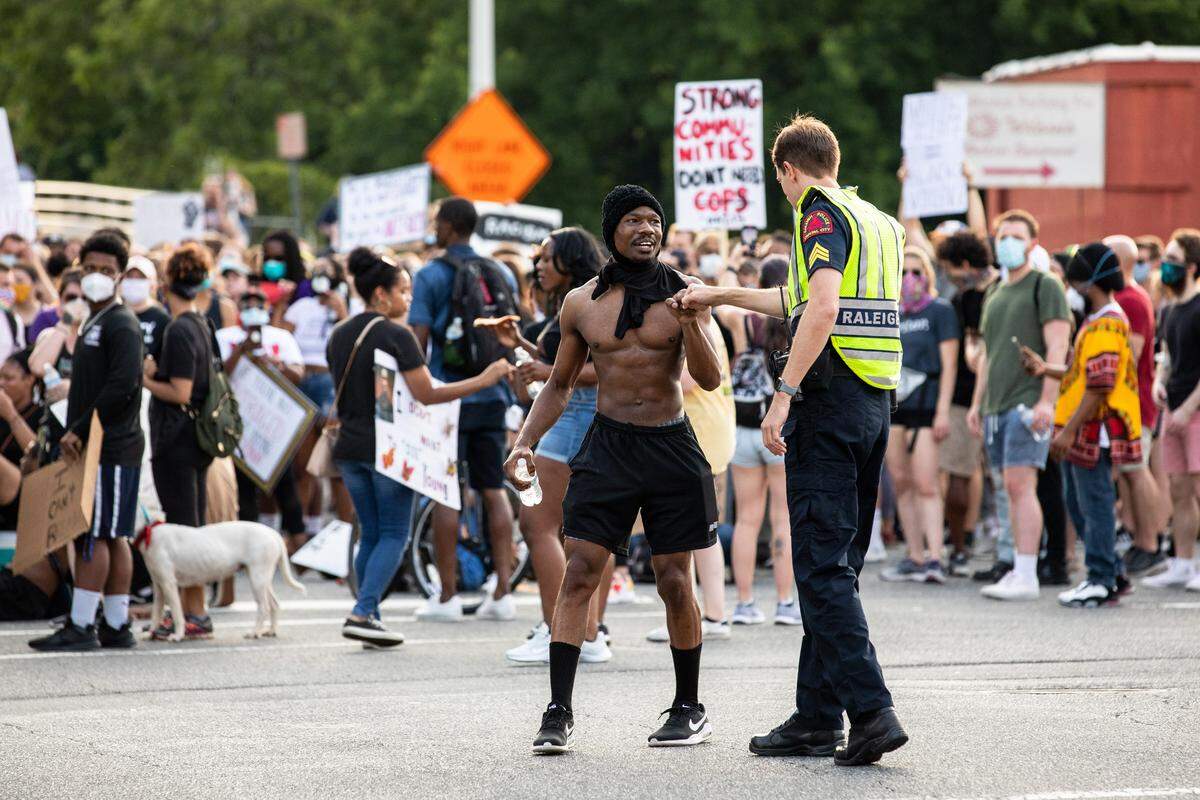
Volunteers offer protesters support
Dani Sheller, 31 of Garner, organized a supply stand at Moore Square Park to help protesters during marches.
“Right now we’re just trying to ... support their efforts in having their voices heard and taking our step back as white people and using that real privilege to allow the black communities and black brothers and sisters to say, ‘Hey this is our list of grievances, this is what we want to discuss,’” Sheller said.
She said she saw a need for an organized effort after marching with protesters over the weekend and started the group “Bring the Dream Back 2020.” She said the group is trying to take advantage of the momentum and create a “targeted approach for change.”
“We’re not part of the anti-police movement,” Sheller said. “We are part of just .. greater unity.”
A similar aid station in Asheville, manned by medical workers and other volunteers, was ransacked by police there on Tuesday. Officers overturned tables stacked with bananas and granola bars, destroyed medical supplies and stabbed hundreds of bottles of water to dump their contents onto the sidewalk.
In a Facebook post, Asheville Police Chief David Zack said on Wednesday the aid station had not been permitted by the city; was on private property; and that the water bottles could have been used as projectiles. Emergency medical services have been posted nearby during the protests, the chief said, and could treat any injuries.
Floyd family plans service in Raeford
On May 25, Floyd was arrested in Minneapolis, Minn., handcuffed and forced to the ground face down. In a bystander video, a white police officer can be seen holding a knee on Floyd’s neck for nearly nine minutes until Floyd became unresponsive. The officer, Derek Chauvin, and three other officers face criminal charges in Floyd’s death.
Floyd’s family, who live in North Carolina, will hold a memorial service for him in Raeford on Saturday, The News & Observer reported. Hoke County Sheriff Hubert A. Peterkin said the service will include a public viewing from 1 to 3 p.m. followed by a private service. The address is Cape Fear Conference B Headquarters at 10225 Fayetteville Road.
The family held a private service for Floyd in Minneapolis on Thursday, attended by the Rev. Jesse Jackson, Democratic Minnesota Rep. Ilhan Omar, Martin Luther King III and actor Kevin Hart, according to news reports. The Rev. Al Sharpton gave a eulogy.
“George Floyd should not be among the deceased. He did not die of common health conditions. He died of a common American criminal justice malfunction,” Sharpton told mourners, according to the Minneapolis Star Tribune.
“He died because there has not been the corrective behavior that has taught this country that if you commit a crime, it does not matter whether you wear blue jeans or a blue uniform, you must pay for the crime you commit.”
News & Observer reporters Anna Johnson and Josh Shaffer contributed to this report.
This story was originally published June 4, 2020 at 6:31 PM.