No plan to move Alamance County Confederate marker, despite Burlington, Elon request
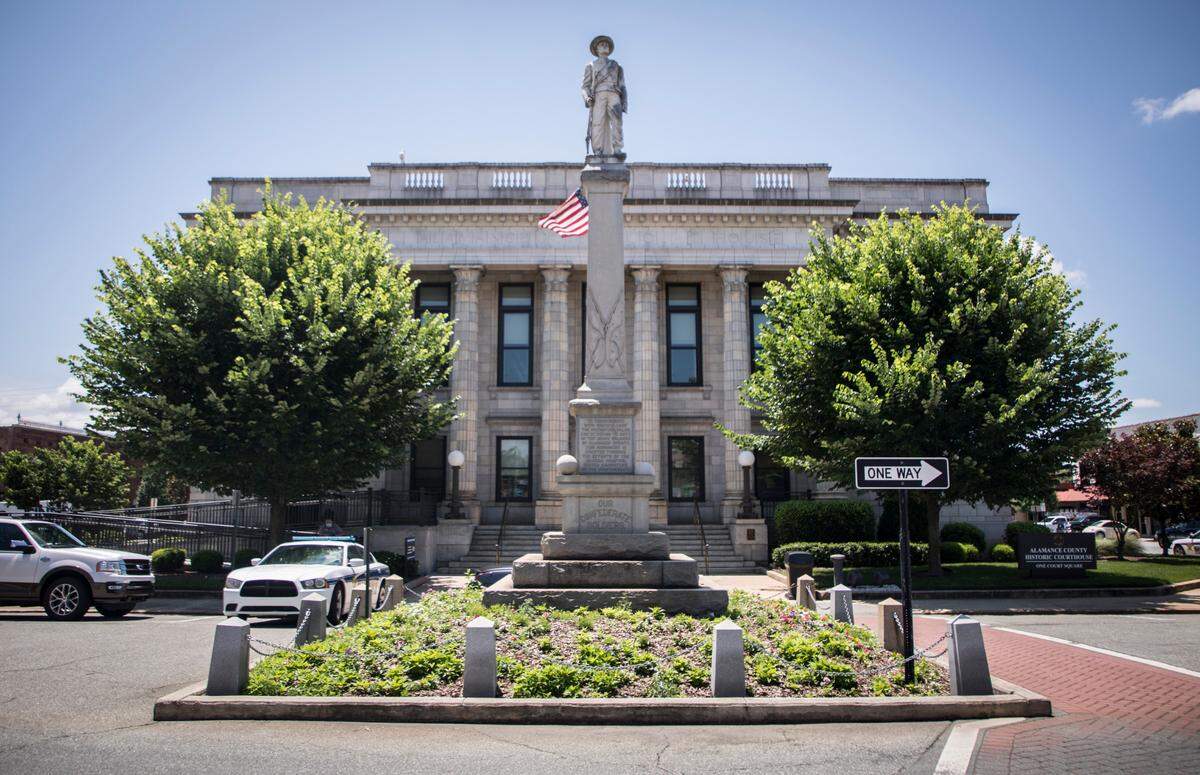
The Alamance County commissioners have no plan to talk about moving the Confederate monument in downtown Graham, the chairwoman said Monday, despite over 50 community leaders requesting it be moved.
“There’s nothing to vote on, because it’s illegal to move it,” Chairwoman Amy Scott Galey said.
County attorney Clyde Albright has said the commissioners don’t have the legal authority to move the monument under the state’s 2015 monument law, a county news release stated Monday.
The courthouse square around the Confederate monument has attracted protesters for and against its removal. On Monday night, a lone protester stood at the corner for several minutes with a sign — “There are no white people in the Bible” — before a Graham police officer warned her to move. Two Alamance County sheriff’s deputies arrived at the courthouse.
“If you want to put that (sign) in the car and hang out ... there’s no loitering,” Graham Police Sgt. R.S. King said. “That’s your first warning. I’ll give you two more.”
The protester placed the sign on her windshield and stood by her car. Two more people arrived and stood nearby, chatting about the statue. King returned about 15 minutes later and told the protester to put the sign in her car, or she and everyone else standing there, including two journalists from The News & Observer who had been there for roughly two hours, would be arrested.
“I know what you’re doing and you know what you’re doing,” King said about the sign on the windshield. “If you want a court date, I’ll be glad to abide by it. That’s your second warning. When I come back, the third one will be failure to disperse and then anybody standing out here (is) going to get it.”
King left the courthouse square soon after and did not return before the protester and two others left at 8:30 p.m.
The city of Graham’s permit rules, which have been temporarily suspended, only require a permit for protests involving two or more people. The rules do not prohibit a peaceful assembly of people who are talking to each other.
Petition to remove statue
Burlington Mayor Ian Baltutis and local government, education and civic leaders also petitioned for the monument’s removal from the county seat Monday in a letter to the county and the city of Graham.
“Obviously, as these monuments start to come down around the state and the country, the remaining ones become more a lightning rod as to draw attention, and so we’ve seen increased activity around our monument,” he said in an interview with The N&O.
“A big piece of the call was for the monument to be respectfully relocated, recognizing that it is a piece of our community’s history but that in its present location, it represents a major threat to the public safety of the community,” Baltutis said. A violent incident could be “a tragedy, whether it’s deadly force or some other activity in our community, (and) would be a scar that we would take a long time to recover from.”
The county called the letter, announced at a Monday news conference, “troubling.”
“Very few of the people who participated in this statement (four of the fifty-six) have contacted any one of the five commissioners in the past few months to discuss their concerns about the monument,” county officials stated in a news release. “We have learned that at least some of those whose support for this letter was sought were told, ‘Don’t tell the commissioners’ about the effort to draft it.”
Galey learned about the letter just before the news conference and was unable to attend, the release stated.
“We do not doubt that those who signed the letter are sincere in their beliefs and hope to see the county find a resolution to this difficult challenge,” it said. “The best way to seek a resolution is not by operating in secret, drawing up in opposing lines, and engaging with the press.”
The letter also referenced a June 20 email in which Alamance County Manager Bryan Hagood asked the commissioners to relocate the monument. Hagood “neglected to obtain information about the legality of his opinion before he offered it,” the release said.
In Monday’s letter, Baltutis was joined by Mebane Mayor Ed Hooks, Elon University President Connie Book, Alamance-Burlington school board members and others. The Alamance County Chamber of Commerce also supports the relocation, Baltutis said.
“This monument has long been a source of conflict, and it stands as a symbol of racism,” Book said. “I want to be clear on Elon University’s position that members of the Black community and other people of color in Alamance County deserve an inclusive and equitable environment. They deserve an environment in which they feel safe and protected by our justice system, to conduct business and pursue an education and fulfill their lives.”
Alamance County Sheriff Terry Johnson told WFMY News last week that he will enforce the law, whether the monument stays or is relocated.
Marches at courthouse square
The courthouse square has been the target of protests since 2015, but the furor grew this month, resulting in arrests. The protests prompted Graham Mayor Jerry Peterman to amend the town’s state of emergency declaration and temporarily suspend permits for parades and demonstrations “due to the clear and imminent threat to public safety.” The town also instituted an 8 p.m. curfew, which was lifted Monday.
The Alamance News reported that roughly 150 marchers dressed in black and wearing masks walked around downtown Graham until 8 p.m. Thursday.
The Graham Police Department and the Alamance County Sheriff’s Office were present for that gathering, but since the marchers were not carrying signs or chanting, no one was charged with violating the temporary ban on protests.
Sheriff’s Office vehicles ringed the courthouse ahead of another demonstration that was expected Saturday and roadblocks were in place to prevent traffic from circling the courthouse square. The Graham Police announced that a permit for a planned protest was denied, but another group was expected to show up.
The ACLU of North Carolina is investigating Graham’s ban on protests, spokeswoman Citlaly Mora said Monday.
The Burlington Times-News reported that roughly a dozen people, many wearing black shirts, walked around the square Saturday afternoon before police asked them to leave. Police asked another group of more than 20 people, including ACTBAC founders Garry Williamson and Barry Brown, to move off the sidewalk after the first group left, the Times-News reported.
ACTBAC, which stands for Alamance County Taking Back Alamance County, is a neo-Confederate group that has protested against removing statues, including in Chapel Hill, Pittsboro and Graham. Williamson pleaded guilty last year in Orange County to attempting to slash the tire of a vehicle removing the Silent Sam Confederate statue base on the UNC-Chapel Hill campus with a pocketknife.
Brown was found guilty in 2018 of punching a UNC student during a rally at the Silent Sam statue.
On Saturday, Graham police charged one man, Matthew Broderick Edwards, 27, of Burlington, with failure to disperse and resisting, delaying or obstructing a public officer, according to a news release. Edwards, who was holding a sign, was arrested when he “became confrontational with officers” after being asked to leave, the release stated.
Graham police also charged two men at a June 20 protest with assaulting Elon University professor Megan Squire and her husband, Tony Crider, also an Elon professor.
Chadwick Hightower, 48, of Burlington was charged with disorderly conduct, and Christopher Overman, 39, of Gibsonville, was charged with assault on a female, police reported.
Confederate statues and white supremacy
In his remarks Monday, Baltutis noted the complex history of the nation’s Confederate monuments.
“While many believe they exist simply to honor fallen soldiers, in actuality they were erected at a time of fervent white supremacy,” he said. “The monument’s prominent location before a house of justice, an entity which has historically failed to serve our communities of color with equality, perpetuates this symbol as a barrier to the inclusion we aspire to achieve.”
Confederate veteran Jacob A. Long, who founded the county’s branch of the Ku Klux Klan, spoke at the May 1914 dedication of Alamance County’s monument, saying those in attendance, “have a common interest: to recall the achievements of the great and good of our own race and blood.”
Long’s other significant contribution to Alamance County history was his participation in the February 1870 lynching of Wyatt Outlaw, a prominent Black town councilman in Graham who led a group against the Klan in an armed defense of the town. The Klansmen later dragged Outlaw from his home and hanged him from a tree in the courthouse square, where the monument stands today.
The charges against Long and other members of the mob were dismissed in 1871.
This story was originally published June 29, 2020 at 11:38 AM.