Bluegrass fest 2020 is virtual but with bands together in person, the emotion is real
In the middle of September, as a favor for a friend, Joe Newberry went with his banjo-playing, singing, songwriting, storytelling skills to visit a man in home hospice.
Newberry had not performed live — in person — with an audience since teaching at the Suwannee Banjo Camp in Florida in March, before the pandemic hit hard and the nation went into lockdown.
He couldn’t go inside the hospice patient’s house because of the risk of spreading COVID-19, so the man came out on the porch to listen. A couple of neighbors joined them. They were all a safe distance apart, but close enough that Newberry could see their eyes light up above their masks and crinkle at the corners as the music poured out. He could hear them chuckle at his jokes.
After six months of Facebook videos and Zoom workshops, Newberry said, “I’ve got to tell you, it felt like I was playing at Carnegie Hall.”
The pandemic, which has pushed restaurants out of business, shut down shops and sent hourly workers onto unemployment rolls also has closed down live music venues, including the festivals, bars and makeshift stages where bluegrass pickers normally perform from early spring until late fall.
One of the biggest of those has been part of the weeklong gathering of the International Bluegrass Music Association in Raleigh, which came to the capital city in 2013 and was immediately embraced.
The event has four components: the IBMA annual business conference; the Bluegrass Ramble, with bands playing nightly at the Raleigh Convention Center and in specific clubs around downtown; the annual IBMA Music Awards show, sometimes referred to as the Hillbilly Grammys; and Wide Open Bluegrass, the two-day festival that includes shows at the convention center, Red Hat Amphitheater and Duke Energy Center for the Performing Arts, as well as a street festival with free performances on eight outdoor stages and jam sessions in the corners of parking decks, hotel lobbies and hallways.
Total attendance at the week’s activities has been estimated at more than 220,000 people, some of whom came downtown without knowing the music of Lester Flatt from Larry Sparks, but soon found out they were welcome anyway.
Organizers of the week’s events, including the Nashville-based non-profit IBMA, PNC Bank and PineCone, the Piedmont Council of Traditional Music, hoped COVID-19 would be an unpleasant memory by the end of September and beginning of October so the music could go on as planned. But when infection rates had not dropped enough by mid-June to allow mass gatherings outdoors, they announced the 2020 event would move online.
‘Now, more than ever’ people need music
David Brower, who started as executive director for PineCone on March 1, said it was important not to just cancel the 2020 event, as many festival organizers have done during the pandemic.
From a practical standpoint, he said, “We believe that now, more than ever, people need a professional community to support one another and find ways to celebrate the music and connect audiences with performing musicians,” Brower said in a phone interview.
And just as important, “From a mission standpoint, as a fan of the music and a backyard amateur picker myself, I believe now is the time when this kind of music becomes more important than ever. Traditional music, rooted in a place and a culture and community, is what enriches us. It’s what defines us. It’s a big part of what pulls us together.
“When we have lost so many things in our lives that are normal, that are routine, this music can bring us back to our roots and to who we are.”
Fans still will be able to listen to music for free as part of the event, and can register for other programming for a fee.
For audiences, the big draws will be the awards show, which Newberry traveled to the Ryman Auditorium in Nashville to host as a prerecorded program that will stream on the Swapcard event app, the IBMA’s official platform, starting at 8 p.m. Thursday; and the festival, now called IBMA Virtual 2020 Bluegrass Live Powered by PNC.
The festival will happen Friday and Saturday. Fans can watch for nothing but are encouraged to make a minimum donation of $10 to support the IBMA and the IBMA Trust Fund, which supports industry professionals suffering financial hardship.
PNC Bank announced Thursday it would match all donations to the IBMA and the Trust Fund up to $50,000.
Jim Hansen, PNC Regional President for the Eastern Carolinas, grew up in Winston-Salem and said he has listened to bluegrass and other live music all his life. He said the bank wants to support bluegrass musicians because, “Without art we lack so much as people. And these artists are hurting.”
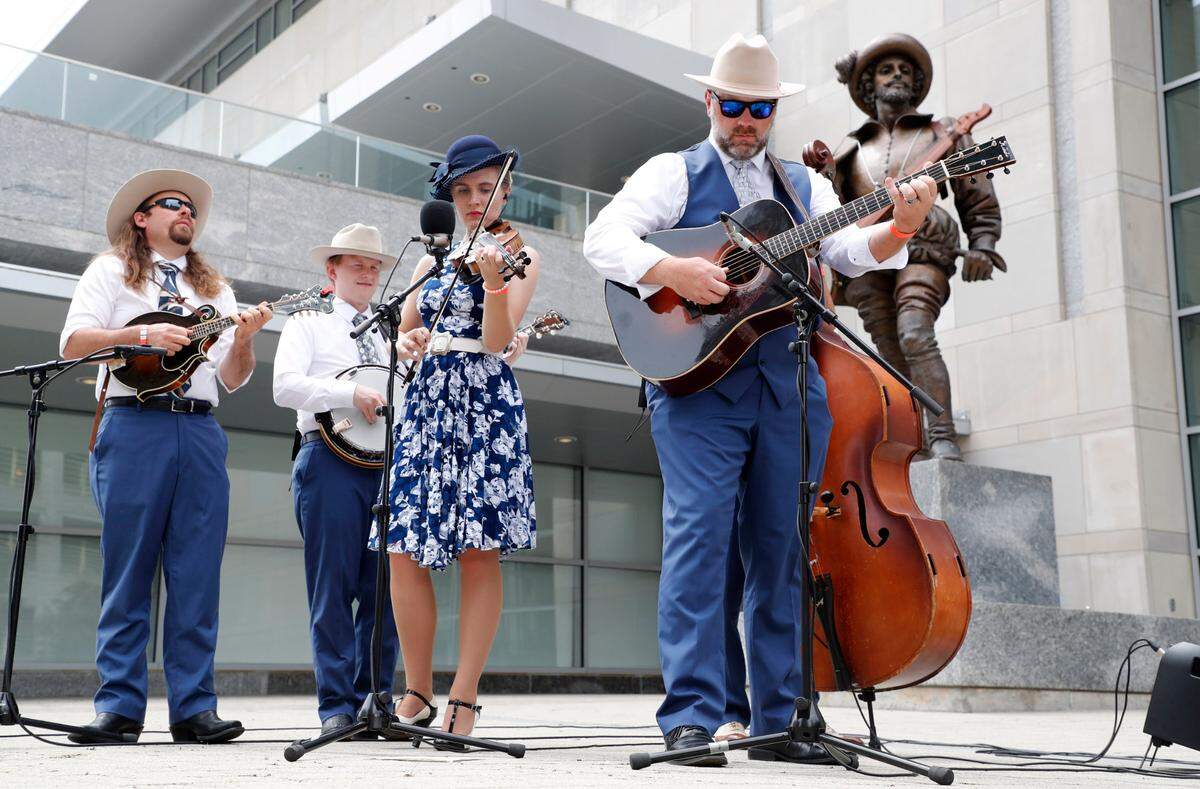
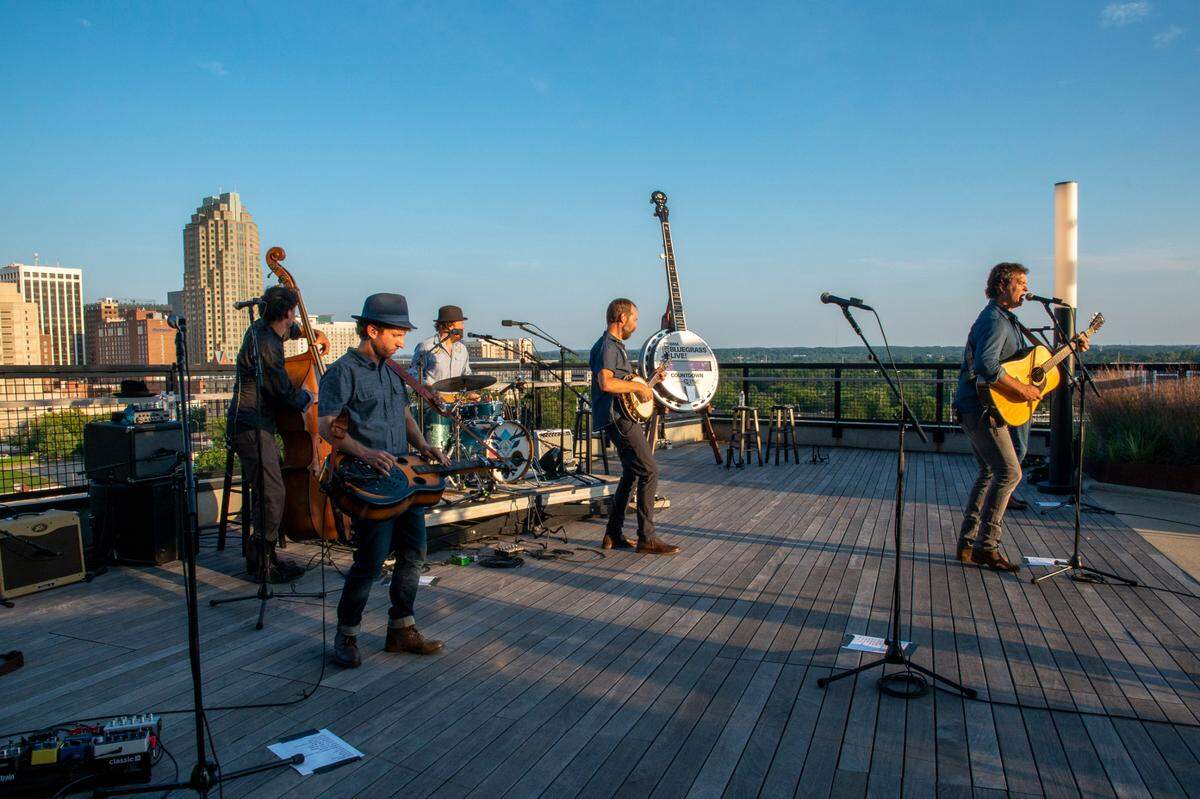
To participate in the festival, IBMA required that bands be able to get together in person to perform — no mashups, no Google hangout collaborations. That knocked a lot of performers out, because they couldn’t or didn’t feel safe to travel or meet with their bandmates. But nearly 40 bands, including more than 100 individual musicians, did participate, meeting up long enough to record “secret concerts” of festival-length sets that will be streamed over the two days.
Some will only be seen during the festival dates because of music-rights agreements prohibiting rebroadcast later.
The specific timing of performances hasn’t been announced yet, but the lineup will include The Travelin’ McCourys with special guest Del McCoury; Steep Canyon Rangers; Jerry Douglas & Odessa Settles; Sierra Hull & Molly Tuttle; Carolina Blue; Chatham County Line; Chatham Rabbits; Dewey & Leslie Brown and The Carolina Gentlemen; Hank, Pattie & The Current; Kruger Brothers; Lindsay Lou, Phoebe Hunt & Mimi Naja sing the songs of Bluegrass Women; and Mountains of Infamous Leftovers.
While making the recordings wasn’t the same as climbing onto a stage at City Plaza or Hargett or Martin streets, playing a mini-concert gave Pittsboro-based guitarist, singer and songwriter Tommy Edwards a chance to do something he had been missing.
He teamed up with singer-songwriter Andrew Marlin of the duo Mandolin Orange for a performance at a house near downtown where Bill Monroe once lived.Some folks from the neighborhood heard the commotion and came over to listen and get cell-phone photos and video.
“It felt really good,” Edwards said in a phone interview. “It was just great to have people where you could look out and see they were paying attention.”
‘Energy from the people’
Edwards, 75, a retired educator with a state pension and a sporadic income from a music shop in downtown Pittsboro, won’t starve for the loss of gigs caused by the pandemic. Sure, he said; he misses the money he was making playing 15 times a month with Leroy Savage or Carolina Lightnin’ before the pandemic. But for him, playing is about the musical conversation he has with his cohorts onstage and with the audience.
“I get a lot of energy from the people that I play with and the people who are listening,” Edwards said. “When those people are out there and they clap for something or they act like they like something, it can push you to add something to the performance that you wouldn’t have if you were just in a recording studio.”
Musicians who learned over the spring and summer to perform live for webcams as a way to compensate for lost income or just to stay connected to audiences say it’s a big transition for a bluegrass musician.
Bluegrass is a storytelling music, an emotional genre well suited to venues where the players can see the faces of audience members moved by a particularly resonant line or universal theme.
Playing into the silence of a camera can be unnerving, Newberry said.
On his first Facebook live stream after the pandemic hit, he said, he was using the phone on his camera because he didn’t have a good enough computer. His home WiFi also was unreliable.
But people tuned in, and liked what he was doing well enough to make donations, which showed up as notifications that instantly stopped the live stream.
“It was the hillbilly equivalent of the Myth of Sisyphus,” Newberry said.”I would roll that rock up the hill, and the notification would hit and it would roll back down.”
Darren Nicholson, who plays mandolin for Haywood County-based Balsam Range, said he has watched a lot of virtual concerts during the pandemic and has performed a few. He and other performers said that while there may have been an over-saturation of virtual performances, this experience has shown there may be a place for online components of some festivals or camps because they take the music to a worldwide audience that wouldn’t otherwise have a chance to experience it.
The forced break from Balsam Range’s rigorous traveling schedule has had another unexpected benefit, Nicholson said. It has given him an opportunity and a muse for songwriting he hasn’t had in a while.
“There’s a saying: Where there’s pressure, there’s diamonds,” Nicholson said. “This thing has been hard, but so many beautiful things have come out of it. Like perseverance, learning what’s really important.
“I’ve been on the road since I was 18,” said Nicholson, who’s 37 now. “I missed most of my son’s childhood because I was traveling. I’ll never get those moments back. But I’m making up for it now.”
The band released a new single during the pandemic called “Grit and Grace,” about meeting hard times with spiritual courage.
Nicholson said he has heard that some musicians are struggling financially as a result of the pandemic, but he and his bandmates have always saved in case they had to take a break from playing. Nicholson said he’s especially lucky; he has a friend who owns a huge choose-and-cut Christmas tree farm and has hired Nicholson to work in it. Balsam Range, together for 13 years so far, also earns regular royalties from an established catalog of recordings.
“If you’re a smart musician you’ll always have a Plan B,” Nicholson said.
‘Bluegrassers connect with each other’
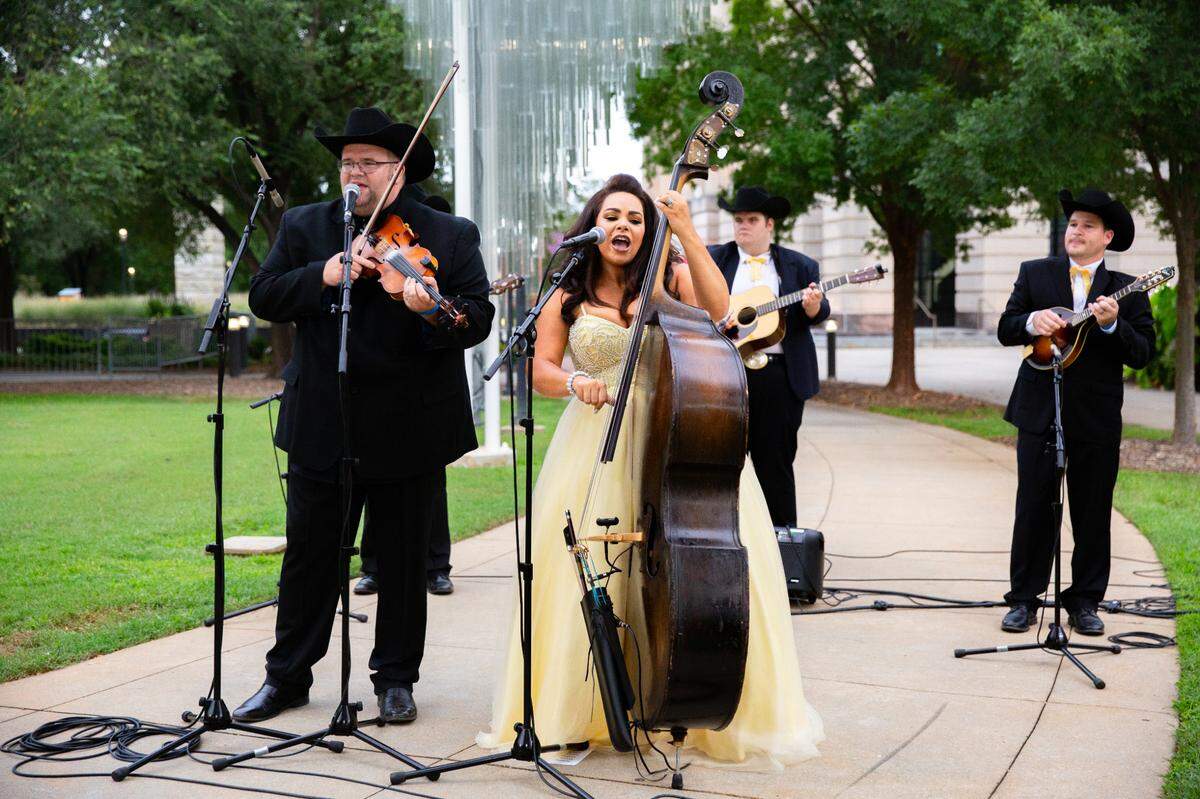
Tina Adair, who plays mandolin and sings for the all-female band Sister Sadie, a regular at Wide Open Bluegrass, got together with her bandmates in late August to do a number for the IBMA Music Awards Show. With Adair in Nashville, band members are scattered across Tennessee, North Carolina and Kentucky, and they hadn’t seen each other since a show in Ohio in late January or early February before the pandemic knocked 25 dates off their books.
When they got together at the Ryman, Adair said, “It felt good. It felt like home. Because as a musician and a singer, music is a part of your soul and who you are. And to get together with people you enjoy playing music with the most, it’s like you’re going back home to visit.”
Adair things the reason that musicians miss playing before audiences and audiences miss hearing performances in person is that, “Bluegrass music is a shared experience between the artists and the fans. It’s not something you can necessarily capture in a record. It’s just a different experience.
“Bluegrassers connect with each other.”
Though Gov. Roy Cooper has not yet lifted the ban on large gatherings, other states have loosened some restrictions. On Sept. 26, Sister Sadie was scheduled to play its first festival since the lockdown, a 4 p.m. set at Kentucky’s Vine Grove Bluegrass Music Festival.
“We’re in kind of uncharted territory here,” Adair said in a phone interview. “This is something that I don’t think any of us have ever faced. The live music scene was just stripped away from us all in fell swoop, just done.
“There’s uncertainty not just with music but with the world in general. But bluegrassers — musicians and our fans — we’re pretty resilient. We’ll always find a way to bounce back, hopefully bigger and better,” Adair said.
“Most of the festivals, they have been so kind. Nobody knows what’s going to happen. But for the most part, we just said, if the festival happens next year, put us down and we’ll reconvene then.”
How to watch
All IBMA Bluegrass Live! performances can be viewed for free via an online platform called Swapcard. To access the videos there, first register for a free IBMA World of Bluegrass Music pass at worldofbluegrass.org. Some of the performances will also be streamed on WRAL.com and aired via radio on That Station – 95.7 FM.
This story was originally published September 25, 2020 at 1:30 PM.