
Residents of NC’s redlined neighborhoods have higher COVID-19 risk, study shows
People living in Durham neighborhoods that were racially redlined in the early to mid 1900s have a higher COVID-19 risk than people in neighborhoods that weren’t discriminated against, according to a study by the National Community Reinvestment Coalition.
The study found people in these predominantly Black neighborhoods are more likely to have conditions like high blood pressure, asthma and obesity that make the coronavirus more deadly.
Nearly half of the 111 deaths from COVID-19 in Durham County have been among Black people, despite African Americans making up around 37% of the county’s population. Statewide, 29% of deaths have been among Black people, despite African Americans making up around 22% of the state’s population.
Sterling Fulton, evaluation director at the Center for Black Health & Equity, a Durham-based organization, says these disproportionate risks are, at least in part, a consequence of decades-old housing discrimination.
“Even though the practice of redlining ended 40, 50 years ago formally, over time what’s happened is there’s a ripple effect that happens over generations,” she explained. “In the United States, home-ownership is the largest asset that people are able to pull from to benefit from one generation to the next.”
By comparing redlining maps created by the Home Owners’ Loan Corp. (HOLC) in the 1930s and maps showing today’s Centers for Disease Control and Prevention social vulnerability scores, the study shows how legacies of segregation have left predominantly Black neighborhoods across the country without the health resources or economic stability to stay safe from COVID-19.
In the 1930s, the HOLC created maps assigning grades to neighborhoods in nearly 250 American cities on a four-grade scale: A to D, “Best” to “Hazardous.” Only white neighborhoods received A and B grades; neighborhoods where people of color lived received C or D grades. In those neighborhoods, Black and other residents of color were systematically denied credit from the 1930s until the passage of the Fair Housing Act in 1968.
Being unable to buy and build equity in homes, along with workplace discrimination that kept them in low-paying jobs, left residents of those neighborhoods economically disadvantaged, which aggravates a number of COVID-19 risk factors.
People in economically disadvantaged areas are more likely to work in low-wage jobs they can’t do from home, more likely to live in denser housing, and more likely to have preexisting health conditions due to lack of access to healthy food, exercise, and medical care.
Between 2015 and 2017, 46.5% of people in poverty in Durham County were Black, 26.3% were Latino, and 19.4% were white, according to an analysis by Henry McKoy, a professor at the N.C. Central University School of Business.
Structural injustice ‘baked into our systems’
“We know that there is structural racism and structural injustice that has been baked into our systems over many, many, many decades, and I think when we get into crisis points like this it only shines a light on what is happening,” said N.C. Department of Health and Human Services Secretary Dr. Mandy Cohen in an interview with The News & Observer.
“Our historically marginalized communities are also the ones keeping our economy going,” she continued. “These are our essential workers, they’re our child care workers — the majority of folks who work in long-term care settings are African-American women, those that work in our child care settings are women from African-American or Latinx communities.”
Cohen said the data reflects this; for example, Hispanic people, who often live in formerly redlined neighborhoods, make up 28% of COVID-19 cases in North Carolina but are just 10% of the state’s population. In Durham, Hispanic people make up 46% of the county’s 10,807 COVID-19 cases according to Durham County Public Health, but less than 14% of people in the county. The state does not track COVID-19 cases by socioeconomic status.
In April, Black people made up 38% of positive cases and 39% of deaths, despite making up 22% of the state’s population. Cohen said DHHS’ work to address these disparities helped bring down those numbers to 22% of cases and 29% of deaths. In Durham, Black people now make up around 30% of cases, and 37% of people in the county.
DHHS has increased testing capacity in ZIP codes with Black and Latinx communities, Cohen said. And, starting in August, the state launched a Community Health Workers program to provide not just health services but food assistance and relief payments to help people isolate. Nearly 4,000 relief payments had been completed through Nov. 13.
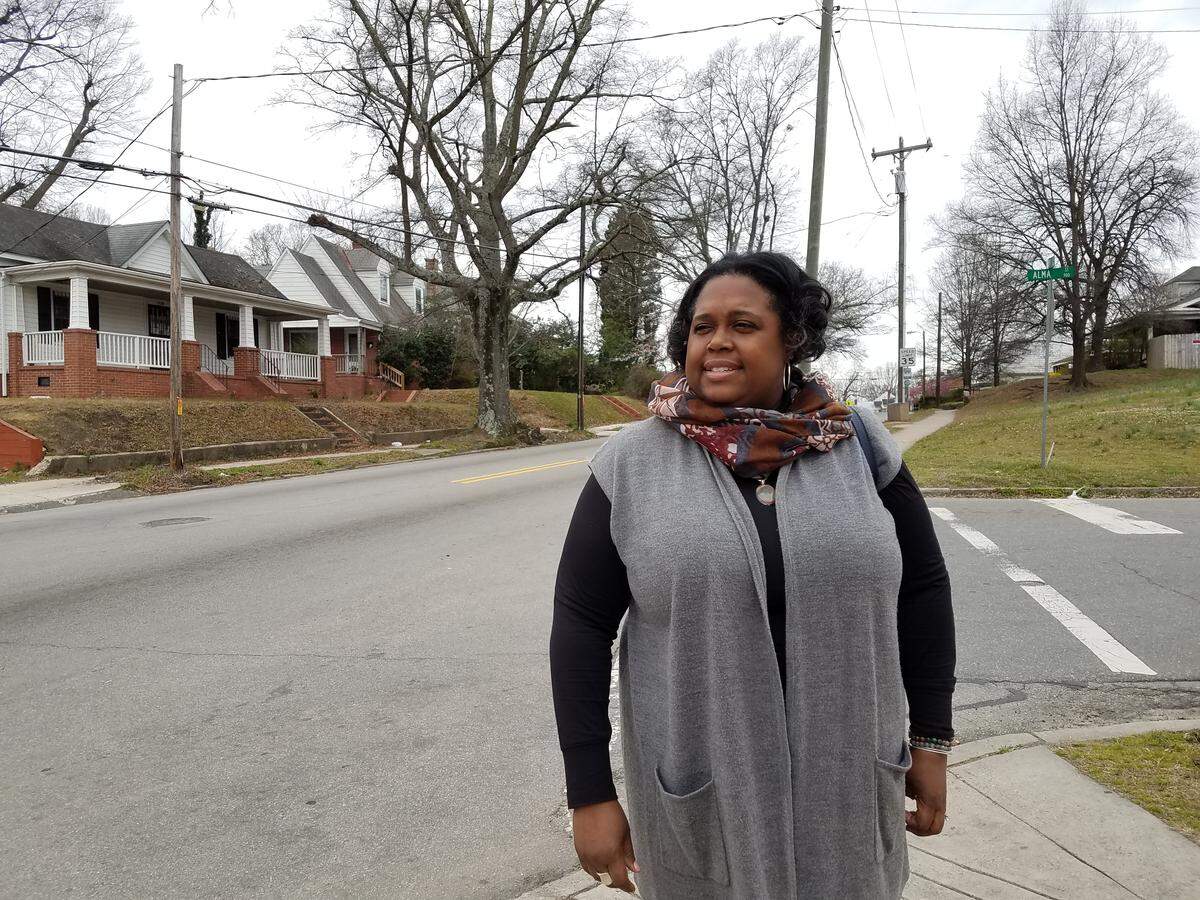
Camryn Smith, executive director of the grassroots organization Communities in Partnership in Durham says that addressing the disparities in COVID-19 risk would require legislation that “hits the source of the problem,” like legislation to protect renters from being evicted.
Smith said the disparities in COVID-19 risk show that, in Durham: “We are not who we say we are. We say we are compassionate and loving and equitable, we want to be highly involved and want to value the diversity, knowledge, and intellect that exists in every community. That is not true, because we do not know how to operationalize that.”
To do that, Smith said, would mean the state “transferring access and resources and power — monetary resources — to communities that know how to take care of themselves.”
Higher social vulnerability in redlined neighborhoods
In Durham, every neighborhood assigned a D grade by HOLC back in the 1930s — mostly in the eastern part of the city — and many that were assigned a C grade have high social vulnerability scores today.
The Durham census tract with the highest social vulnerability index, located in East Durham, was given a D grade by HOLC, which cited the high number of Black residents in the northwest part of the neighborhood. The area remains 63% Black today, according to the 2018 American Community Survey, far higher than the county average.
And residents there are far more likely to suffer from health conditions that make them more vulnerable to COVID-19 complications. The area has an average life expectancy of 70, compared with 80 countywide. The rate of diabetes there is 17%, nearly twice the county average. The area has among the highest rates of high blood pressure (43%), asthma (12%), and obesity (45%) in Durham.
The study shows that neighborhoods that have been gentrified in recent years still have high rates of social vulnerability, even as wealthier people with more access to health care move in.
“Even though you have people with wealth move into the neighborhood, [there’s] the fact of the disparity in income — those who are doing poorly are doing far more poorly than they were doing before,” explained Ernest Smith, a civil rights lawyer in Durham and husband of Camryn Smith. Rising rents leave long-term residents struggling to keep up, he said, which “creates this effect where, before they’re pushed out, of causing more poverty in those households because money that was staying in the household is going to the landlord.”
The study includes maps for 200 cities nationwide. The other North Carolina cities included in the study — Asheville, Charlotte, Greensboro and Winston-Salem — all reflect the same pattern of many redlined areas having high social vulnerability today.
This story was originally published November 24, 2020 at 10:54 AM.