NC man forecasts a ‘fantastic experience’ rowing across North Atlantic for the planet
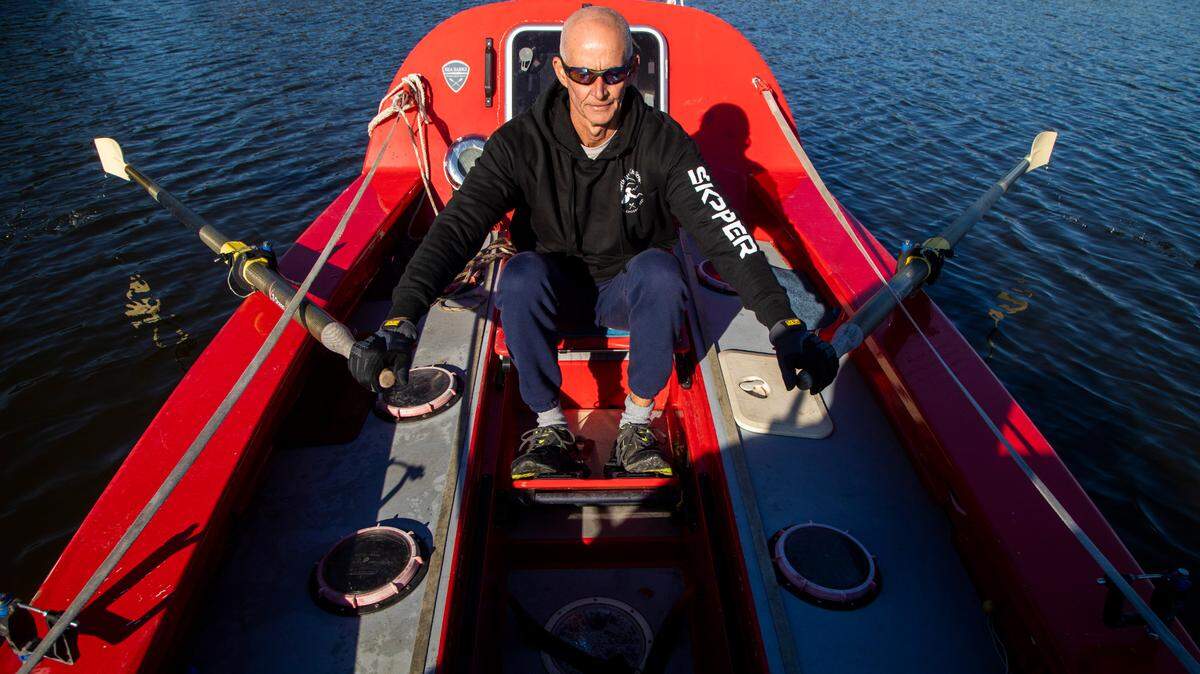
Peter Harley rotates the oars, his hard plastic seat sliding forward and back with each movement on shiny rails the length of the boat’s bottom, propelling the 24-foot vessel across Jordan Lake.
“The rowing action is horrendous on the backside,” he says, as the red fiberglass hull cuts silently through the water. He leans into the motion as mid-morning sun sparkles off the ripples from each turn.
Earlier, off the Seaforth landing on U.S. 64, a fisherman had stood in his boat, watching.
“You see everything down here, don’t you?” he said to another fisherman working nearby. They turned to watch Harley rowing before they fired up their outboard motors and pulled away.
Soon, only the steady splash of oars on water remained as Harley pushed at nearly 4 mph to the highway bridge and back to shore. It’s a far more serene experience than the Cary resident may find crossing the North Atlantic Ocean next summer.
At 60, Harley wants to be the oldest man to row solo from west to east across the North Atlantic. He also wants to bring attention to the effects of climate change, ocean pollution and widespread deforestation on the planet and its people.
A GoFundMe account has been set up to raise $100,000 for his trip and $400,000 for ocean clean-up groups and the Day One Disaster Relief organization based in Pittsboro.
The 4,000-mile North Atlantic Challenge begins in late May in Virginia Beach, Virginia, and, with luck and skill, will end by October in La Trinité-sur-Mer, a coastal town in northwestern France.
If the weather doesn’t cooperate, Harley could steer south to Gibraltar on the Spanish coast.
Ocean waves, wind challenging
The crossing is unpredictable, stacked with high seas, opposing winds, difficult currents and shipping traffic. On the water, there is also loneliness, salt sores and the physical toll on the rower.
The National Oceanic and Atmospheric Administration notes that summer waves, while calmer, can still range from 8 to 12 feet tall in the North Atlantic Ocean, with rogue waves and waves in rough weather reaching more than twice that height.
Most avoid the North Atlantic “because of its complex problems and difficulties,” Harley said.
He’s giving himself four months to make the journey, averaging 40 to 60 miles a day, depending on the conditions. Hurricanes shouldn’t be a factor until late October, he said.
“There would be some days, where if it’s really favorable conditions … you could push that to 100 if you stick with it,” Harley said. “And of course, you will get the other days where you will probably go backwards a couple of days or go sideways.”
Others have made similar treks, including in 2013, when Montreal resident Mylene Paquette became the first person to row solo from the North American continent across the North Atlantic — 3,100 miles from Halifax, Canada, to Lorient, France, in 129 days.
The first American to take on the challenge was Ohio teacher Bryce Carlson, 37, who set a record for the fastest trip in 2018. His 2,000-mile trip from St. John’s, Newfoundland, to the Isles of Scilly, off England’s southwestern tip, lasted 38 days, six hours and 49 minutes.
Carlson capsized roughly a dozen times during his trip; Paquette only a few.
Harley’s SeaSabre ocean rowing boat, “Wild Ride,” is built for the journey and already has made the mid-Atlantic crossing twice in the Talisker Whiskey Atlantic Challenge, known as the “world’s toughest row.”
Launched in December, it covers more than 3,000 miles from the Canary Islands to the Caribbean. Wild Ride — formerly known as the Poppy — last traveled that route in 2017, with a three-woman team from England.
Extreme sports, South Africa
Harley is no stranger to extreme sports and adventure, from skydiving to mountain climbing to marathons. In his native South Africa, he spent time in the sea, ski-boat and spear fishing, free diving and kayaking.
Last year, he emigrated from Kloof, a small community near South Africa’s third most-populous city Durban, on the western coast.
“The country itself is really, really beautiful. Absolutely spectacular,” Harley said. “It’s wild and rugged in certain places, and absolutely flat in other places, like a pancake, so you get a tremendous diversity in the geography.”
He moved to the United States to be closer to his daughter Bonnie and her husband, who have lived in California for about 15 years. But the cost of living, combined with the traffic and heat, did not make it a good fit for him, he said.
Having previously read about North Carolina, he moved to Mooresville, near Charlotte. When that didn’t work out, he moved to Cary in July, where he is a self-employed home inspector.
Now, he gets to spend his time at the lake and with his daughter, who is using her marketing skills to advertise his mission. He hopes they can inspire others to try something new.
“It doesn’t matter how old you are, how young you are, doing something possibly out of your comfort zone is a fantastic experience,” Harley said.
Age and inspiration
What inspired him was watching the 2017 Talisker Whiskey Challenge, Harley said. He mulled over the idea for the next three years.
In January, he started to prepare, paddling his kayak until the boat arrived from England in October, lifting weights and building his endurance. He’s rowing up to 25 miles a few days a week now, he said.
“Age is a factor,” Harley admitted. “I try to as much as possible pretend that it isn’t, but there are times when you’re training on the lake, and you feel it. At 60, you don’t have the same endurance that you do at 40, there’s no doubt about it.”
In January, he also eliminated meat from his diet, in part because of the devastation he saw caused by the Australian wildfires, he said, but also because of his passion for animals.
“The way the world works at the moment in terms of the commercial meat industry I think is absolutely horrendous,” Harley said. “The amount of grain and the amount of energy that’s utilized in growing grain and food for the beef industry is absolutely appalling.”
He found the change gave him more energy, he said, as he manipulated the oars to orient his boat toward land.
Ocean boat, sea life, pollution
The Wild Ride is built of fiberglass, carbon fiber and Kevlar, and has self-righting capabilities should the seas turn stormy. Solar panels atop the fore and rear storage and sleeping cabins charge two 12-volt batteries to power GPS, radio, an automatic identification system, and a desalinator for converting salt water to fresh.
The deck is lined with watertight storage pods that will hold dehydrated pre-made meals, high-calorie shakes and high-energy snacks to replenish the 5,000 to 6,000 calories a day that Harley will burn while rowing.
He will use cameras and a drone to document the journey for his website, keeping an eye out for shipping vessels and “islands” of floating plastic that collect, in particular, in the North Atlantic currents.
“It’s damaging sea life, and the continuation of that without any kind of intervention cannot only be detrimental to the life in the ocean, but life as we know it,” he said.
The sea life also will “be fascinating,” he said, from dolphins and turtles to sharks and whales, and the birds that land on the boat.
“I’ve got to enjoy it. It’s a once in a lifetime event, so I don’t want to go and make a nightmare of it,” Harley said. “I’m very passionate about the sea and the sea life, and the problems that are occurring around the world in terms of ocean pollution and the degradation of the planet. It’s a huge problem.”