
The discovery of this new animal species in NC is more than 50 years in the making
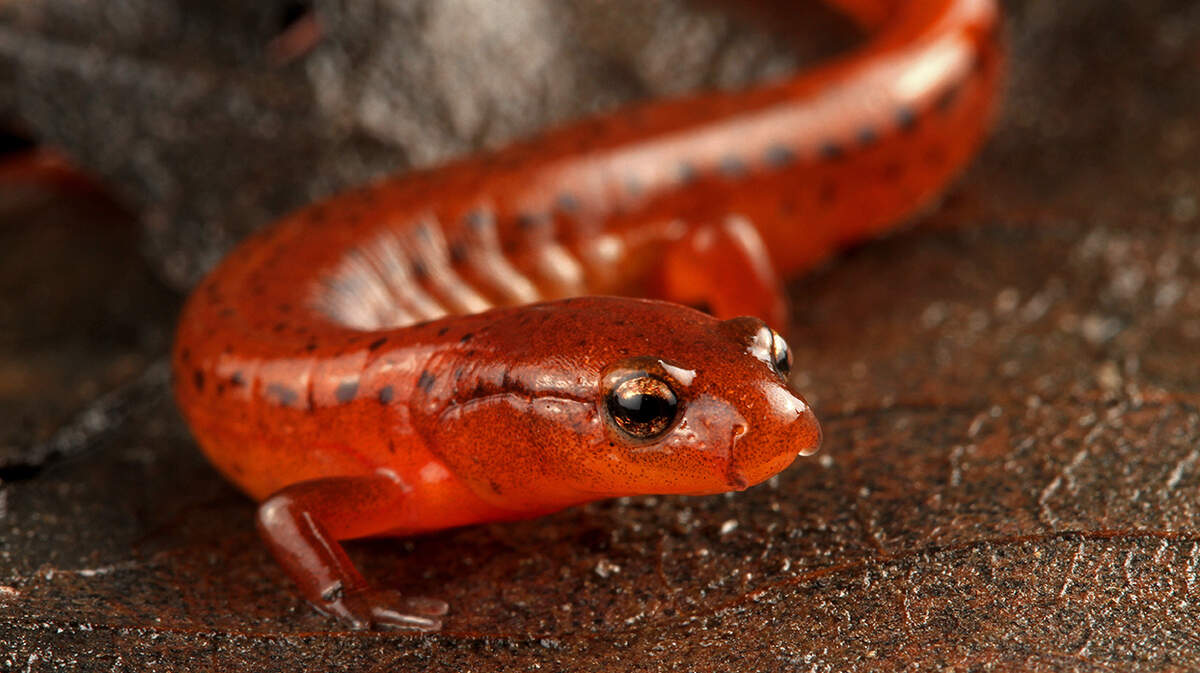
Animal researchers have uncovered a new species in the Tar Heel State, further cementing NC’s status as home to the greatest variety of salamanders in the country.
The Carolina Sandhills Salamander is a spotted, crimson-orange amphibian that dwells in the springs and blackwater rivers of the Sandhills region.
Looking somewhat like a cross between a frog and a lizard, its size is smaller on average compared to similar species’. Unlike reptiles, a salamander’s body is slippery and smooth.
The discovery brings the state’s count of salamander species from 63 to 64, according a news release by the North Carolina Museum of Natural Sciences.
“It’s a real neat critter,” Alvin Braswell, a now-retired researcher from the NC Museum of Natural Sciences who helped make the discovery, said in the release.
A case of mistaken identity
For 50 years, researchers had mistaken the Carolina Sandhills Salamander for something else.
Braswell collected the first known specimen of the critter in 1969.
Back then, he had thought it was just a strange looking Southern Two-Lined Salamander, a similarly dotted amphibian with a yellowish-brown hue. After he found more “weird individuals” of the salamander species in the ‘70s, he thought, “Whoa, maybe there’s something to this,” the release states.
He began the process of describing the new animal species in the ‘80s, but stopped working on it after his duties as an assistant curator became too burdensome, the release states. Then, Braswell passed the baton to Bryan Stuart, who joined the museum as a research curator of reptiles and amphibians in 2008.
It wasn’t until the museum accessed a new technology that Stuart could complete Braswell’s project, the release states.
In 2013, Stuart received an award from the National Science Foundation that enabled him to use a next-generation DNA sequencer.
“With that machine, we were able to sequence a sufficiently large number of genes to test the distinct species status of the Carolina Sandhills Salamander,” said Stuart, the lead author on the paper revealing the discovery.
What makes this salamander special?
Part of why the salamander is unique is that its range in limited to the Sandhills region, according to Braswell.
The NC Sandhills is a small patch of what’s left from the Longleaf Pine ecosystem, a vast landscape that once spanned from southeast Virginia to the south of Florida, the release states. About 3% of the ecosystem remains after decades of deforestation and development, according to the Sandhills Ecological Institute.
The salamander’s scientific name, Eurycea arenicola, reflects its origin. Arenicola translates to “dweller of a sandy place” in Latin.
Researchers found specimens in Harnett, Hoke, Montgomery, Moore, Richmond, Robeson and Scotland counties, the release states.
“Almost every known specimen of the new species is housed in our collection, with just a handful of individuals at a few other museums,” Jeff Beane, the museum’s collections manager for amphibians and lizards, said in the news release.
“No records are yet known from South Carolina, but we have a record in North Carolina that is only two miles from the state line, so it gets close,” he said.
Scientists may track down even more salamanders in the coming years.
The research paper on the Carolina Sandhills Salamander shows that there are other unidentified species that await description, including some in North Carolina, Stuart said.
“So, there is definitely more to do with two-lined salamanders in the state,” he said.