
Students at NC college split from fraternity they say glorifies a Confederate general
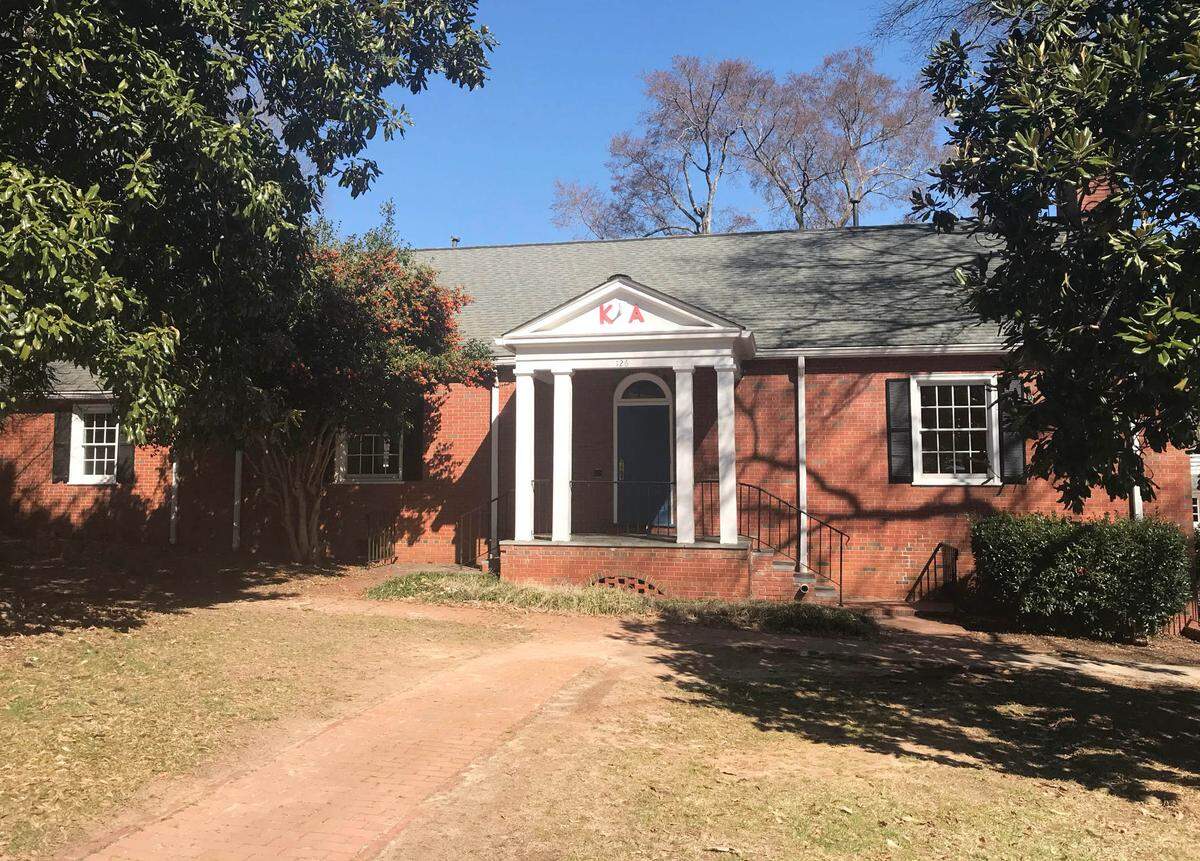
As a Davidson College student in the 1990s, Issac Bailey remembers the Kappa Alpha Order fraternity chapter on campus hosting parties and celebrations on Confederate Gen. Robert E. Lee’s birthday.
“I was not happy about them, of course, but the sentiment back then was a lot more conservative,” Bailey, now a professor at the college, told The Charlotte Observer. “The time was much different.”
Bailey, a former Observer editorial board member, recalls Confederate battle flags on some windows of the fraternity house and how students argued how states’ rights and not slavery caused the Civil War.
“That kind of sentiment was fairly strong at Davidson back then,” he said of the “states’ rights” argument.
For Bailey, who is Black, a vote by the Kappa Alpha chapter last month to disaffiliate from its national fraternity “was another positive step for Davidson College and dovetails well with other moves to finally own up to our history of slavery and to trying to more fully embrace our principle of inclusivity.”
The moves included an apology by the college in August for supporting slavery during its first 30 years in the 19th century — and for what Davidson called “its embrace of the racist laws and policies” in subsequent decades, the Observer previously reported.
The apology followed a two-year examination of Davidson’s ties to slavery and racist policies by a campus commission headed by alumnus Anthony Foxx, the former Charlotte mayor and U.S. secretary of transportation.
Over two-thirds of the 20 Davidson chapter members voted on Feb. 17 to disaffiliate, according to Paul Mullinax, now-former president of the chapter. The few who voted against the move also favored a split but wanted to wait longer, he said.
Mullinax, who graduates in 2022, said his chapter previously joined 19 other Kappa Alpha chapters nationwide last year to ask the fraternity to stop referring to Lee as its “spiritual founder” and to make other changes. No chapter wanted to disaffiliate at the time, he said, and Davidson’s is the only one so far to have done so.
The chapters included those at mostly larger universities, Mullinax said, among them Duke, Vanderbilt, Stanford and Lee’s namesake university, Washington and Lee in Lexington, Va.
Kappa Alpha’s national organization disputes it is racist, but the fraternity acknowledges past instances of racial injustice or inequality.
“Kappa Alpha Order is keenly aware of all sides of our history,” Jesse Lyons, the fraternity’s assistant executive director for advancement and the editor of its journal, told the Observer in an email. “We have researched it, and we have learned from it.”
‘Racist history’
In their letter, the chapters asked that Kappa Alpha “no longer recognize former members and fraternity leadership who practiced or supported discrimination, racial violence, or white supremacy.”
The letter cited John Temple Graves, “our ninth Knight Commander, who openly spoke in support of lynching.”
The chapters also wanted the fraternity to revise its mission statement to exclude references to Lee.
Mullinax said the message about Lee was: “You’re glorifying a man who shed blood, sweat and tears for the Confederacy. Maybe that’s something we don’t want to be affiliated with.
“Let’s erase the racist history and turn it into something more positive,” he said the chapters were telling the national organization.
“Essentially what they said (in response) is that no major changes could be made until their convention” a year later, he said. The fraternity did rename one of its provinces that had been named for a Confederate, according to Mullinax.
The Davidson chapter’s disaffiliation occurred as more students nationwide question Greek life in general. Many are leaving their sororities and fraternities because they realize they’re “exclusionary, racist and misogynist,” The New York Times reported.
‘Glorifying’ a Confederate general
Kappa Alpha Order was founded by Confederate veterans in 1865 at Washington College, where Lee was president until his death in 1870. The college later was renamed Washington and Lee.
Davidson’s Sigma Chapter was established in 1880 with three charter members and claims 1,858 alumni, according to the chapter website.
The Kappa Alpha website describes Lee, who was not a member of the fraternity, as “a descendant of patriots who aided in the founding of the United States, related by blood and closely tied by marriage to George Washington.”
Because of “his religious convictions, exemplary ideals, values, strong leadership, courtesy, respect for others and gentlemanly conduct,” Lee is considered the fraternity’s “Spiritual Founder,” the website says.
The fraternity website highlights musician Zac Brown and PGA golfer Brandt Snedeker among its “profiles of success.”
Kappa Alpha’s UNC Charlotte site lists U.S. Rep. Richard Hudson, R-N.C., among its “distinguished alumni.”
Critics, including hundreds of former Kappa Alpha members, contend the fraternity has glorified Lee and other Confederates and allowed members to commit racist acts for more than a century.
Alumni renounce fraternity
The Feb. 17 vote at Davidson followed a renunciation of Kappa Alpha by 225 alumni of the chapter in October.
The killing of George Floyd by a Minneapolis police officer in May and the Black Lives Matter protests last year inspired the alumni to act, several of them told the Observer.
“It’s our view that KA is a Confederate fan club and shouldn’t have a place on the Davidson College campus, or any other college campus,” Columbia lawyer Brook Andrews said. He is a 2001 Davidson College graduate and a former member of its Kappa Alpha chapter.
Thad Sieracki said he was among a small group of Davidson chapter alumni who helped start the renunciation effort. He graduated in 2010 and lives in Kansas City, Mo., where he is assistant portfolio manager at a mutual funds firm.
“I joined this organization because I liked the guys that were a part of it,” Sieracki said. “And it turned out the flag you were flying was not of an organization I was proud to be part of and probably never should have been a part of.“
“I think people were broadly aware of the history, and the traditions and symbols that remained as part of the organization,” Sieracki said. “I think that what we were not aware of was the insidiousness of that history and how it continued to play a role to the present day, and the persistent impacts that those symbols continued to play.”
Criticism elsewhere
In a letter published in the campus newspaper, The Davidsonian, former chapter member Sherwood Callaway said fraternity members “have perpetrated numerous incidents of overt racism over the years.”
Callaway graduated from Davidson College in 2016 and works as a software engineer in New York.
Joining Kappa Alpha was a decision he “deeply” regretted, Callaway said.
He cited various racist acts by Kappa Alpha members since the early 1900s and that “continue more than a century later.”
In 2019, he said, Kappa Alpha members from the University of Mississippi “were suspended after posting photos of themselves holding rifles in front of a memorial for Emmett Till,” the Black teenager lynched in 1955. “The memorial had been defaced,” Callaway said. “It was riddled with bullet holes.”
The chorus of Kappa Alpha critics also includes Thomas Cullen, a U.S. District Court judge in Virginia. He belonged to the fraternity as an undergrad at Furman University in Greenville, S.C.
“It’s time for KA and other fraternities with similar founding ties to step back from this history and focus on friendship, inclusion, and service,” Cullen told The Roanoke Times in August.
And Rachael Kirkconnell, a front-runner on Season 25 of ABC’s “The Bachelor,” apologized on Instagram after a photo appeared to show her at a 2018 Kappa Alpha plantation-themed fraternity formal, The Indianapolis Star reported. The show currently features its first Black Bachelor, Raleigh native Matt James.
Fraternity response
Claims of Kappa Alpha Order being a racist organization are false, said the fraternity’s Lyons.
Kappa Alpha has a full-time staff member dedicated to diversity, equity and inclusion education, he told the Observer.
“We are saddened that some alumni chose to end their lifelong membership and negatively influenced some current members to take this path as well, despite efforts to engage and discuss their concerns as well as KA’s continued progress,” Lyons wrote. “Unfortunately, separating from the national organization eliminates the educational resources and produces no lasting positive effect.”
Lyons said Kappa Alpha has “great relationships with 120 campuses across the country. Thousands of good young men, fathers, husbands, brothers, and friends, and the organization they belong to, should not be painted with such a broad and defamatory brush.
“Our members teach and exemplify that KA’s purpose is to be a Moral Compass for the Modern Gentleman,” Lyons said. “Our values are in fact reverence, gentility, knowledge, leadership, brotherhood, and excellence.”
Lyons said several members of the Davidson College chapter disagree with the decision to disaffiliate, “and it is our goal to support them and eventually reinstate the chapter.”
Mullinax said he’s had “multiple conversations” with those who voted against disaffiliation and none said they wanted to stay with the organization.
Asked to comment about the Feb. 17 student vote, campus spokesman Jay Pfeifer said in an email: “Davidson College supports our students’ decisions to determine for themselves the organizations with which to remain affiliated.”
Bailey, the Davidson College professor who teaches Exploring Fake News and other courses, said of former Kappa Alpha members who regret joining the fraternity: “We have to give people that space to actually evolve.”
“I’ve asked, and been asked, why it has taken so long,” Bailey said.
His answer: “At least it’s happening now.”
This story was originally published March 6, 2021 at 6:30 AM with the headline "Students at NC college split from fraternity they say glorifies a Confederate general."