
Former NC State professor, Carter-Finley Stadium architect dies at 95
Charles Kahn, a former professor at N.C. State University and one of the architects behind the university’s Carter-Finley Stadium, has died at 95.
At times an actor, an educator, a naval officer and a civil rights advocate, Kahn’s life touched many in North Carolina, and in Kansas, where he later relocated before moving back to Chapel Hill in retirement.
He received a bachelor’s degree in mathematics and physics from UNC-Chapel Hill and, after serving as a lieutenant in the U.S. Naval Air Corps during World War II, a bachelor’s in civil engineering from N.C. State.
He would follow these degrees with a master’s in engineering at the Massachusetts Institute of Technology, before returning to Raleigh to teach engineering at N.C. State, while simultaneously earning a bachelor’s, and then a master’s degree in architecture from the school.
And while at N.C. State, Kahn left a permanent mark on the campus as one of the leading architects of Carter-Finley Stadium. With a capacity of 58,000 people, Carter-Finley Stadium has played host to generations of Wolfpack football fans since it first opened in 1966.
In interviews with The News & Observer, Kahn’s family and former colleagues affectionately described the “booming baritone” of his voice, and the “larger than life” personality they say was imbued with a deep sense of warmth and care.
Sarah Kahn, his daughter, described him as “a true career academic,” who “took great interest in helping other people and students.”
But it was the voice, she said, that was most immediately distinctive.
“People who hadn’t seen him for years would hear the voice before they saw him, and recognize it right away,” she said. “Whether it happened in a library in London, or at a restaurant in Chapel Hill.”
In and out of North Carolina, Kahn advocated for social equity in architecture and in his community, his family and colleagues said.
“He cared deeply about his family and humanity in general, and was a loving and generous man who felt a really profound obligation to society,” Sarah Kahn said.
An approach to architecture ‘rooted in social justice’
Kahn spent seven years teaching at N.C. State before leaving in 1968, when he was recruited to serve as the first dean of the University of Kansas School of Architecture and Urban Design.
Kent Spreckelmeyer, a former student of Kahn and now a professor of architecture at KU, said when he first arrived as a freshman on campus, Kahn looked and sounded “almost like a prophet.”
But Kahn could “make a young person to feel very comfortable,” he added. Spreckelmeyer said Kahn helped architecture students “feel confident that they could be part of this ambitious enterprise that he had a vision for.”
Kahn looked at architecture as a scientific and social pursuit, with an approach to the practice “very strongly rooted in social justice and social equity,” Spreckelmeyer said.
In his time at KU, Kahn emphasized recruiting students and faculty members of color, and was a driving force behind the recruitment of Robert Coles, a nationally prominent Black architect, as a visiting faculty member. He also was involved with and chaired the University Committee for Urban Action, a student and faculty group that worked to effect social change in the community, according to his family.
“He had a tremendous amount of concern for students, especially students from disadvantaged backgrounds,” Spreckelmeyer added.
Kahn served as dean of the school until 1981, when he stepped down. He continued to serve as a faculty member for another decade before retiring.
“He will be remembered as the person that not only initiated the school, but started it down the path it’s been on ever since,” Spreckelmeyer said. “He brought a sensibility to architecture that transcended merely technical competence, and he had a real ambition for the environment to be a positive force in the human condition.”
Advocacy in Raleigh
Kahn’s emphasis on social justice and equity dated back to his time in Raleigh, according to his family. While at N.C. State, Kahn helped organize The Citizens Group, which called for an end to racial segregation.
In 1963, he took out a full-page advertisement in The Raleigh Times that featured the pledges of roughly 900 people standing against the practice of segregation by local businesses.
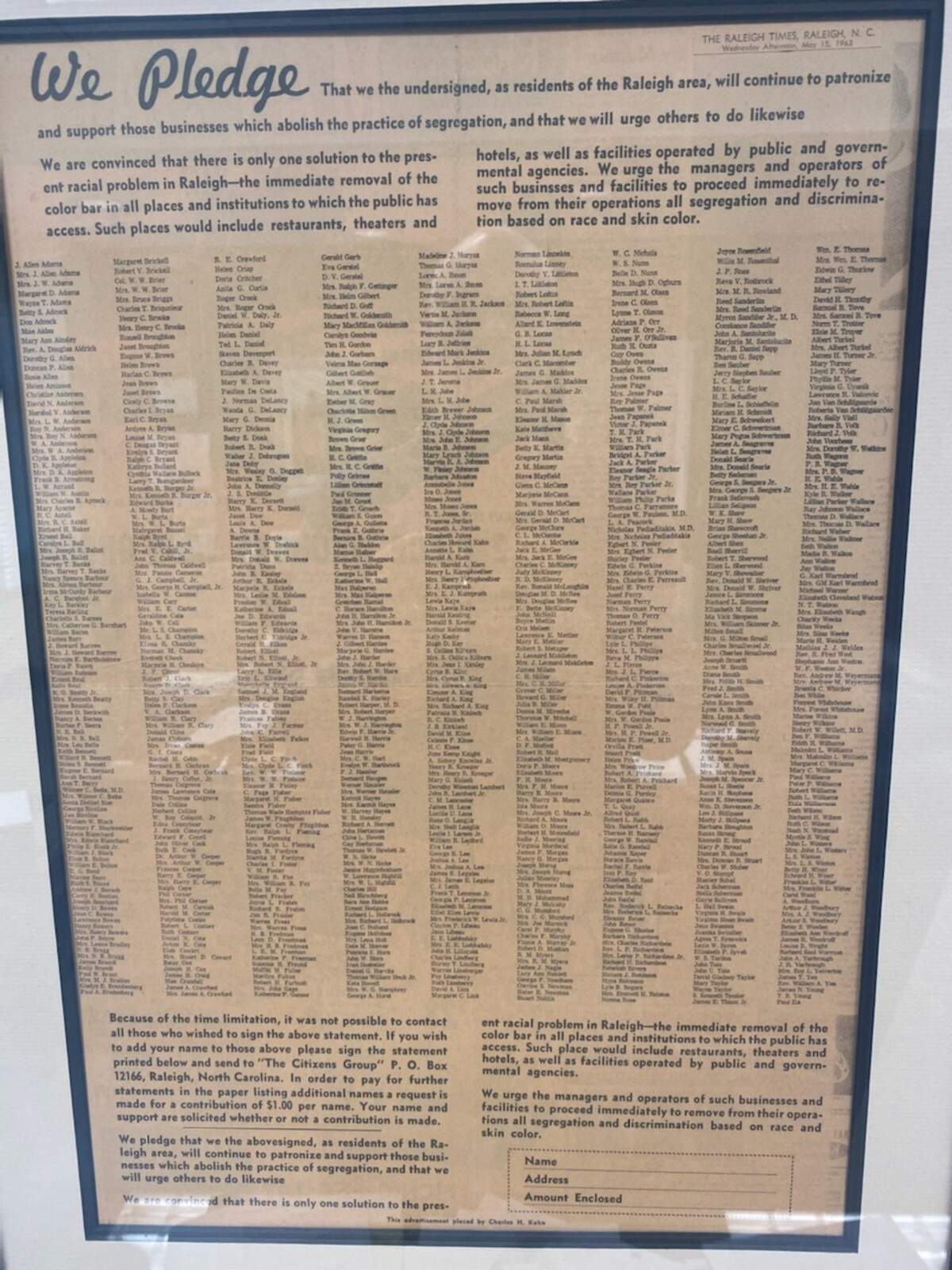
“We are convinced that there is only one solution to the present racial problem in Raleigh — the immediate removal of the color bar in all places and institutions to which the public has access,” the ad read.
Kahn’s name was singled out at the bottom of the advertisement as the person who had placed it. His family said Raleigh police responded to death threats placed against him by the Ku Klux Klan in the aftermath of the ad’s publication.
“My father always felt that it was important to do the right thing morally, independent of the cost to you personally,” Sarah Kahn said.
She added that Kahn was “absolutely devoted to his family,” giving up aspirations of a theater career for a more stable job that wouldn’t require him to travel frequently.
He was a loud voice among the cheering parents at her sports games growing up, Sarah Kahn added. And as an avid Carolina basketball fan, Kahn grew anxious that watching the team play may “jinx” them, his daughter said. So instead of sitting with the family, he would go to his study in the next room, yelling frequently “’What happened?’”
Though the COVID-19 pandemic has made it difficult to hold in-person ceremonies, Sarah Kahn said there will be a virtual memorial in his honor.
Kahn died Thursday of heart failure. He is survived by his wife, Annette Kahn, his daughters Kathryn and Sarah Kahn, his son Benjamin Kahn and his five grandchildren.
“I don’t know that we’ll ever measure up to kind of the life he led,” Sarah Kahn said of her father’s legacy. “But I figure if I do half as well as he did, in terms of giving back to the world and the community, I’ll consider it a great success.”
This story was originally published April 11, 2021 at 7:25 PM.