
‘Making a difference.’ How a mural in a Raleigh underpass is more than just a painting
Just one day after Hurricane Fran made landfall in North Carolina in September 1996, Luke Buchanan went swimming.
But when he and his friend Jackson Griffin jumped into Crabtree Creek at Old Lassiter Mill, they had no idea that the storm had caused an undercurrent. They had no idea that it would pull them under.
Buchanan was lucky. A man who saw what happened tied a garden hose around his waist and plunged in after him.
Griffin, who was not found until later, drowned in the creek. He was 17.
“It changed me overnight,” said Buchanan, now 42, of losing his friend.
Twenty-five years later, Buchanan is a Raleigh artist whose murals color walls all over the city, including the iconic “All are welcome, Raleigh, NC” on the side of Poole’side Pies, the fire escape maze on the side of Death & Taxes restaurant and the Royal Crown Cola sign on Hillsborough Street.
His most recent mural, though, is more personal. With the painting on an underpass of Blue Ridge Road, just past the Beltline by Glenwood Avenue, he’s hoping to raise awareness of how dangerous storms can be.
The mural recognizes the powerful storms that have hit Raleigh and flooded its neighborhoods — and honors his friend.
‘Not just a pretty painting.’
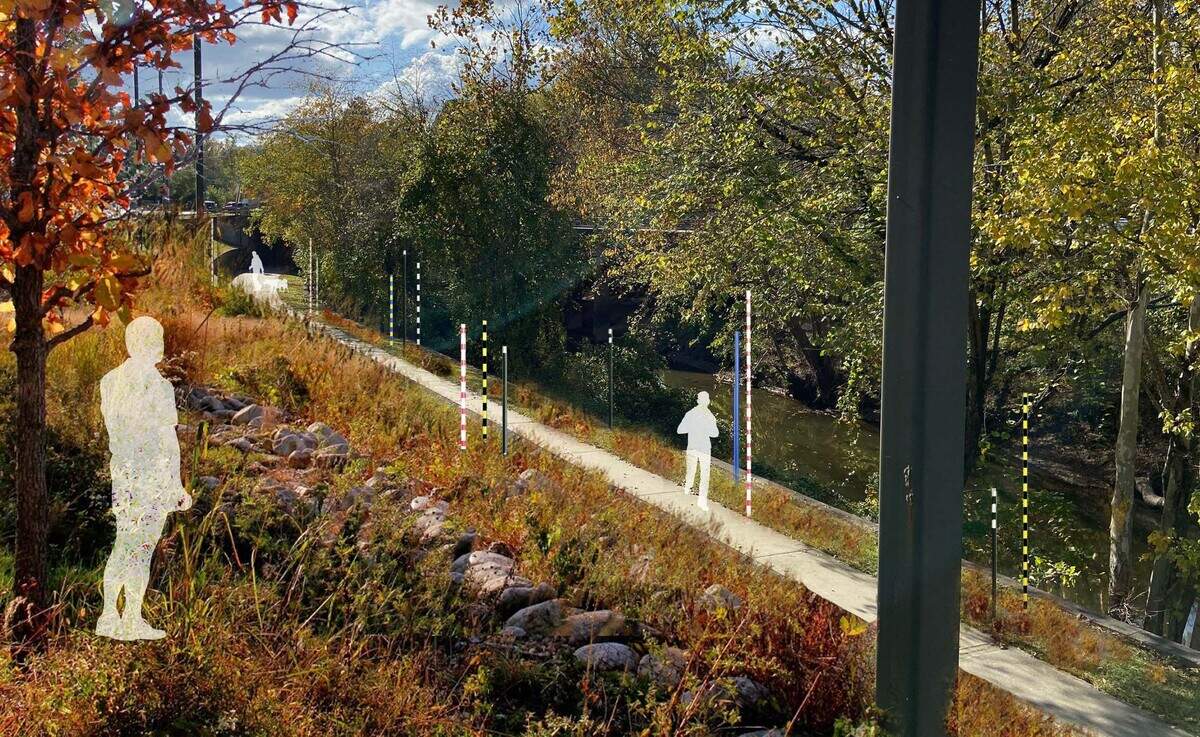
The mural is one part of a broader floodplain education project, which illustrates how water levels rise during major storms and hurricanes. It is located on the banks of Crabtree Creek, along the Raleigh Greenway.
The project is a joint effort between Raleigh Arts and Stormwater, as well as local design team A Gang of Three, the city said.
The title of the project, “Alluvial Decoder,” refers to alluvium, the sediment left in areas around a water source after a flood, said Lincoln Hancock, one of three members of the design team.
He and fellow designers William H. Dodge and Will Belcher designed the mural and other elements of the project, hoping it will help visitors understand the floodplain at the site. A reinstituted meadow along the Greenway path will also serve to absorb and clean water from future floods, Hancock said.
Buchanan, who was brought on by A Gang of Three to paint the mural, met Dodge at Griffin’s funeral.
“It’s not just a pretty painting under a bridge,” Buchanan said. “It’s really a multifaceted project that is making a difference.”
What the mural represents
Agnes. Fran. Eta. Hanna. Alberto. Kyle. Matthew. Danny. Floyd.
These are the names that line the wall of the underpass. Though you might not see the names at first, give it enough time, and they will stand out in the sequences of neat, colorful squares that make up the mural.
It’s a semaphore font stylized after Navy flags, Buchanan explained.
The goal wasn’t to “completely veil it from the public, but just to take a little time to stop and look at it,” he said.
“It helps it to sink in a little better,” Buchanan added.
How the mural came together
For weeks, Buchanan would rise early in the morning to spend hours drawing in chalk, priming the wall, and eventually painting the squares before the August afternoon heat set in.
Buchanan did everything by hand, using a 4-foot level and chalk to draw the letters initially, and forgoing newer technology, like projectors and laser levels.
“There’s more intention in the work if you do the small steps,” he said.
It took roughly 20 hours to paint the mural, Buchanan said.
But in a moment that went viral on social media, Buchanan found his routine disrupted near the end of the painting process. On Labor Day, he said he was working on the mural when a stranger tapped him on the shoulder.
“He just started yelling at me and demanding that I leave, or else show him my permit,” he said.
The man, who declined to provide Buchanan his name, repeatedly said the mural was “graffiti.”
“I told him the permit is filed with the city, (and) if he wanted to see it he could go downtown and look it up,” Buchanan said. “But he insisted that he had to see it.”
When Buchanan tried to disengage and move away from him, the man would follow, he said.
“It was just very bizarre,” Buchanan said, adding he had never experienced anything like it before.
“Most of my murals are downtown. I’ve dealt with people just walking by and saying ‘hi’ or wanting to see or just asking what’s going on,” he said. “That’s one of the things I like about painting murals.”
Buchanan left that day to avoid any conflict with the man, adding the man was not wearing a mask and was breathing heavily near him.
“I was frightened because he seemed unhinged,” Buchanan said. “I told him ‘Please leave me alone,’ and ‘Please go away,’ and he wouldn’t.”
The next day, when Buchanan returned to work on the mural, the man approached him again and told him to leave.
But when Buchanan said he would call the police if the man kept bothering him, the man left without incident.
“I’ve never been harassed like I was by that guy,” he said.
Still, Buchanan added that the process of painting a mural generally invites in the public in a positive way.
“When people see my paintings or any paintings really in a gallery or in a museum, they see it as a finished object,” he said. “But when people see a mural being painted, usually it’s people that walk by every day, so they get to see the process and the steps that go into it.
“I think that gives them an appreciation, and also maybe an inclusion,” Buchanan said. “Like they saw this being made, and they’re somehow kinda part of it.”
‘The mural can be a memorial’
Hancock said the square lettering of the mural will act as a key to decode the next stages of the project.
Next comes the installation of a grove of vertical totems along the Greenway, which will mark the flood levels of past storms, and whose patterns will match the names written out in the mural.
“So many people drive by the site every day and don’t really know that the path is down there and don’t know the story behind the floodplain,” Hancock said. “What we’re doing is making that more visible and legible.”
Some of the totems will also display water levels of unnamed storms, Hancock said.
“That’s part of what we want people to understand,” he said. “It doesn’t take a major hurricane, that storm with a name that you might remember, to cause flooding.”
Hancock said he and the other designers wanted a “monumental, mysterious feel” to the sight of the grove of vertical markers — one that would invite visitors to learn more.
“There’s certainly a lot of fear, intense emotions associated with weather that is out of control,” he said.
“I’ve had neighbors and friends who have experienced damage. I’ve been scared out of my mind as trees were falling on my mom’s house,” Hancock added. “I remember leaving the next morning and just seeing the entire neighborhood submerged.”
The next stages of the project are still under development, he said, but A Gang of Three is tentatively hoping to hold an opening event in late October.
Buchanan, who finished the mural last month on the 25th anniversary of Griffin’s death, still goes out to Old Lassiter Mill on occasion. But he added there is nothing there to mark the place where his friend died years ago.
“I like the idea that for people who know what it is, the mural can be a memorial,” he said.
“But at the same time, it’s not just about him. It’s about the whole area, all of the people who have been affected by these floods, and the people who continue to be affected.”
Staff writer Anna Johnson contributed to this story.
This story was originally published October 1, 2021 at 8:00 AM.