Complicated commute? Tips on navigating the Triangle via public transit
It’s always a good time to consider using our personal automobiles less often and checking out the public transportation options where we live and work.
In most cases, the city you live in will offer services to help in figuring out the best way for you to get around — which bus to take, which route you’re on and more.
“If you’re a newcomer, or even if you’ve lived here a long time and it’s been a while since you’ve looked at your transportation routes and options, you can get in touch to learn what’s available for you – and what might be better than driving alone in a car,” said Jayna Victor, a Commute Smart Consultant for Raleigh’s transportation department.
We’re also here to help you sort it out.
Before we jump to options, routes and schedules, here are some terms to know:
▪ Fixed-route service: This kind of service refers to public transportation systems that use predetermined routes and run on a predetermined schedule, according to Rural Health Information Hub. This is the most common form of public transportation in the United States, and it can include buses, vans, trains and more. In compliance with the Americans with Disabilities Act (ADA) of 1990, all fixed-route services must meet accessibility requirements so passengers with disabilities can use them.
▪ Paratransit: Paratransit is a shared-ride public transportation service that’s intended to serve passengers with disabilities unable to use ADA-compliant services, according to Regional Transit Service. The ADA requires paratransit to be comparable to fixed-route service. Customers typically call (or use some sort of online portal) ahead of time to schedule reservations, so the buses or vans can come to the pick-up location.
Here’s what you need to know about public transportation in the Triangle.
Triangle bus services: cost, discounts and more
GoRaleigh bus service has extended free fares until June 2023, with the others (GoTriangle, GoDurham and GoCary) expected to follow suit. Chapel Hill Transit is always free.
Outside of these fare-frees, some groups are able to get free or discounted rides:
- Children: Youth under 12 ride free. If you’re between 13 and 18, you can get a (free) Youth GoPass, which gives free rides on all GoTriangle, GoRaleigh, GoCary or GoDurham buses. Without a pass, youth between 13 and 18 can ride buses at half price.
- Seniors: Seniors over 65 ride free on all GoTriangle, GoRaleigh, GoCary or GoDurham buses. You can use any government-issued ID to show proof of age.
- Riders with disabilities: Riders with disabilities get discounts on one-way case fare, all passes: Apply for a GoTriangle discount ID card by visiting gotriangle.org/fares-passes/discount-qualifications.
Getting around the Triangle
GoTriangle is a separate entity from GoDurham, GoRaleigh and GoCary, but you can get a regional pass to bus hop between systems. For more information on regional passes, visit gotriangle.org/fares-passes.
Riders can download the app TransLoc to see the Triangle’s bus routes, plan trips and track bus locations in real time. The app is available for both Apple and Android users. For more information, like how to download the app and tips for getting around, visit goraleigh.org/transloc.
.jpg "unnamed (10).jpg")
Need help planning your commute?
Some Triangle towns and cities offer customized commute plans to get around. Get in touch with your town and see if this is available to you.
In Raleigh, the go-to person is Commute Smart consultant Jayna Victor.
“If someone starts a new job, recently moved here or just realized they’d like one, I can help you find your best commute options,” Victor said.
Victor customizes commute plans to navigate Raleigh, and they can include carpooling, biking, taking the bus and more.
Public transportation in Raleigh
Eligible riders can get a GoRaleigh ID card, which lets passengers take advantage of free and/or discounted rides. For more information, including how to apply, visit goraleigh.org/goraleigh-fares-passes.
Raleigh’s paratransit services are known as GoRaleigh ACCESS. For information on this system, visit raleighnc.gov/go-raleigh-access.
For hours of operation, service maps and schedules, visit goraleigh.org/sites/default/files/goraleighsystemmap_0.pdf. Here are GoRaleigh’s fixed route hours:
- Monday through Friday: 4:30 a.m. to midnight
- Saturday: 5:30 a.m. to midnight
- Sunday: 5:30 a.m. to 11 p.m.
For information on NC State’s transportation systems, visit transportation.ncsu.edu/wolfline. And for information on NC Central’s transportation systems, visit nccu.edu/division-student-affairs/transportation-parking-services.
Public transportation in Durham
Eligible riders can get a GoDurham ID card, which lets passengers take advantage of free and/or discounted rides. For more information, including how to apply, visit godurhamtransit.org/godurham-fares-passes.
For hours of operation, visit godurhamtransit.org/bus-overview. Here are GoDurham’s fixed route hours:
- Monday through Saturday: 5:30 a.m. to 12:30 a.m.
- Sundays and holidays: 6:30 a.m. to 9:30 p.m.
Durham’s public transportation system includes GoDurham ACCESS, an ADA paratransit system. Learn more at godurhamtransit.org/access.
And for information on Duke University’s transportation systems, visit parking.duke.edu/buses.
Public transportation in Chapel Hill, Carrboro
Chapel Hill Transit is a fare-free system. It’s available for residents and visitors of Chapel Hill, Carrboro and University of North Carolina communities.
Here are its hours of operation:
Monday through Friday: 5 a.m. to 1:15 a.m.
Saturday: 8 a.m. to 6:30 p.m.
Sunday: 10:30 a.m. to 11:30 p.m.
This schedule is year-round, except for most holidays, and during UNC breaks.
EZ Rider is Chapel Hill Transit’s paratransit option. Riders must apply for certification and be approved to ride EZ Rider buses. For more information, visit townofchapelhill.org/government/departments-services/transit/ez-rider.
UNC’s Park-and-Ride offers free services to connect to a UNC bus, which brings you to campus. Get details at move.unc.edu/transit/park-ride/.
And for more information on UNC-Chapel Hill’s transportation systems, visit move.unc.edu/transit/local-transit/.
Public transportation in Cary, Apex
Cary: GoCary passes are only valid on GoCary buses. But the $25 Value Card and all Regional Passes can be used on any GoCary, GoTriangle, GoRaleigh or GoDurham bus. For more information, including elibility for a GoCary ID Card, visit gocary.org/fares-passes-gocary.
For hours of operation, visit gocary.org/service-hours-holidays. Here are GoCary’s fixed route hours:
- Monday through Saturday: 6 a.m. to 10 p.m.
- Sunday: 7 a.m. to 9 p.m.
Cary’s paratransit bus service is called Cary Door to Door. Passengers with disabilities and Cary residents aged 60 and over can use this service. For more information, including how to apply, visit gocary.org/about-gocary-door-door-service.
Apex: The Town of Apex does not have a GoApex equivalent… yet. The route is expected to begin in the spring of this year, and it will provide free (yes, free!) hourly trips from 6 a.m. to 10 p.m. six days a week (no Sundays).
The fixed-route service will be provided by GoCary, and GoWakeAccess will provide the ADA paratransit service, per the town website. You can get more information at apexnc.org/201/GoApex-and-Regional-Transit.
Public transportation in Morrisville
The Morrisville Smart Shuttle provides free, on-demand transit throughout the town. Some stops connect to GoCary and GoTriangle transit options.
For more information, including maps and schedules, visit townofmorrisville.org/residents/morrisville-smart-shuttle.
Public transportation in Chatham County
Chatham Transit provides public transportation throughout Chatham County for as little as $2 each way. Reservations are required 48 hours in advance. The service is available to all Chatham County residents. For more information, visit chathamtransit.org.
Public transportation in Johnston County
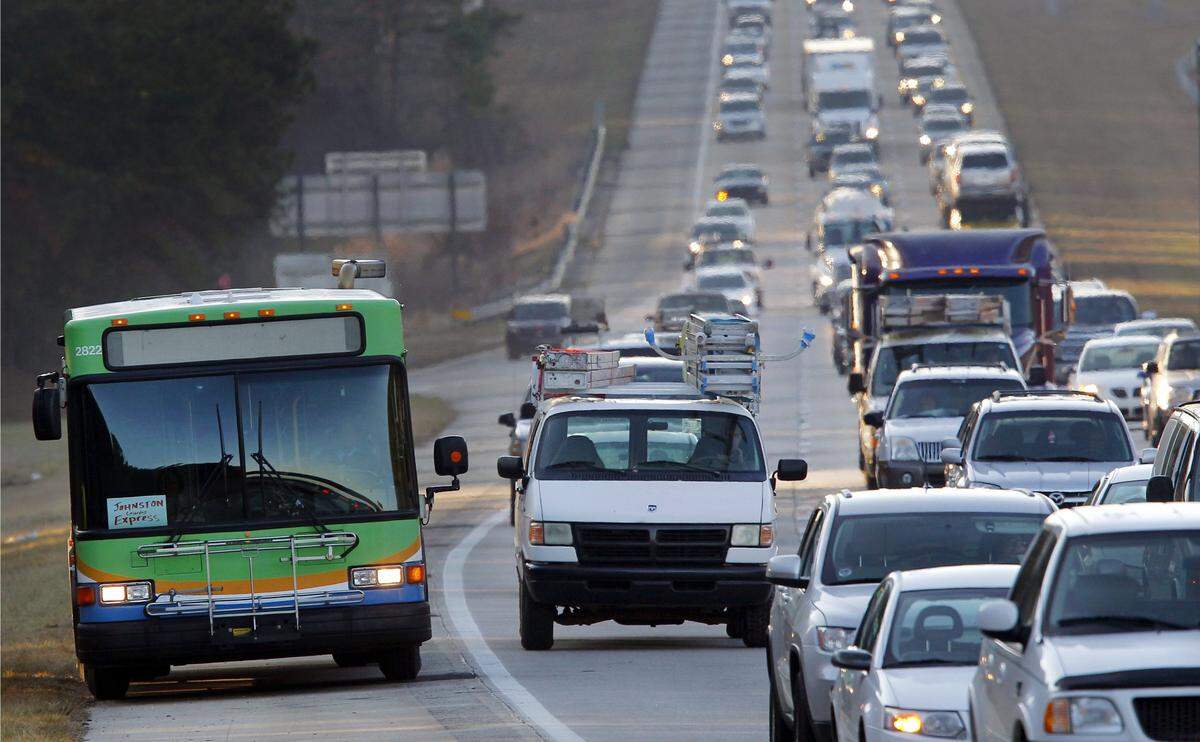
The Johnston County Area Transit System (JCATS) provides Rural General Public transportation to school, work, appointments and more. This service is available for Johnston County residents, and appointments must be made in advance. For more information, visit cssjohnston.org/wwwjcatsorgservices.
Public transportation in Orange County
Orange County Public Transportation has three fixed routes throughout the county: the Hillsborough Circulator, the Orange - Chapel Hill Connector and the Orange - Alamance Connector. The Hillsborough Circulator is fare free. This transit system offers on-demand services, which require reservations. For more information, visit orangecountync.gov/778/Transportation-Services.
Get out of town: Taking Amtrak from the Triangle
For traveling beyond the Triangle, take advantage of train service via Amtrak’s Piedmont and Carolinian trains.
The Piedmont makes three roundtrips a day between Raleigh and Charlotte (the ride from Raleigh to Charlotte takes about three and a half hours), with stops in Cary, Durham, Greensboro and four other cities.
The Carolinian covers the same route but goes beyond Raleigh to Rocky Mount, Richmond, Washington, Baltimore, Philadelphia and New York.
For more information, visit amtrak.com/carolinian-piedmont-train.
Bikeshare and scooter share options
Some Triangle towns offer bikeshare and scooter share options, sometimes known as micro mobility options.
Get in touch with your town to see what’s available and if you’re eligible for any discounts.
This story was originally published March 10, 2022 at 11:15 AM.