Wake County Sheriff and Raleigh Police to accept new community-issued ID cards
A new identification program will be recognized formally by law enforcement in Wake County, after years of advocacy by the Triangle’s Latino immigrant community.
Through collaboration with Latino advocacy nonprofit El Pueblo, the Wake County Sheriff’s Office and Raleigh Police Department announced their acceptance of “Community Action IDs” as identification for individuals who cannot obtain government-issued IDs for various reasons or have difficulty in getting one.
The need for IDs has been among the primary concerns the Latino community has brought up to local government and law enforcement.
Activists say it will facilitate identification for immigrants and noncitizens who otherwise have to use foreign passports or other documents to identify themselves — although the IDs will not serve as substitutes for driver’s licenses or government-issued identification, the Sheriff said.
“This is what we needed. It’s long overdue,” said Wake County Sheriff Gerald Baker in a Raleigh news conference Wednesday. “To allow law enforcement in this county to identify who we’re dealing with out there and keeping things safe ... (to) build that trust through the entire county for this office and letting them know that we are here to serve you.”
In a written statement, Baker said his office’s acceptance of the program stems “primarily on a past history of poor and/or failed communications” with the Latino immigrant community.
“Circumstances that often prohibit these communities from obtaining legal identification has always been an issue and concern for law enforcement,” said Baker.
Previous Wake County Sheriff Donnie Harrison declined to have his office recognize these IDs at the request of advocates and grassroots organizations in 2016, according to Iliana Santillan, executive director of El Pueblo.
Raleigh Police Chief Estella Patterson was not present at the news conference where Baker and activists spoke, but said in a statement that the IDs would “help build a meaningful relationship” with the city’s Latino residents. confirming the police department’s cooperation.
“We understand that many times members of these communities are victimized and are uncomfortable reporting crime for fear of retribution,” said Patterson. “We hope that by working closely with the Faith Action ID program residents will become comfortable with RPD officers and call us to report crime and provide information on who may be committing crimes in their neighborhoods.”
Officers will undergo tutorial sessions on what the FaithAction ID program is and what the Community Action ID cards will look like, Patterson said.
“Much of our community needs a form of identification,” said Griselda Alonso, an activist with Women Organizing Remarkable Opportunities (MOON in its Spanish acronym) a Latina-led grassroots group. “I am one of them because of my (immigration) status.”
How Community Action IDs work
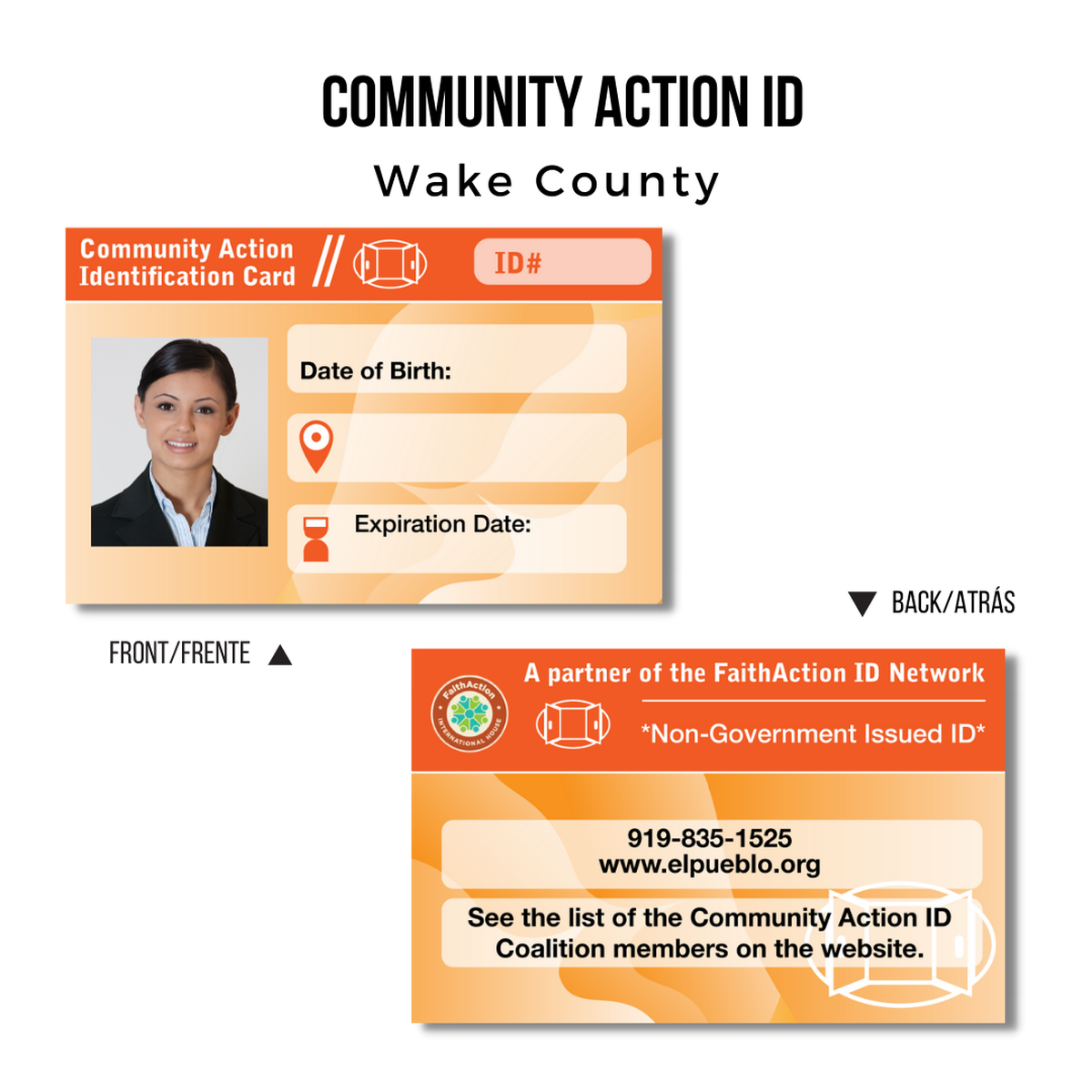
According to a model shown by El Pueblo, the group producing and issuing the cards, the Community Action ID is orange, with a watermark and unique logos. It will include the organization’s contact information and website on the back.
The IDs must be renewed after one year and cost $10. Production of IDs will begin Saturday, Feb. 26 at El Pueblo’s office at 2321 Crabtree Blvd., Suite 105 in Raleigh, the organization said.
The program in Wake County will be part of the FaithAction ID network started by FaithAction International House, a Greensboro-based advocacy group who pioneered the ID program eight years ago and partnered with other localities and jurisdictions for recognition of the ID program.
The program is currently in use in Durham, Orange and Mecklenburg counties, and recognized by local governments in Burlington and Winston-Salem, according to the organization. The over 30,000 ID cards they have issued have also been used by refugees, homeless people and people recently incarcerated, their website says.
This story was originally published February 23, 2022 at 3:04 PM.