
‘It’s not about just Ukraine anymore’: Community comes together for Raleigh supply drive
Natalya Thomasian found out Russia had invaded Ukraine from her sister, who called screaming to say their hometown was being bombed.
Thomasian’s family lives in Henichesk, a town a short distance from the Crimean border that received attention early in the conflict for a Ukrainian soldier who died while detonating a bridge in an effort to slow the invasion.
Over the last week and a half, Thomasian has slept very little, staying up through the night in case her family’s cellphone connection works or they want to talk.
“If you simply talk to them from outside, it makes them feel better because they are very confused and disoriented and scared,” she said.
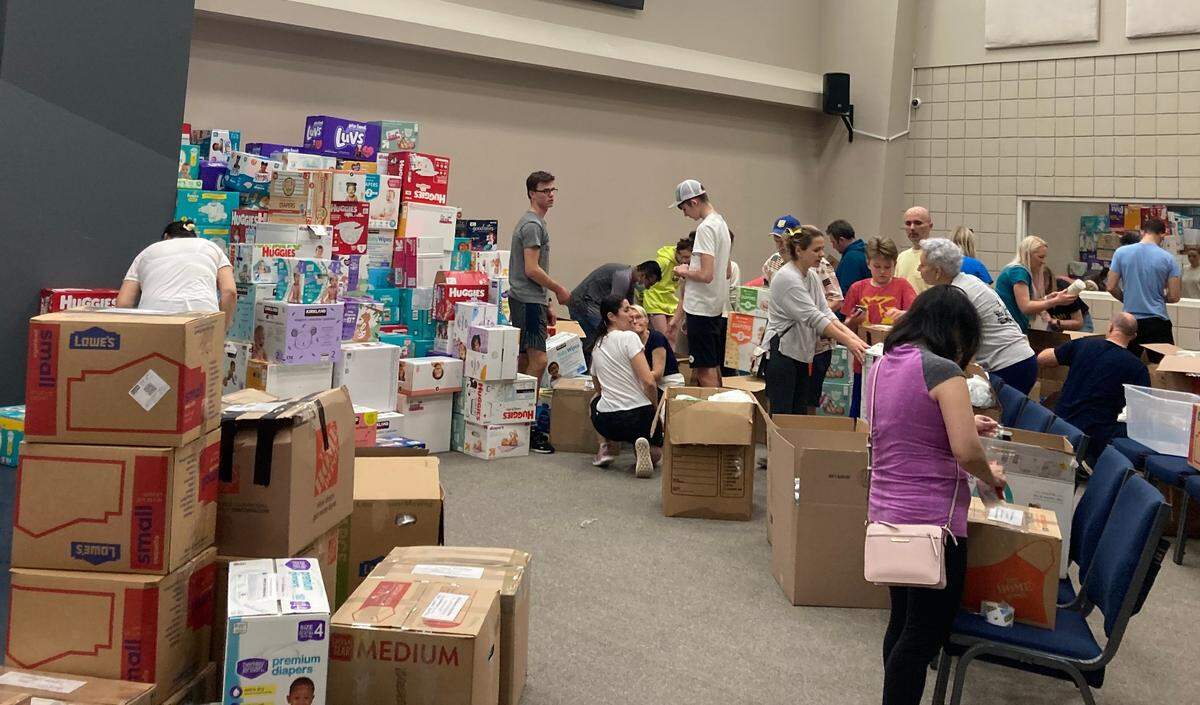
Sunday, Thomasian was one of dozens of people volunteering with the Ukrainians in the Carolinas community group, collecting and sorting donations brought to the North Raleigh Church of Christ and preparing them for shipment to Ukraine.
The list of items the group was gathering stood as a stark reminder of the reality in the increasingly war-torn country. There were medical supplies like tourniquets, quick-clotting gauze and anti-burn bandages. There were supplies for the newly enlisted who find themselves defending the country, items like black beanies, thermal wear and night vision goggles. And there were baby diapers, wipes and formula.
Snippets of Ukrainian broke through the sounds of boxes being tossed and reels of packing tape unraveling. A pile of boxes stood in one corner, sleeping bags in another. A drone peeked out of one box.
“It’s not about just Ukraine anymore,” Olena Kozlova-Pates of Ukrainians in the Carolinas said. “It’s truly about freedom, democracy, human spirit, human dignity, and it’s really about so much more than just Ukraine right now.”
Like others, Kozlova-Pates is keeping up with family members in Ukraine, including her parents and grandmother. A cousin in Mariupol has unsuccessfully tried to escape the city twice.
“After the first five hours, I turned my TV off, and since then I haven’t had time to do anything but basically this,” Kozlova-Pates said, gesturing to the volunteers packing boxes throughout the church. “I think when people come together, it’s almost a psychological relief, like I am with people who believe the same thing I believe, we’re doing something to help.”
Supply drives started with Crimea
Sunday’s donation drive comes a day after hundreds gathered on State Capitol grounds to voice their support for Ukraine. Russia invaded Ukraine on Feb. 24, and the United Nations estimates that more than a million Ukrainians have fled the country since. The UN has confirmed 364 civilian deaths and 759 injuries, but said the total is likely “considerably higher.”
In North Carolina, the volunteer group Ukrainians in the Carolinas has organized supply drives and rallies, calling for a no-fly zone over Ukraine and for Congress to expedite legislation that would allow Ukrainian refugees to enter the U.S. The organization has also raised thousands of dollars in donations at the rallies and at ice skating fundraisers.
Ukrainians in the Carolinas has conducted similar supply drives since 2014, when Russia annexed Crimea and started providing aid to a separatist movement in the Donbas region of eastern Ukraine. A supply drive held by Ukrainians in the Carolinas last week collected two trucks’ worth of goods, which are expected to reach Lviv in the western part of the country on Tuesday.
Many of Ukrainian heritage are communicating with friends and relatives through WhatsApp and other chat services, checking in every day to make sure they’re still alright. Images from the country show apartment complexes and infrastructure that have been bombed.
As soon as she heard about the invasion, Thomasian sent $1,000 to her parents in Henichesk. Worried that either a run on the banks or faltering technology would make it impossible for her family to access money, Thomasian called her mom and told her to grab the money right away.
Thomasian’s mother was only able to retrieve $800 due to limits that were placed on the ATM. When she called Thomasian to tell her that, Thomasian could hear the sounds of explosions in the background, and her mother said she was going to drop to the ground.
Then the connection cut out.
“ I was just — it’s so scary when you don’t know what’s going on,” Thomasian said.
Thomasian’s mother was OK, and Thomasian would later find out the bombs had been falling two blocks away.
Now, the Russian army has occupied Henichesk, and food is running low. Families are allowed to pick up one loaf of bread per day, no more.
The phone networks have gone down for extended periods of time during the invasion, and when Thomasian talked to her mother two days ago, her mother wondered aloud whether it would be the final conversation between them because of the uncertainty.
Thomasian said, “It’s hard to find the words to calm them down and make sure they stay positive.”