
More than 50 years later, DOJ to investigate James Cates Jr.’s murder in Chapel Hill
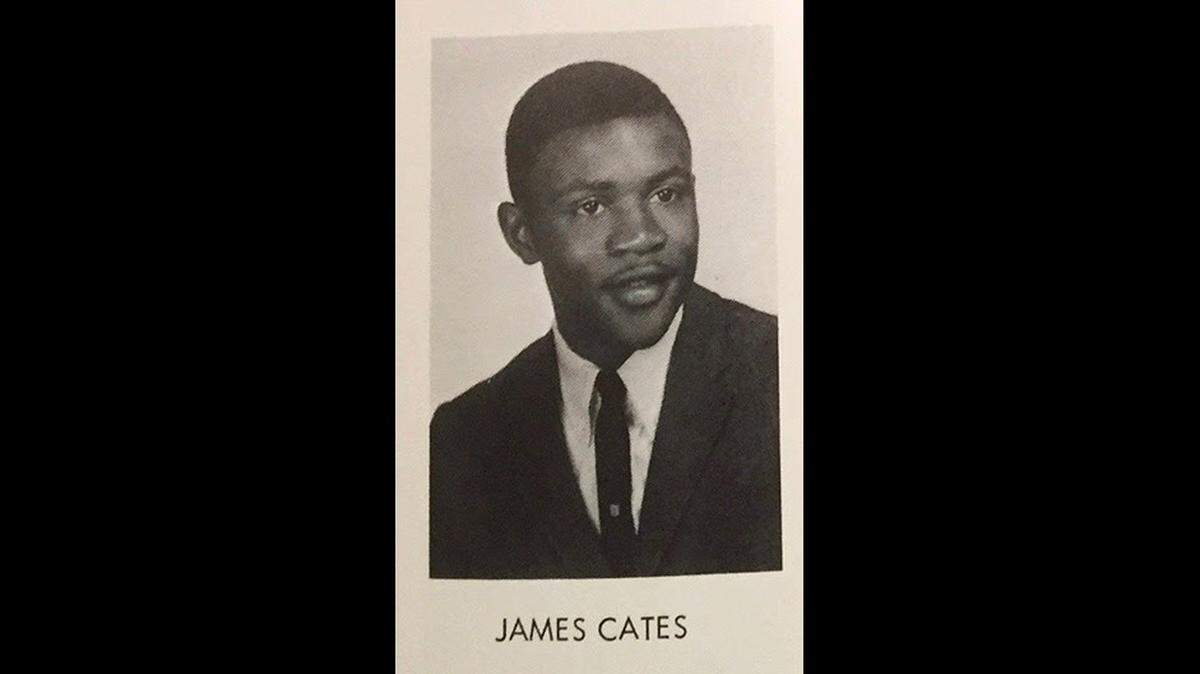
More than 50 years after James Cates Jr. was murdered on UNC-Chapel Hill’s campus, the U.S. Department of Justice will investigate the circumstances that led to his death.
Cates, a 22-year-old Black man, died Nov. 21, 1970, after being stabbed outside an all-night dance marathon at UNC’s Student Union. Three members of the Storm Troopers motorcycle gang were charged with first-degree murder, but they were later acquitted by an all-white Orange County jury.
The investigation was opened under the Emmett Till Unsolved Civil Rights Crime Act, which in 2008 granted the Federal Bureau of Investigations authority to investigate racially-motivated murders committed before 1970. The law was reauthorized in 2016 and expanded to encompass cases that occurred before 1980. (It is separate from the Emmett Till Antilynching Act of 2022 signed this week.)
Cates’ family welcomed news of the federal investigation. They had asked the Department of Justice to investigate in 1970, but never got a response, said Cates’ cousins, Nate Davis and state Sen. Valerie Foushee, in a statement this week.
They gave the statement to North Carolina journalist Mike Ogle, who has spent years researching and reporting on the Cates’ case and produces the Stone Walls newsletter.
“We do not know where this process will lead, but we are glad that it is taking place, even if all these decades later,” Foushee and Davis said in the statement. “We would like to express our deep gratitude to our community, especially those who loved him and have kept his memory alive, and extend our heartfelt thanks to so many who have refused to let the name James Cates fade again.”
‘He will not be forgotten again’
In 2020, the 50th anniversary of Cates’ murder spurred renewed calls for justice and remembrance in Chapel Hill.
Cates, who was affectionately called “Baby Boy” by friends and family, was born in October 1948 and was raised by his grandmother Annie Cates, The News & Observer previously reported. He attended Lincoln High School, an all-Black high school that later integrated with Chapel Hill High School in 1966. While a student there, he wrote for the school newspaper and became a part of student government.
Cates also marched in Chapel Hill against Jim Crow segregation.
In the days following his death and for decades after, local community and family members expressed pain and outrage over the town’s handling of Cates’ murder and the ensuing case.
“That he could’ve been stabbed so close to a world-class medical facility, with law enforcement present, yet not receive life-saving care — it rattled Chapel Hill’s close-knit Black community,” Foushee and Davis wrote in The Assembly last year. “What happened to our cousin wasn’t shocking. But it laid bare for the community the reality of our place in town, despite the hard-fought gains of the 1960s.”
In 1971, The New York Times reported that there were “widespread reports that Mr. Cates might have lived had the ambulance service been faster or had campus police men allowed friends to remove him to the hospital.”
Davis, who was 20 at the time, tried to pick up Cates and carry him to the hospital, but police officers stopped him, he and Foushee wrote in The Assembly. An unclear number of minutes passed before officers relented and took Cates to the hospital, where he died of excessive blood loss.
Reports of how long police waited ranged from 14 to 45 minutes or more, Ogle wrote in 2018, noting that the lower figure was unlikely given the circumstances.
An ER doctor testified that Cates could have lived had he reached the hospital sooner, Ogle added.
In a 2020 statement, Chapel Hill Mayor Pam Hemminger acknowledged the “need for a full accounting of the events that led to the attack on James Cates, his subsequent death, and all that occurred after he died.”
“We seek to learn why this tragedy happened in Chapel Hill, what role the Town of Chapel Hill played in these events, and how we can ensure that it never happens again,” she said.
Hemminger said then that the town would work with the Cates family and UNC to investigate the circumstances of Cates’ murder.
Cases reopened under Till Act
Five other North Carolina cases have been opened under the Till Act and its reauthorization, according to the Department of Justice. All but two, including Cates’ case, have since been closed.
“If he died today in the manner he did in 1970, you’d be hearing ‘James Cates’ on national television, with hashtags on social media and protests in the street,” Foushee and Davis wrote in The Assembly. “But we lost James Cates well before it became common for Black victims’ names to echo in the broader public’s consciousness.”
In their Wednesday statement, Davis and Foushee said Cates “can never be brought back, but perhaps there might finally be some accountability.
“And we know he will not be forgotten again.”
Staff writer Tammy Grubb contributed to this report.
This story was originally published March 30, 2022 at 2:00 PM.