This article, originally published in June 2022, has been updated to reflect the Piedmont’s new schedule starting July 10, 2023.
Traveling to the cities of North Carolina’s mid-section usually means joining the throng of cars and trucks on a six- or eight-lane highway lined with billboards for fast-food restaurants and gas stations. From between the guardrails, one part of the state can look like any other.
But there is an alternative, one more familiar to our ancestors or to tourists and backpackers in Europe or Asia.
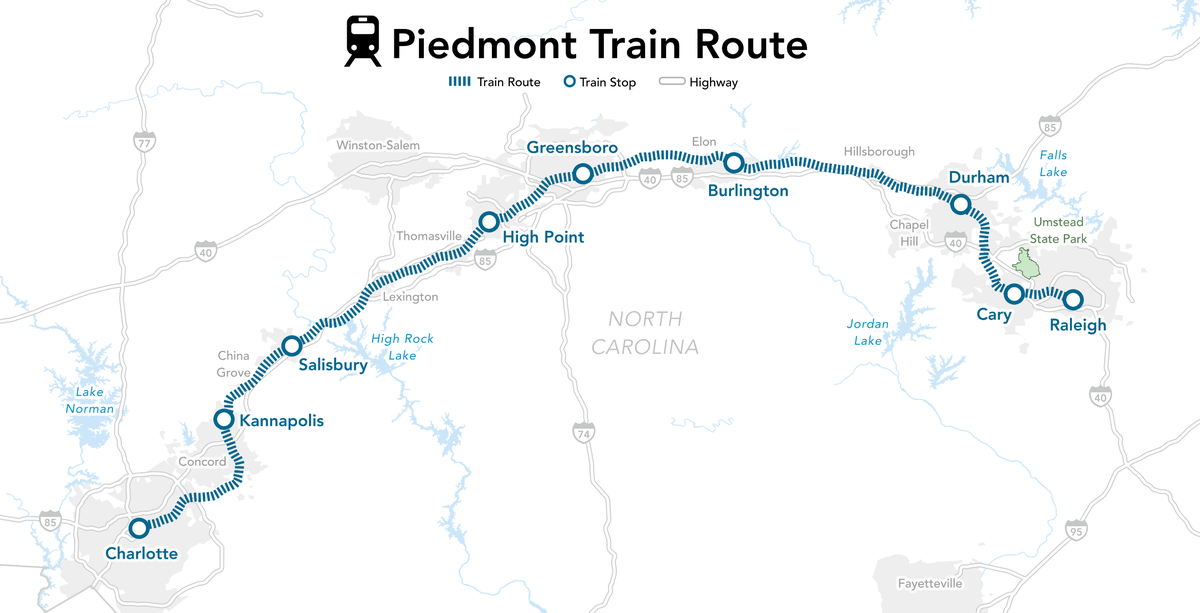
The Piedmont, a train owned by the state of North Carolina and operated by Amtrak, makes three round trips a day between Raleigh and Charlotte, with stops in seven cities and towns in between. The route carves a 173-mile arc across nine counties and, with the notable exception of the state’s largest city, delivers people to historic downtowns with shops, breweries, restaurants, museums and minor league baseball parks (three of them!) within walking distance of the stations.
On the way, the Piedmont carries passengers through main street business districts, old mill towns and countryside that are invisible from interstate highways. From the gently rocking coaches, riders catch glimpses of junkyards and backyards, churches and college campuses and the mills and factories of what was the state’s industrial heartland when textiles, tobacco and furniture powered the economy.
If you’ve never ridden the Piedmont, consider this your introduction to train travel in North Carolina. If you have taken the train, what follows might inspire you to get off in a town you’ve never visited before.
The following guide has information about all nine stops on the Piedmont. The destinations are the same as on the first leg of the Carolinian, another Amtrak train that makes one round trip a day between Charlotte and New York City via Raleigh.
We’ve included some of what you might find within walking distance of each station. We’re considering that to be a half mile, understanding that everyone’s idea of a reasonable walk may differ. We also include a list of hotels near the stations, in case you want to make a night of it, and some places to visit a short taxi or rideshare trip away.
The Piedmont passenger train runs daily between Charlotte and Raleigh, with seven stops along the way. Map by David Newcomb dnewcomb@mcclatchy.com
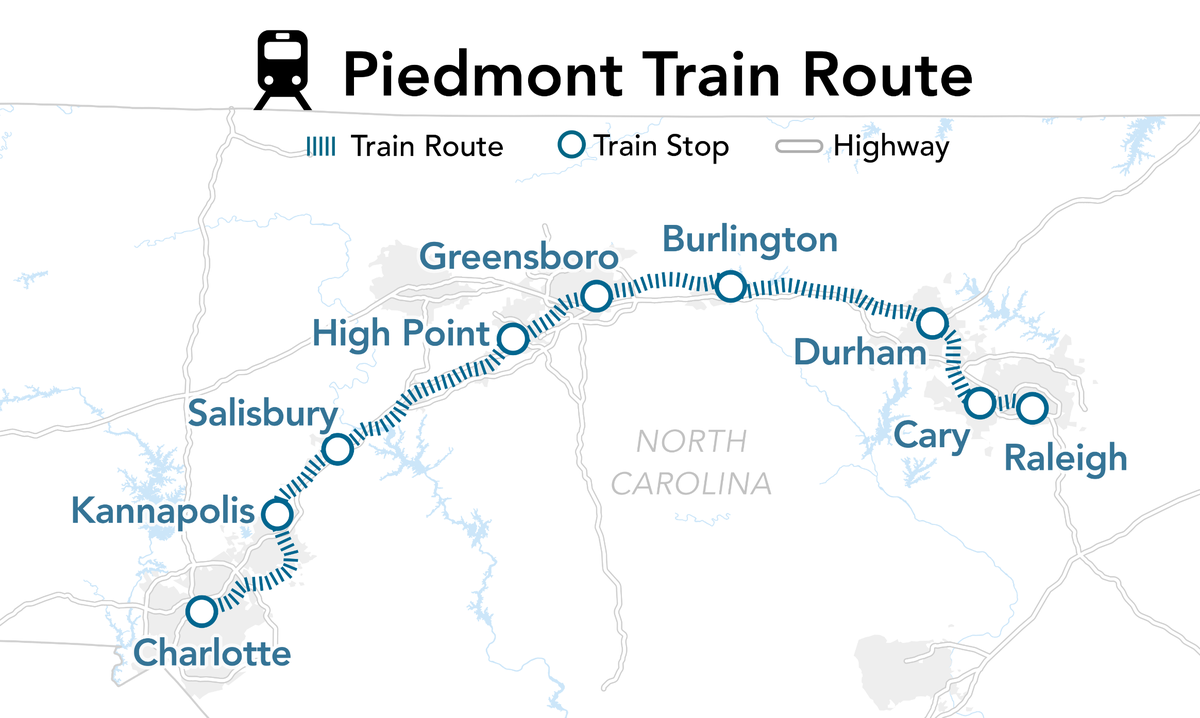
The Piedmont passenger train runs daily between Charlotte and Raleigh, with seven stops along the way. Map by David Newcomb dnewcomb@mcclatchy.com
Where are you headed? Click the links below to jump to:
North Carolina has more passenger rail service than most states outside of the Northeast. Four of Amtrak’s long-distance trains — The Crescent (New York-New Orleans), The Silver Meteor and Silver Star (New York-Miami), and The Palmetto (New York-Savannah) — each pass through twice a day, going north and south, though sometimes late at night or in the wee hours of the morning.
What sets North Carolina apart is the Piedmont. Other states subsidize Amtrak service, but few have been as aggressive in establishing an intercity passenger train that never leaves the state.
The Piedmont made its inaugural run from Raleigh to Charlotte in May 1995. By then, the state-subsidized Carolinian had been making daily round trips between Charlotte and New York for five years, but that meant people could catch a train between the state’s two largest cities only once a day.
The state approached Amtrak about adding another train, but the national railroad balked, saying it didn’t have the equipment. So NCDOT began buying its own engines and coaches, usually decades old, and refurbishing them. The Piedmont was born.
The state also helped local communities upgrade their passenger stations and made track improvements that allowed the trains to go faster. In 1995, at best the Piedmont took three hours and 45 minutes to go between Raleigh and Charlotte. Now it’s three hours and 10 minutes.
More upgrades are coming. NCDOT has received $157 million in federal grants to buy new locomotives and 26 new passenger cars, the first new equipment the state has ever had on the Piedmont. Those cars are expected to arrive by 2026.
Also that year, a new train station is scheduled to open in Uptown Charlotte, bringing rail passengers to the center city for the first time since the early 1960s.
North Carolina’s state-subsidized passenger trains had a record year in 2022. To meet demand, NCDOT will add a fourth round trip on the Piedmont on July 10, 2023, though the new schedule shows not all runs of the Piedmont will stop at all stations between Raleigh and Charlotte. Along with the Carolinian, that means people will be able to catch a train between Raleigh and Charlotte five times a day.
What you need to know about riding the train
For now the southbound Piedmont leaves Raleigh at 6:30 and 10 a.m. and 3:15 p.m., with stops in Cary, Durham, Burlington, Greensboro, High Point, Salisbury, Kannapolis and Charlotte. The northbound Piedmont leaves Charlotte at 10:30 a.m. and 3:15 and 7 p.m., making the same stops in reverse.
Starting July 10, NCDOT will add a 1 p.m. departure of the Piedmont from Raleigh headed south and add another afternoon northbound train leaving Charlotte. The afternoon trains from Charlotte will depart at 2:20, 5:30 and 7:45 p.m., all new times.
The northbound Carolinian leaves Charlotte at 6:30 a.m., making all the same stops, but continues on north through Selma, Wilson and Rocky Mount on its way to the Northeast. The southbound Carolinian is scheduled to depart Raleigh at 5:30 p.m., though after a full day of travel from New York it can run late.
The cost of a ticket varies by distance. One way from Raleigh to Charlotte is $30. Raleigh to Greensboro is $12. You can buy tickets at the stations from either ticket agents (Raleigh, Cary, Durham, Greensboro and Charlotte) or from kiosks (Burlington, High Point, Salisbury and Kannapolis). You can also buy them in advance through Amtrak or on NCDOT’s website, www.ncbytrain.org/, which has more information than Amtrak’s site, including scheduled arrival and departure times.
Each passenger can bring two pieces of luggage; anything more must be checked 45 minutes before departure. There are bike racks in the baggage cars, but space is limited and you need to reserve a spot in advance.
You can arrange to bring a small dog or cat on the train for a fee, but it must remain in a carrier and “be odorless, harmless, not disruptive and require no attention during travel.”
The Piedmont serves free water and coffee in the lounge car, where you’ll also find vending machines with drinks and snacks. You’re also welcome to bring your own food on board, though not alcoholic beverages.
Here’s a brief description of each stop and what you might be find there. You should do some research of your own before you start out, especially in this era of COVID-19 and labor shortages, to make sure the museum, bar or restaurant you want to visit will be open when you get there.
Raleigh
Raleigh
Raleigh was established in 1792 to become North Carolina’s capital city, and for most of its history state government and its appendages were the city’s main preoccupation. That included not only the legislature, governor and state bureaucracy, but also a large psychiatric hospital and prisons and, starting in 1887, the college now known as N.C. State University.
But partly because of NCSU and its graduates and the establishment of Research Triangle Park in 1959, Raleigh and surrounding Wake County became one of the fastest-growing regions in the country, drawing companies and people from all over the world. That’s reflected in the city’s downtown, which has come alive in the past two decades with restaurants, bars and shops catering to visitors and the workers and residents in the new buildings sprouting up.
The train station is on the west side of downtown, in an area known as the Warehouse District for the one- and two-story brick buildings that clustered around the railroad tracks more than a century ago. From here, it’s a five-block walk to Fayetteville Street, the city’s heart.
The station: Raleigh Union Station opened in 2018 with a cavernous waiting room built in the shell of a former steel warehouse. Echoes of the building’s past are found throughout, including the massive steel pillars and ceiling beams and two gantries that used to move steel overhead. The station has the first raised passenger platform in North Carolina, allowing people to walk on or off the train without stairs. To reach the platform from the waiting area, passengers descend a long walkway, lined with rusted steel plates salvaged from the old warehouse, then ascend by escalator or elevator. 510 West Martin St.
Within walking distance: Downtown Raleigh is easy to navigate on foot, but several of the most popular destinations are just beyond the half-mile threshold. These include the Marbles Kids Museum at 301 East Hargett St. on Moore Square and the N.C. Museum of History and N.C. Museum of Natural Sciences, both on Bicentennial Plaza. The plaza runs between the historic 1840 State Capitol building, which is open to the public Monday through Saturday, and the Legislative Building where the General Assembly has met since it opened in the 1960s.
Within a few blocks of the station, you’ll find several restaurants and the Morgan Street Food Hall, with a bar and nearly two dozen eateries. You’ll also find CAM Raleigh, a contemporary art museum; Father & Son, a beloved thrift shop with vintage clothing, furniture and accessories; Videri Chocolate Factory and Crank Arm Brewing. Also within reach is the Glenwood South entertainment district, home to the city’s busiest nightlife and great restaurants worth visiting during the day.
There are way too many places to eat and drink to list here. For more information, go to downtownraleigh.org/.
Hotels within walking distance: Like some of the city’s attractions, some of Raleigh’s growing number of downtown hotels might be considered beyond a comfortable walking distance, depending on your preferences and your luggage. Within five blocks you’ll find:
A short ride away: The State Farmers Market, about two miles from the station, has loads of seasonal fruits and vegetables as well as North Carolina-made foods. Come for breakfast all day at the State Farmers Market Restaurant or lunch of fried fish, shrimp and crab at the N.C. Seafood Restaurant. 1201 Agriculture St.
The N.C. Museum of Art was created by the General Assembly in the 1940s and has a collection that ranges from ancient to contemporary. The museum left downtown in the 1980s for more space five miles west, and its two buildings are surrounded by a 164-acre park with outdoor art and trails. Admission is free, though be aware the main building is closed until the end of October for renovations.
Raleigh has antique carousels at two parks, John Chavis Memorial Park east of downtown and Pullen Park just to the west. Both parks have playgrounds for kids, and Pullen has a small lake with pedal boats in season. Also nearby is the developing Dix Park, gradually taking shape on the former 800-acre campus of the Dorothea Dix psychiatric hospital. For information about Raleigh parks, go to raleighnc.gov/services/parks.
If you bring your bike: Raleigh has an extensive greenway trail system, with connections downtown. For a map, go to raleighnc.gov/find-a-trail.
Cary
Cary
Like many communities along the Piedmont route, Cary owes its existence to the railroad. When the Chatham Railroad branched off the North Carolina Railroad’s main line in the late 1860s, the junction became the center of the town that was incorporated in 1871. The old house that’s now part of the Page-Walker Arts & History Center just north of the tracks was built as a hotel for railroad passengers.
Though it insists on calling itself a town, Cary is now a sprawling suburb of more than 175,000 residents. But the area around the train station still has the feel of the small railroad town it was for much of its history.
The station: Cary’s train station is at the spot where the N.C. Railroad and the former Seaboard Air Line diverged. The town’s old passenger station was torn down in the 1970s, so the state built a small one in 1996, then a decade later added a platform where Amtrak’s Silver Star Florida train could stop. The station was doubled in size in 2011, including a separate waiting room for GoCary and GoTriangle bus riders. 211 West Academy St.
Restaurants include the upscale Southern eatery Scratch Kitchen & Taproom, 160 East Cedar St., the Bosphorus, serving Turkish and Mediterranean food at 329 North Harrison Ave., and Hank’s Downtown Dive at 111 East Chatham St., which despite its name has tuna tartare and a $34 beef tenderloin on its menu.
Save room for ice cream at FRESH, 138 East Chatham St., and see what’s playing on the big screen next door at The Cary Theater.
And to work all that off, walk around Cary Downtown Park (currently under construction but coming soon) or visit the Page-Walker Arts & History Center, which in addition to inside galleries and a local history museum has a garden and outdoor exhibits.
A short ride away: The entrance to William B. Umstead State Park, a 5,600-acre forest in the heart of the Triangle, is less than four miles away. The park is laced with hiking trails. A good place to start is the Company Mill Trail, which winds down to an old mill site on Crabtree Creek.
Five miles the other way is Hemlock Bluffs Nature Preserve, a smaller forest that features trees usually found in much cooler climes.
If you bring your bike: Cary has an extensive greenway system that will take you all over town. Look for the trails that head north to Lake Crabtree County Park, which has off-road cycling trails, or to Umstead State Park, which has an all-purpose trail suitable for bikes. If you’re really feeling ambitious, you can follow greenway trails west to the American Tobacco Trail into Durham or north and east through Umstead to the west side of Raleigh.
Durham
Piedmont Train: Divider - Durham
Durham refers to itself as the City of Medicine, because of the hospitals and health care companies found here. But the city’s prosperity came from processing tobacco and making cigarettes, and signs of that legacy are everywhere.
Durham was founded as a railroad stop in the years before the Civil War and for more than a century thrived as a center of the tobacco industry. It’s known as the Bull City, after the Bull Durham brand of tobacco long made here. Images of bulls and bull-derived names are everywhere; a bronze statue of Major The Bull stands at the center of the city, across from the Bulldega Urban Market.
Today, the city of about 290,000 is known more for being home to Duke and N.C. Central universities as well as a growing number of tech companies attracted to the city’s old industrial buildings and to nearby Research Triangle Park. The former American Tobacco and Liggett & Myers factories and warehouses have been converted into offices, restaurants, condos and other uses, as have other tobacco-related buildings in and around downtown.
The station: Durham passengers arrive through one of the city’s handsome brick tobacco warehouses. The rear of the warehouse, built in 1897, was converted into the Amtrak station in 2009, including a large waiting room with wooden benches under a soaring wood-beamed ceiling. The station is in a cluster of redeveloped tobacco warehouses and manufacturing buildings known as West Village, on the west side of downtown. 601 West Main St.
Explore the city’s business district, where you’ll find shops and galleries and the strip of buildings that once made up Durham’s Black Wall Street. There are also numerous bars and restaurants — more than 75, according to Downtown Durham Inc. — catering to all tastes and price ranges. For more information, go to www.discoverdurham.com or downtowndurham.com/dine/.
Hotels within walking distance:
▪ Marriott City Center, 201 Foster St.
▪ Aloft, 345 Blackwell St. on the American Tobacco Campus.
▪ The 21c Museum Hotel, in a 17-story office tower completed in 1937 at 111 North Corcoran St.
▪ The Durham Hotel, in a mid-century bank building at 315 East Chapel Hill St.
▪ Unscripted Durham, which revived the old Jack Tar Motor Lodge from the early 1960s, at 202 Corcoran St.
A short ride away: Sarah P. Duke Gardens, a 55-acre arboretum of themed and specialized gardens and landscapes, is about two miles west on Duke University’s main campus. The Durham Museum of Life and Science, with indoor and outdoor exhibits, a butterfly house and resident black bears and red wolves, is 2.5 miles north. And the Hayti Heritage Center, which promotes the arts and culture of the city’s African-American community, is a little more than a mile southeast.
Bennett Place State Historic Site, where Confederate Gen. Joseph Johnston surrendered to Gen. William T. Sherman in the closing days of the Civil War, is about six miles northwest. And Duke Homestead State Historic Site, where Washington Duke grew and processed tobacco and where the family’s tobacco empire was born, is about four miles north.
If you bring your bike: The American Tobacco Trail begins just south of Durham Bulls Athletic Park, at the corner of Morehead and Blackwell streets, and heads south into Chatham and Wake counties. The South Ellerbee Creek Trail begins on West Trinity Avenue and heads north, where it connects with a network of trails in North Durham.
Burlington
Burlington
Burlington got its start when the North Carolina Railroad chose to build repair shops for locomotives and rail cars here in 1855. The town that sprang up around the railroad complex was incorporated in 1866 as Company Shops. When the railroad work shifted elsewhere in the 1880s, the town appointed a committee to find a new name and settled on Burlington.
Textiles took the place of the departed railroad jobs, and the city eventually came to call itself the Hosiery Center of the South. In the 1920s a company called Burlington Mills was formed and specialized in rayon and other synthetics. It grew into a global giant called Burlington Industries, now gone after bankruptcy and mergers. The city’s economy has since become more diversified, and its population has continued to grow, approaching 59,000 in 2021.
The station: Company Shops Station opened in 2003 in a former engine repair building that dates to the 1850s. The renovated building includes offices for the city police department and the N.C. Railroad’s Whistlestop exhibit of town and railroad history. From the platform, you can see the historic brick depot that was built in 1892 and used until Southern Railway discontinued passenger service to the city in the early 1960s. The old depot, now used for events, has been moved at least twice over the years. 101 North Main St.
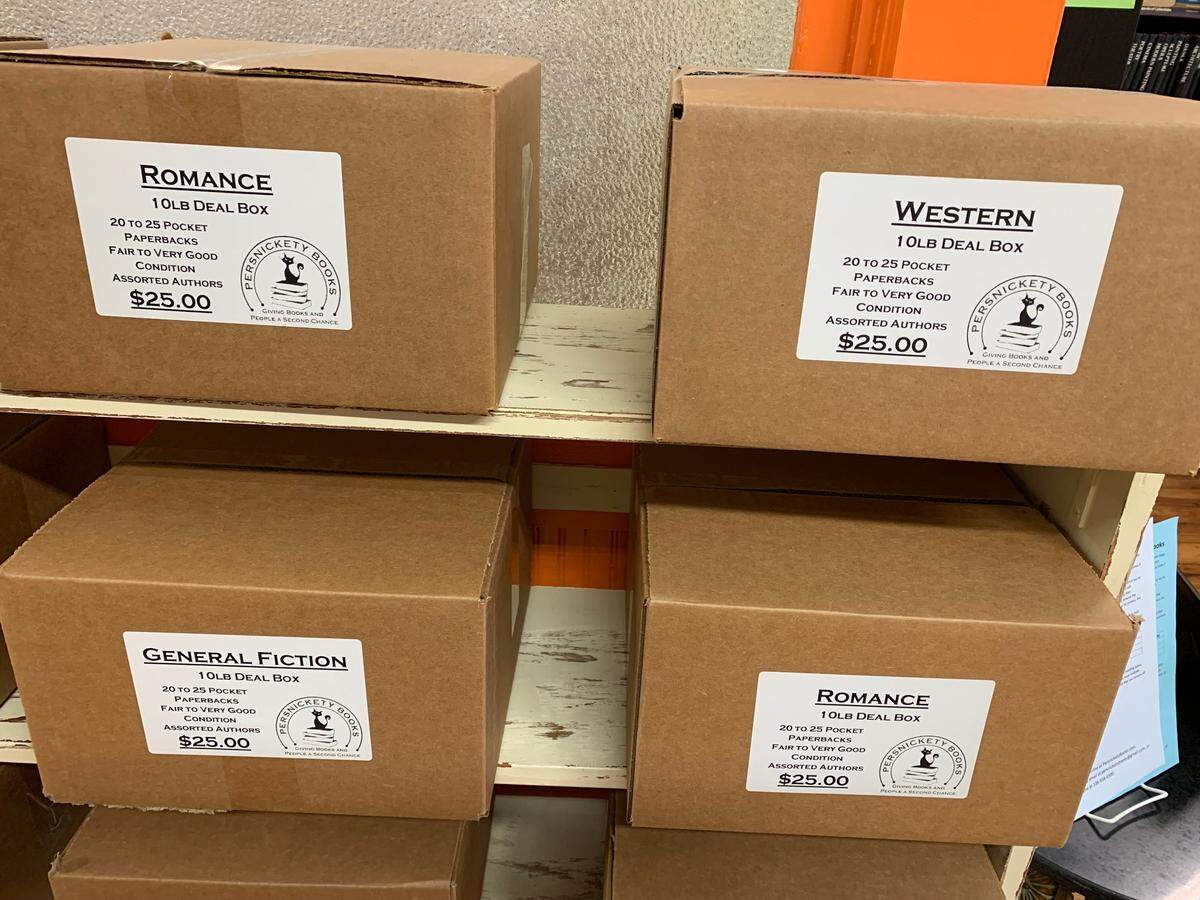
Persnickety Books in Burlington, N.C. offers books by topic for $25 a box. Richard Stradling rstradling@newsobserver.com
Within walking distance: The downtown Burlington historic district is on the National Register of Historic Places, with buildings that went up during its heyday as a railroad and textile center. They include the former Atlantic Bank and Trust Company building, a nine-story art deco tower completed on South Main Street in 1929 and now occupied by Labcorp.
The historic district and surrounding blocks have a small but growing number of businesses that cater to visitors. They include Carolina Sundries, a specialty grocery store that serves breakfast and lunch at 404 South Spring St.; Smitty’s Homemade Ice Cream, which boasts more than 100 flavors at 107 East Front St.; and Burlington Beer Works, serving local brews as well as lunch, dinner and brunch at 103 East Front St. And while its building on West Davis Street may not be historic, Zack’s has been selling Burlington’s best hot dogs since 1928.
A short ride away: Burlington City Park includes an amusement area with boat rides, a train and the Menagerie Carousel, built around 1915 and moved from Ohio to Burlington in 1948. The carousel is being repaired but should reopen late this year. About a mile and a half down South Main Street.
Glencoe Mill Village and the Textile Heritage Museum are about 3.5 miles north of downtown. You can take a self-guided tour of the restored village built around the Glencoe Mill, where textiles were made along the Haw River from 1882 to 1954. The former company store is now a two-room textile museum.
More than 20 miles of Haw River Trail, a hiking trail along the river, are now open, with entry at various points from north of Burlington to Saxapahaw. For information, go to www.thehaw.org/.
If you bring your bike: The Burlington Park-Way consists of three marked routes that radiate from downtown. They also connect with a larger system of Alamance County bike routes. For information and maps, go to www.burlingtonnc.gov/1499/Bike-Routes-and-Maps
Greensboro
Greensboro
Greensboro, the state’s third-largest city with more than 300,000 residents, was founded in 1808 because it was centrally located in the new Guilford County. Greensboro remained a small courthouse town until residents, including a former governor, persuaded the General Assembly to include it on the route of the North Carolina Railroad, which was to connect Goldsboro and Charlotte.
Greensboro became a railroad hub, which helped it attract manufacturers, particularly textile makers. Moses and Caesar Cone made Greensboro home to Cone Mills, which had textile plants across the South and employed thousands locally. Kontoor, the company that makes Lee and Wrangler jeans, is headquartered downtown, but the city is also home to HondaJet and Mack Trucks and soon a factory that makes supersonic jets. Greensboro has two state universities, the historically Black N.C. Agricultural and Technical State University and UNC Greensboro, and is one of three cities, along with Winston-Salem and High Point, that make up the Triad.
The station: The Southern Railway built the station in 1927, with stone ionic columns holding up the canopy over the main doorway. Passengers leaving the main waiting room out to the platforms pass under a mural showing Southern’s network in the 1920s. During rail’s heyday, more than 40 passenger trains a day stopped here, but that had dwindled to two — the north and southbound Southern Crescent between New York and New Orleans — when the station closed in 1979.
The city and NCDOT worked together to reopen the station, first for local and regional buses in 2003, and then to trains in 2005. It was renamed the J. Douglas Galyon Depot in honor of a former member of the City Council and state Board of Transportation. The station has two platforms, one for Crescent passengers and the other for the Carolinian and Piedmont. 236 East Washington St.
Within walking distance: The train station is two blocks from Elm Street, the heart of the city’s downtown business district, where you’ll find a former Kress department store and the Jefferson Standard Life Insurance building, an 18-story terra cotta and granite tower that was the tallest building in the South when it opened in 1923. In between, at 134 South Elm, is the International Civil Rights Center and Museum in the former Woolworth’s store where four Black students from N.C. A&T launched a sit-in movement by sitting at a whites-only lunch counter.
If you see families with kids getting off the train, chances are they’re headed to the Greensboro Children’s Museum at 220 North Church St. You’ll find an older crowd at Blandwood Mansion and Museum, a colonial home transformed into a Tuscan villa in 1846 by John Motley Morehead, that former governor who helped lure the railroad. At 447 West Washington St.
Finally, First National Bank Field, home of the single-A Greensboro Grasshoppers, is about eight-tenths of a mile from the train station at 408 Bellemeade St.
Hotels within walking distance:
▪ Historic Magnolia House, a four-room bed and breakfast at 442 Gorrell St. that was listed in the Green Book, the guide of establishments that would serve Black lodgers during Jim Crow segregation.
▪ And just beyond a half-mile walk are two big chain hotels, the Marriott Greensboro Downtown, 304 North Greene St., and the Hyatt Place Greensboro, 300 North Eugene St.
A short ride away: Greensboro Science Center, a science museum and zoo that opened in 1957, about 5.5 miles north of downtown at 4301 Lawndale Dr.
ACC Hall of Champions, a hall of fame and museum for Atlantic Coast Conference athletics, which is headquartered here for now. 1921 West Gate City Blvd., adjacent to the Greensboro Coliseum, about two miles west of downtown.
Greensboro Arboretum, 17 acres of gardens at 401 Ashland Dr., about 3.5 miles west of downtown.
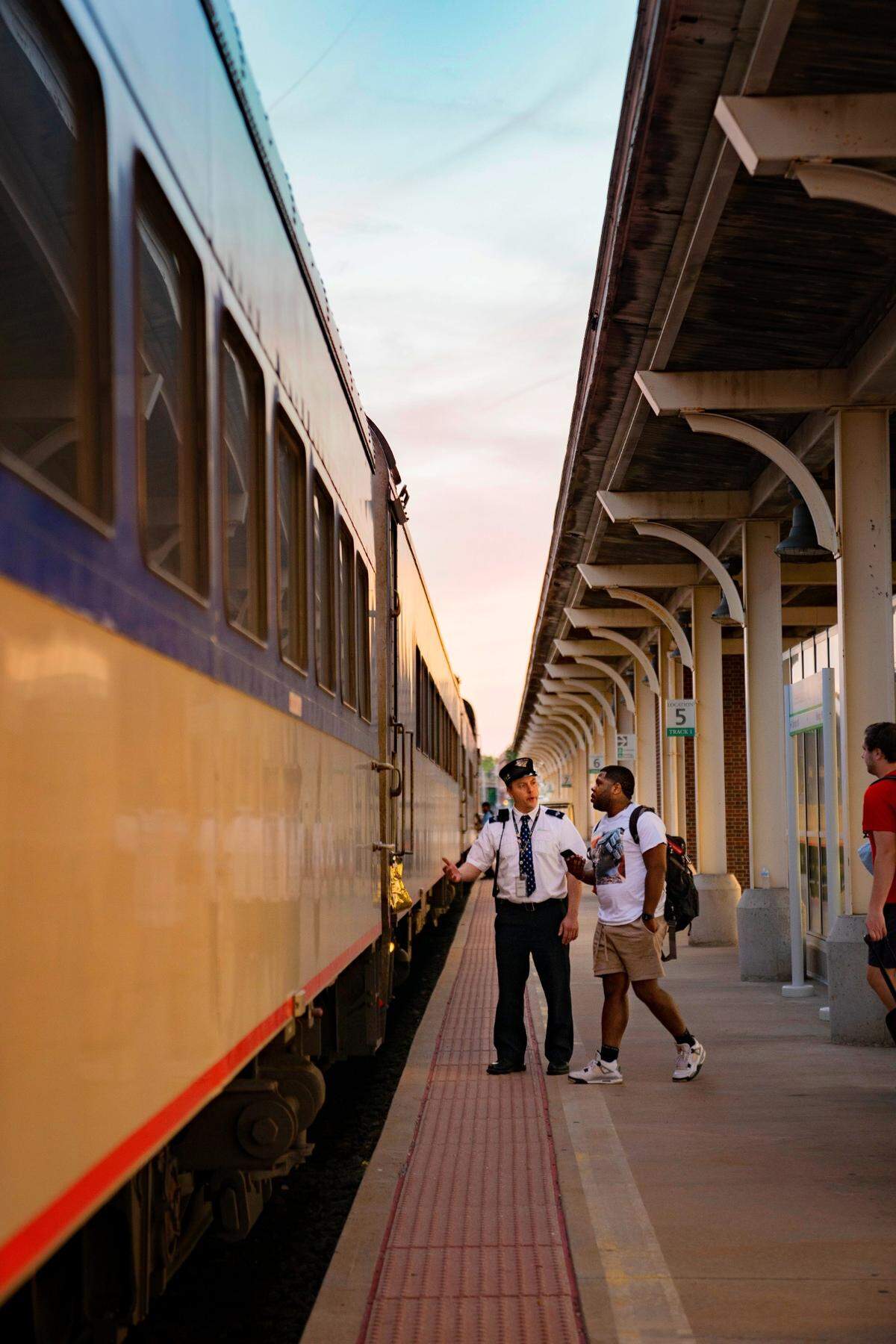
Passengers board the train from Charlotte to Raleigh at the Greensboro station on Sunday, June 5, 2022. Angelina Katsanis akatsanis@newsobserver.com
High Point
High Point
High Point was founded in 1859 at the point where the new North Carolina Railroad crossed the Western Plank Road, a mid-19th century highway. The city was named because it ostensibly sits at the highest elevation (938 feet) along the route of the railroad.
Most people associate High Point with furniture, though most of it is now made overseas. But the city has kept its furniture market, two five-day events held each April and October that draw tens of thousands of retailers, interior designers, journalists and others in the industry to see the latest designs and make deals. First held in 1909, the High Point Market has taken over downtown, with most buildings devoted to showrooms that are locked most of the year and not accessible to the public even when they’re open.
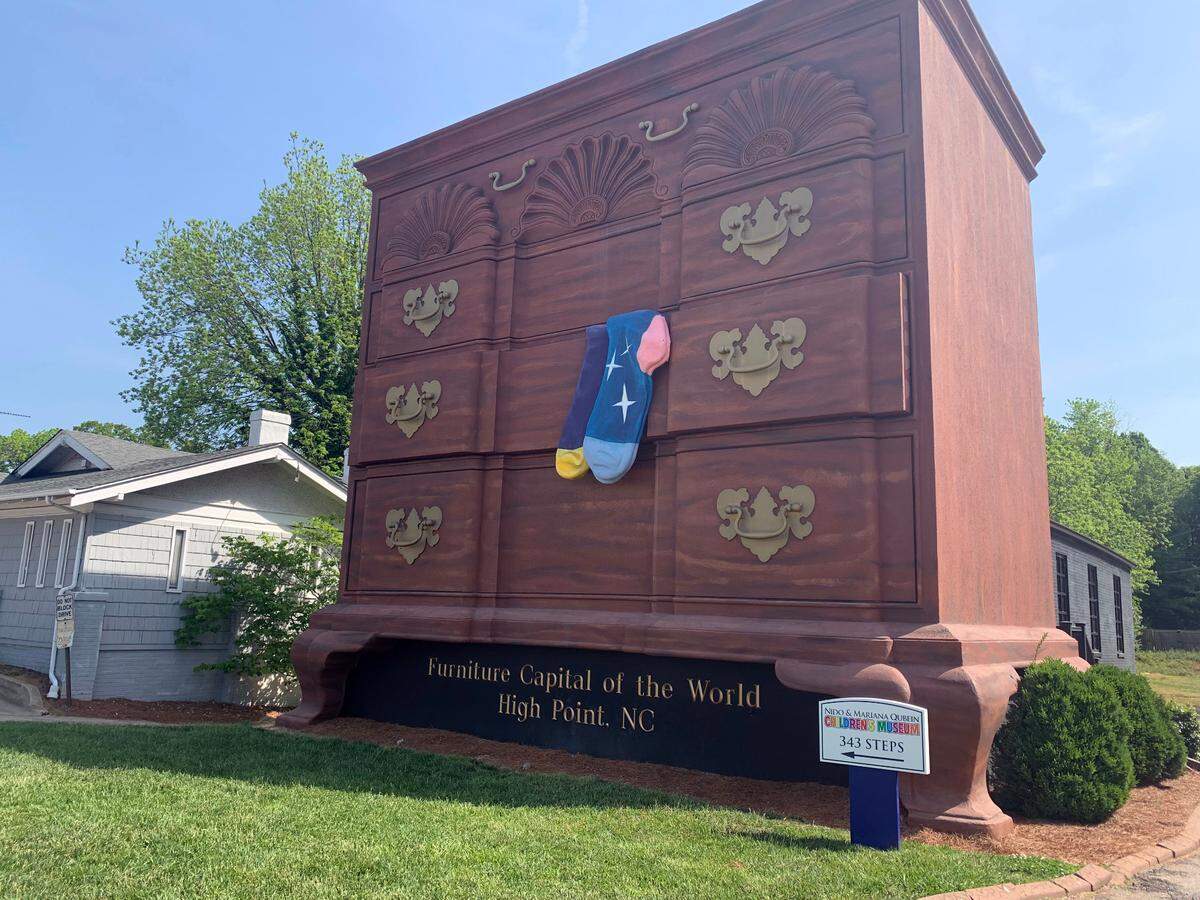
The world’s largest chest of drawers in High Point, N.C., the furniture capitol of the world. Richard Stradling rstradling@newsobserver.com
Right in the middle of this sits the city’s handsome train station, built well before downtown became a giant trade show venue. Visitors who explore on foot will find a few landmarks nearby as well as a nascent effort to create a more year-round center of activity anchored by a minor league ballpark and a hosiery mill-turned-makerspace. There’s also an effort called High Point X Design or HPXD, a community of designers and retailers who are keeping their showrooms open year-round, though sometimes sporadically or by appointment. One of them is Golden Oldies Antiques, which sells all manner of old oddities at 310 West Broad Ave.
The station: Passengers don’t actually see the High Point station from the train. That’s because the tracks pass through a trench dug in the 1930s so trains wouldn’t impede traffic on downtown streets. Disembarking passengers take stairs or an elevator out of the trench to the brick station with a red tile roof that was built at street level in 1907. After being shuttered for several years, the station was fully restored in 2003. 100 West High Ave.
Within walking distance: Since you’re here (and presumably not on one of 10 market days a year), take a walk around the buildings that house the furniture showrooms. Few downtowns in America are as devoted to a single purpose as this one.
A few landmarks you might look for include the eight-foot bronze statue of jazz saxophonist John Coltrane, who grew up here, and the historic marker and plaque marking the spot where, inspired by the lunch counter sit-in up the road in Greensboro, Black high school students began their own sit-in at a whites-only Woolworth’s lunch counter in February 1960. The store, on South Wrenn Street, was replaced by a large hotel that’s now closed.
The Coltrane statue is across the street from the High Point Theatre and the Theatre Art Galleries, which has rotating exhibits.
Into kitsch? Check out the World’s Largest Chest of Drawers, on North Hamilton Street. On the way, in addition to numerous locked furniture stores, you’ll pass a local brewery, Paddled South Brewing Co., and The Dog House, where locals have been getting lunch (only open 11 a.m. to 2:30 p.m.) since 1942. Both are on North Main.
The city’s attempt to draw people downtown is centered on Truist Point, the 4,500-seat home of the High Point Rockers of the independent Atlantic League at 301 N. Elm St. The stadium is part of the Social District, a designated area where people can buy alcohol in a special cup and move from place to place. That includes Plank Street Tavern and Stock & Grain Assembly, “The Triad’s First Food Hall” opening soon outside the center field gate at Truist Point.
Hotels within walking distance: The downtown hotel that for years served as a hub during the furniture market has closed. It was variously a Radisson, a Best Western and, most recently, the Red Lion. There is talk of reviving the hotel, but for now the building stands empty. (The Woolworth’s historic marker is on the back side.)
Founded in 1753, Salisbury is the oldest of the Piedmont stops, and the city preserves and celebrates its history more than any other. Salisbury has five local historic districts and 10 districts on the National Register of Historic Places, and dozens of historic homes and buildings from the 19th and early 20th century. Many are within walking distance of the train station, and the city and Rowan County have developed themed walking tours to help visitors explore.
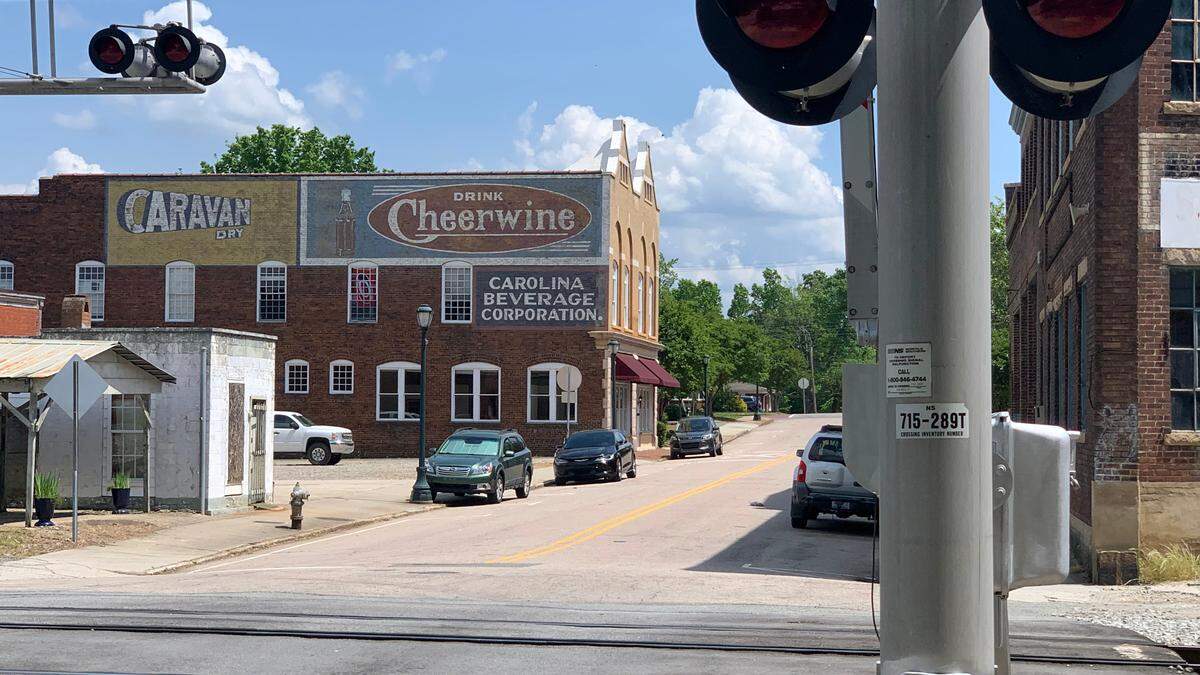
Some may know Salisbury as the home of Food Lion and Cheerwine, though the headquarters of both companies are in business parks at the edge of town. The former Carolina Bottling Corp. building, where Cheerwine was made for decades, is just across the tracks from the station and now houses offices and condos. The city celebrates its local drink with the annual Cheerwine Festival each spring.
The former Carolina Bottling Corp. building, where Cheerwine was made for decades, is just across the railroad tracks from the Amtrak station in downtown Salisbury, North Carolina. Richard Stradling rstradling@newsobserver.com
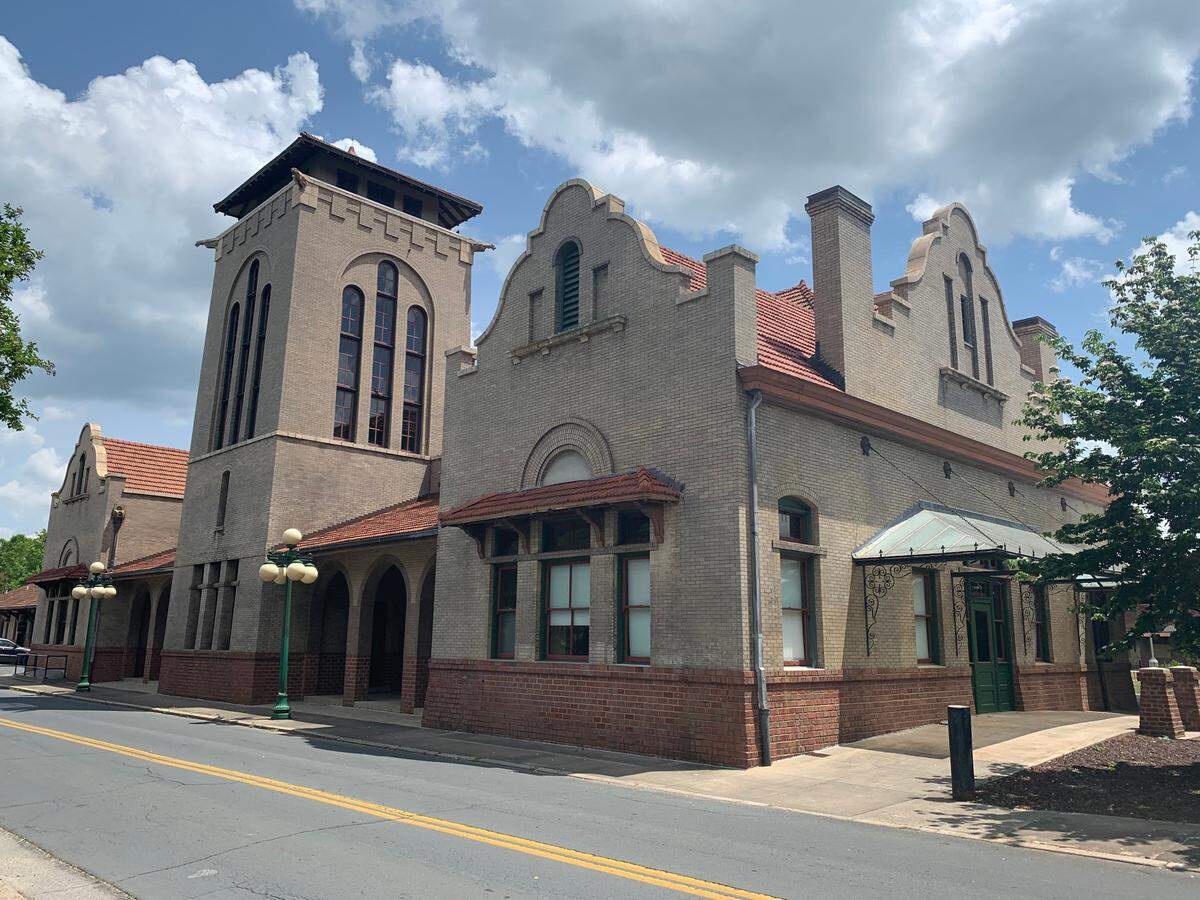
The station: The Southern Railway opened its new Salisbury depot in 1908. The company hired prominent Southern architect Frank P. Milburn, and he chose the Spanish mission style, with tan bricks, a red tile roof and gargoyles peering down from the corners of the main tower. After passenger service ended here in 1979, the building sat empty for years before the Historic Salisbury Foundation bought it and began a series of renovations. The grand waiting room is now an event space, and much of the rest of the station is used for offices. The Amtrak office and a small waiting room are in a corner of the building. 215 Depot St.
The train station in downtown Salisbury, N.C., opened in 1908. Richard Stradling rstradling@newsobserver.com
Within walking distance: The train station is two blocks from the Rowan County Visitors Center, where you can pick up a guide for the Salisbury Heritage Walking Tour (there isn’t one online yet), featuring 142 homes and other buildings in and around downtown. While you’re there, ask for a guide for the African-American Heritage Trail, which includes directions to several sites downtown and information about the county’s African-American history. And get a map for the Salisbury History and Art Trail, which features sculptures, murals and other works around downtown that commemorate events in the city’s history.
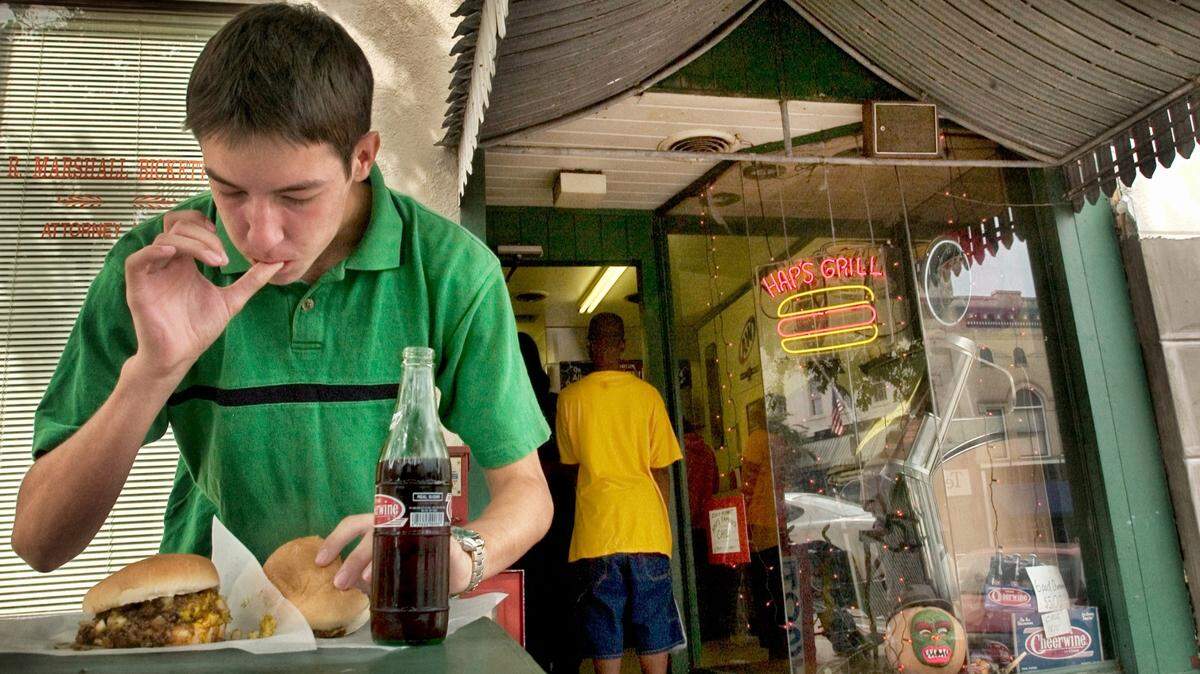
If you’re looking to try a Cheerwine, try Hap’s Grill on Main Street, where the menu consists of hot dogs, hamburgers and more than a half dozen sodas, including three flavors of Nehi.
Hamburgers and hot dogs with chilli and onions from Hap’s Grill on Main Street in Salisbury, N.C. has been a tradition and pilgrimage for many for decades. Scott Sharpe ssharpe@newsobserver.com
There are two museums near the station. The Waterworks Visual Arts Center has five galleries with changing exhibits, and the Rowan Museum of local history housed in the 1850s county courthouse.
If you’re looking for a place to sit for a while, try Bell Tower Green, a public park with seating areas, a water wall and a playground, watched over by the 1891 brick bell tower of First Presbyterian Church.
And for a piece of history that Salisbury is not so proud of, you can walk past the home at 224 E. Bank St., the only surviving structure of the Confederate Civil War prison, where thousands of Union soldiers died of disease and malnutrition during the war. The house is not open to the public, but there’s a marker out front.
A short ride away: In nearby Spencer, the North Carolina Transportation Museum is both a historic site and a museum dedicated to all modes of getting around. It is housed in Spencer Shops, where Southern Railway maintained and repaired locomotives in the age of steam, about three miles from downtown Salisbury.
Salisbury National Cemetery began as a Confederate cemetery for Union soldiers who died at the nearby prison camp and were often buried in unmarked graves or trenches. The cemetery grew over the decades, as veterans of other wars and their families were buried here. 202 Government Road, about a mile from the station.
If you bring your bike: Rowan County has identified 226 miles of “more lightly traveled roads favored by cyclists” that link cities, towns and other points of interest. For information, go to www.visitrowancountync.com/listing/bicycling-rowan-county/147/.
Kannapolis
Kannapolis
Kannapolis was the quintessential company town. Towel City, as it came to be known, was created and for most of its history owned by Cannon Mills, the company James W. Cannon started here in the early 1900s. Cannon Mills built homes, streets, schools, a hospital and YMCA and, in the 1930s, a downtown, with stores and a movie theater for its workers. The company became the world’s largest manufacturer of towels and linens and controlled the town until 1984, when residents voted to incorporate as a city.
After two mergers and staggered by overseas competition, the company declared bankruptcy and then shuttered the old Cannon Mills factory in 2003, resulting in the loss of more than 4,000 jobs.
The next year, billionaire David Murdock, who had owned Cannon Mills for a while in the early 1980s, bought the complex at auction with the idea of establishing the N.C. Research Campus, where university and private-sector scientists could work on nutrition, food and agriculture. The old factory complex was demolished in 2006, and Murdock began building several large brick research buildings, now surrounded by vast lawns like a college campus that’s not finished.
The city retains its blue-collar feel but is fast being discovered by commuters from the Charlotte area.
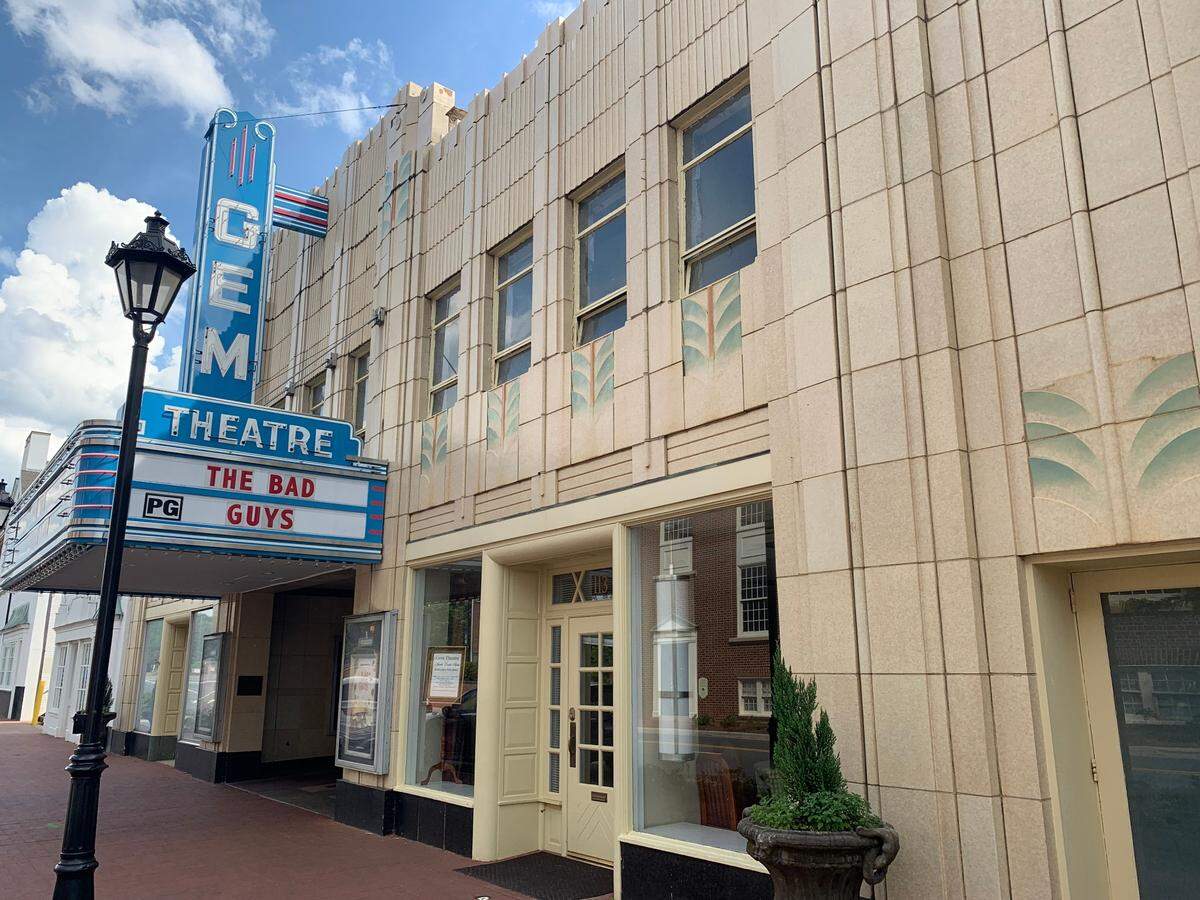
The Gem Theatre in downtown Kannapolis, N.C. was built in 1948. Richard Stradling rstradling@newsobserver.com
The station: Kannapolis Station was completed in 2004 and received a new canopy to cover passengers in 2013. The station is about a half-mile down the tracks from the building it replaced, which Cannon Mills had built in 1939. It was torn down in 2020. 201 South Main St.
Within walking distance: The station is on the edge of the downtown that Cannon Mills built, a collection of Colonial Revival-style buildings inspired by Colonial Williamsburg. A notable exception is the art deco Gem Theatre, which opened in 1936 and reopened in 1948 after being gutted by fire. The building’s terra cotta facade and neon marquee survived the fire, and the single-screen theater, which seats 900 people, has been in business ever since.
Across from the station is Dale Earnhardt Plaza, a memorial to the NASCAR racing legend who was born and raised here. A nine-foot-tall bronze statue of Earnhardt stands surrounded by bricks and bench markers paid for by fans (“He was the man. The McCarthys. Haverhill, Mass.” reads one). It’s said the statue faces the part of town where Earnhardt grew up and toward Idiot Circle, the spot where West Avenue meets Vance Street where legend has it he perfected left turns as a teenager.
Downtown Kannapolis was dead in 2015 when the city bought it from Murdock and set out to rescue it. The city developed a master plan, began selling properties to developers and created a pedestrian plaza along West Avenue, where music emanates from the landscaping. The street is lined with shops and restaurants, a coffee shop, ice cream parlor, a cidery, a brewery and a four-lane bowling alley.
Across West Avenue is Atrium Health Ballpark, home of the Kannapolis Cannon Ballers, a single A baseball team affiliated with the Chicago White Sox. The Ballers play against 11 other teams in the Carolina League, including the Carolina Mudcats and Myrtle Beach Pelicans.
A little more than a half mile from the train station is the museum of the N.C. Music Hall of Fame, with exhibits, artifacts and recordings from the state’s most influential musicians. The hall of fame will induct five new members this fall, including jazz singer Nnenna Freelon of Durham and singer and songwriter Stephanie Mills of Charlotte.
The hall of fame shares space with the Curb Museum for Music and Motorsports, which features race cars and other exhibits collected by country music executive Mike Curb.
Hotels within walking distance: The Mill Inn, a six-room boutique hotel, across Dale Earnhardt Plaza from the train station, at 120 Cannon Baller Way.
A short ride away: Village Park is about a mile from the station and features the only double-decker carousel in North Carolina, a train ride, splash pool and a large amphitheater that hosts concerts and movies in the summer.
If you bring your bike: The Bakers Creek Greenway begins at Village Park and connects with the 8th Street Greenway for a two-mile loop through local parks.
Charlotte
Charlotte
The skyline of North Carolina’s largest city suggests the Emerald City of Oz from a distance, with the 60-story Bank of America building shouldering above the glass and steel towers. Unfortunately, that’s the view you get when you step off the Piedmont, which comes about a mile and a half short of actually reaching the center of the city. The station’s neighbors include a junkyard, a recycling company and a local TV station, WSOC, but nothing you’d really want to walk to.
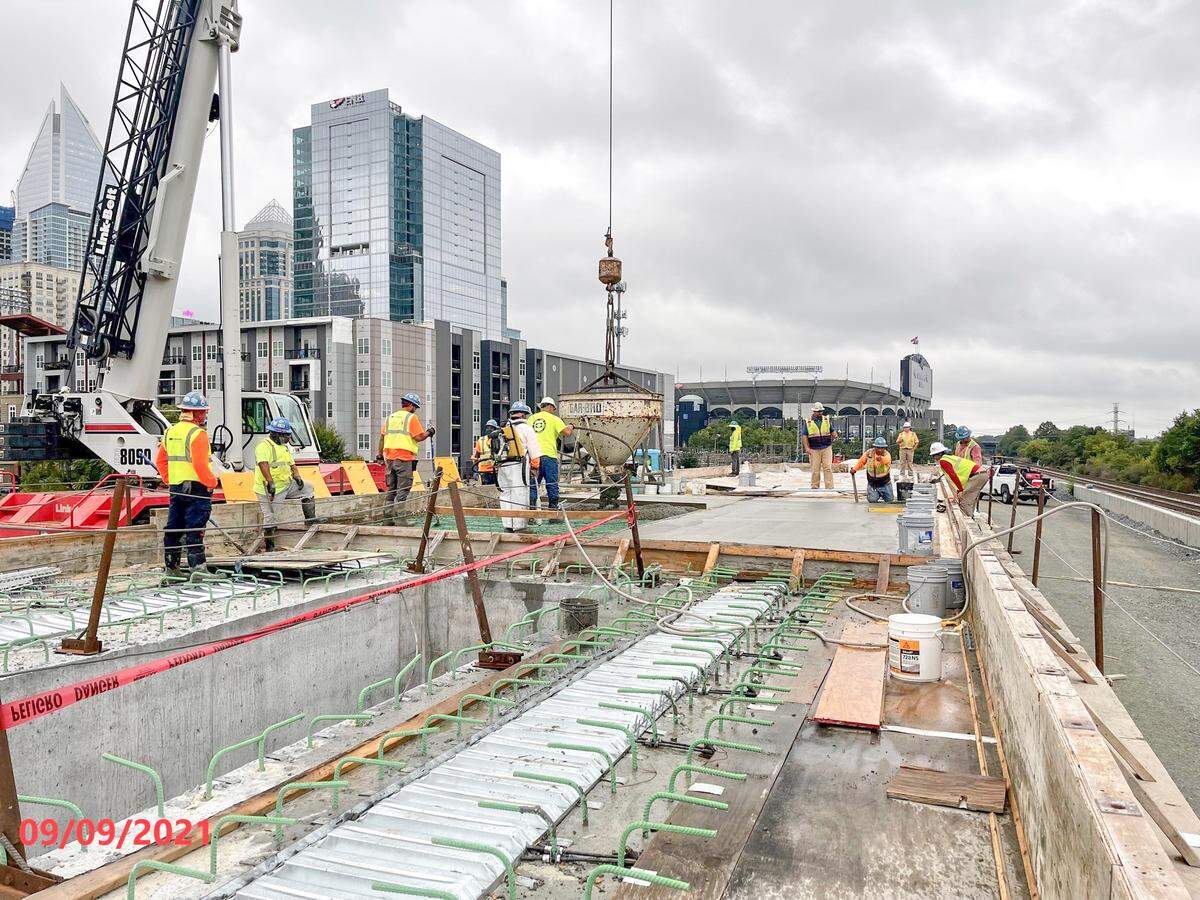
That’s expected to change in 2025, when intercity passenger trains return to Uptown Charlotte (“uptown” being the word Charlotte uses for downtown). A new Charlotte Gateway Station will open on North Trade Street, five blocks from the base of the Bank of America building. The multi-modal station will also be a hub for city buses and include a stop on the CityLYNX Gold Line street car and maybe the future LYNX Red Line commuter train.
The station: The Southern Railway built the station in 1962 at the edge of its freight yard. It replaced a larger Southern depot that opened in 1906 on West Trade Street, a few blocks from the heart of the city. The new Charlotte Gateway Station will be in about the same spot as that old station. 1914 North Tryon St.
Within walking distance: Not much. But Uptown Charlotte is a short ride away (see below).
Hotels within walking distance: None. But check back in 2025, when the new station opens in uptown, where there are now about 15 hotels.
A short ride away: Uptown Charlotte is a short cab ride or rideshare away. If you’re on a budget, a city bus stops across the street and will take you down Tryon Street into town. Uptown Charlotte is full of bars and restaurants and the city’s main attractions: The Discovery Place Science museum, the Levine Museum of the New South, Romare Bearden Park, the Bechtler Museum of Modern Art, the Blumenthal Performing Arts Center, Old Settlers Cemetery, the NASCAR Hall of Fame, the Harvey B. Gantt Center for African-American Arts and Culture, The Mint Museum and the three big sports venues, Bank of America Stadium (Panthers), Truist Field (Knights) and Spectrum Center (Hornets). If you’re looking for things to do in Charlotte, go to www.charlottesgotalot.com/ or uptowncharlotte.com/.
If you bring your bike: Charlotte has an evolving and growing network of greenway trails and bikeways. Recent improvements include new sidewalks and bike lanes along North Tryon Street in front of the Amtrak station that make it easier to get to uptown. Nearby bike routes include the Little Sugar Creek Greenway, The Rail Trail, which runs parallel to Charlotte’s LYNX Blue Line light rail line, and the Irwin Creek Greenway. For more information, go to charlottenc.gov/Transportation/Programs/Pages/Bicycle.aspx.
Construction on the first phase of the Charlotte Gateway Station in uptown. The station is scheduled to open to Amtrak passengers in 2025. NCDOT
This story was originally published June 19, 2022 at 2:00 AM.
Richard Stradling covers transportation for The News & Observer. Planes, trains and automobiles, plus ferries, bicycles, scooters and just plain walking. He’s been a reporter or editor for 38 years, including the last 26 at The N&O. 919-829-4739, rstradling@newsobserver.com.