Invasive spotted lanternfly confirmed in NC. How to report sightings this summer
One of two invasive pests that forestry officials have asked citizens to be on the lookout for has been confirmed in North Carolina.
An established population of spotted lanternflies has been detected in North Carolina for the first time, says the N.C. Department of Agriculture. The population extends for a 5-mile radius in Forsyth County, extending to the Guilford County line.
Officials are still asking the public to be on the lookout for both the spotted lanternfly and the Asian longhorned beetle while spending time at the swimming pool or around other bodies of water this summer. The insects, which potentially pose long-term risks to our natural environment, have both been deemed “poolside pests” by N.C. State University Extension, the N.C. Department of Agriculture’s Plant Industry Division and the N.C. Forest Service because they’re attracted to water.
“It’s just a unique biological thing that both of these happen to be attracted to water,” Kelly Oten, an assistant professor and forest health specialist at N.C. State, told The News & Observer.
That makes pools and pool filters — and dog water bowls and other water sources — a likely place to spot them, though they could be found anywhere, Oten told The N&O. That means if you have a pool — or even if you don’t — you should keep an eye out for the pests this summer, and report any possible sightings.
There is not currently an established population of Asian longhorned beetles in the state, but early detection of both pests is key to preventing the negative impacts they bring to trees and other vegetation.
The N&O talked with Oten to learn more about the invasive poolside pests, the risks they pose and how you can report sightings.
Here’s what we learned.
What is the Asian longhorned beetle?
The Asian longhorned beetle is an invasive pest that is non-native to the United States.
▪ It is native to Asia — specifically, China and the Korean Peninsula, according to the USDA.
▪ It was first discovered in the United States in 1996, when it was identified in New York. Since then, populations have been identified in Massachusetts, Ohio and South Carolina.
▪ It is a wood-boring beetle, meaning its larvae bore into the wood of trees to feed. They are specifically attracted to hardwood trees, especially maple trees — which Oten said are the second-most populous trees in North Carolina’s forest landscape.
What risks do the Asian longhorned beetle pose?
As a wood-boring beetle, Asian longhorned beetles bore into hardwood trees, creating galleries — or tunnels — through the wood to feed on the phloem and xylem, which are responsible for transporting nutrients throughout the trees.
▪ The galleries created by the Asian longhorned beetle disrupt the proper flow of nutrients in the tree, depriving the tree of what it needs to survive and eventually killing it.
▪ The beetle’s galleries, creating the lack of nutrients for the tree, also weaken and compromise the structural integrity of the tree, which can make them susceptible to breaking bark and branches.
That’s a specific concern in the southeastern part of the U.S., including North Carolina, where strong storms and hurricanes can further damage the trees and cause large parts of the trees to fall off, potentially creating a safety risk.
“They make huge galleries all through the wood,” Oten said. “And then what happens is the tree essentially falls apart.”
▪ Asian longhorned beetles pose a big risk to hardwood trees, especially because the treatment of an infestation of the pest is to fully eradicate the pests — which involves removing all infected trees. That potentially means at least a temporary loss of many hardwood trees, which as maple trees, in our natural environment.
“When a new infested area is found, the whole plan is to get rid of them entirely,” Oten said. “And unfortunately, that means removing every single host tree.”
What is the spotted lanternfly?
The spotted lanternfly is an invasive pest that is non-native to the United States.
▪ It is native to China, India and Vietnam, and was introduced to Korea in 2004.
▪ It was first found in the U.S. in eastern Pennsylvania in 2014 and has since been spotted in New Jersey, Virginia, Delaware, West Virginia, Maryland, Connecticut, New York, Ohio, Indiana, Massachusetts and now, North Carolina. An established population of spotted lanternflies with a 5-mile radius was detected in Kernersville in June..
▪ It is a planthopper. Planthoppers are a group of insects that generally bear some resemblance to leaves or other plants. They generally “hop” for quick transportation.
▪ It is a sucking insect. This means the insect has mouthparts intended for piercing and sucking, which they use to feed on nutrients from the plant. This weakens the plant, reducing photosynthesis and making plants more susceptible to other stressors. Note: Spotted lanternflies are not known to bite or sting at any life stage.
▪ Spotted lanternflies can attack and prey on a wide variety of hosts, including about 70 species of woody plants. They have a strong preference for tree-of-heaven plants.
What risks do the spotted lanternfly pose?
The spotted lanternfly is a pest in three main ways:
▪ Agriculturally. Spotted lanternflies pose a risk to agricultural crops, including grapevine, fruit trees and hops. In grapevines, a spotted lanternfly infestation can reduce crop yield by as much as 90%, and the quality of the remaining grape crop will likely be much worse, too.
▪ Targeting ornamental plants. In addition to targeting agricultural crops, the spotted lanternfly can target ornamental plants — those you use for decorative or landscaping purposes. These include tree-of-heaven, sycamore, American beech, dogwood, oak and maple trees.
▪ As a nuisance pest. Spotted lanternflies tend to congregate in large groups, often by the landscape plants of businesses or homes. Oten previously told The N&O that the pests have been known to cluster on the main door of restaurants, forcing establishments to only use side doors for days at a time.
The insects might also affect tourism, especially at vineyards — if grapevines are infested with spotted lanternflies, they could become less desirable visually, and the taste of grapes could be affected as well.
Because spotted lanternflies consume so many nutrients from trees and plants, they are also known to excrete large amounts of honeydew, a sticky, sugar-rich liquid. This may cause sooty mold to grow at the base of plants, which can prevent photosynthesis and be aesthetically displeasing.
Spotted lanternfly feeding sites may also ooze plant sap and be accompanied by a fermented smell, which can attract other insects, including yellow jackets, bees, ants and flies.
“Everyone’s going to know and loathe the spotted lanternfly if it becomes established in North Carolina,” Oten previously told The N&O.
What would the pests look like if you saw them this summer?
The appearance of each pest varies by the stages of their life cycle, which correspond with different times of the year.
If you were to see the Asian longhorned beetle during the warm, summer months — when you’re most likely to be at the pool or around other water and possibly spot the pests — the pest would most likely be in its adult life stage.
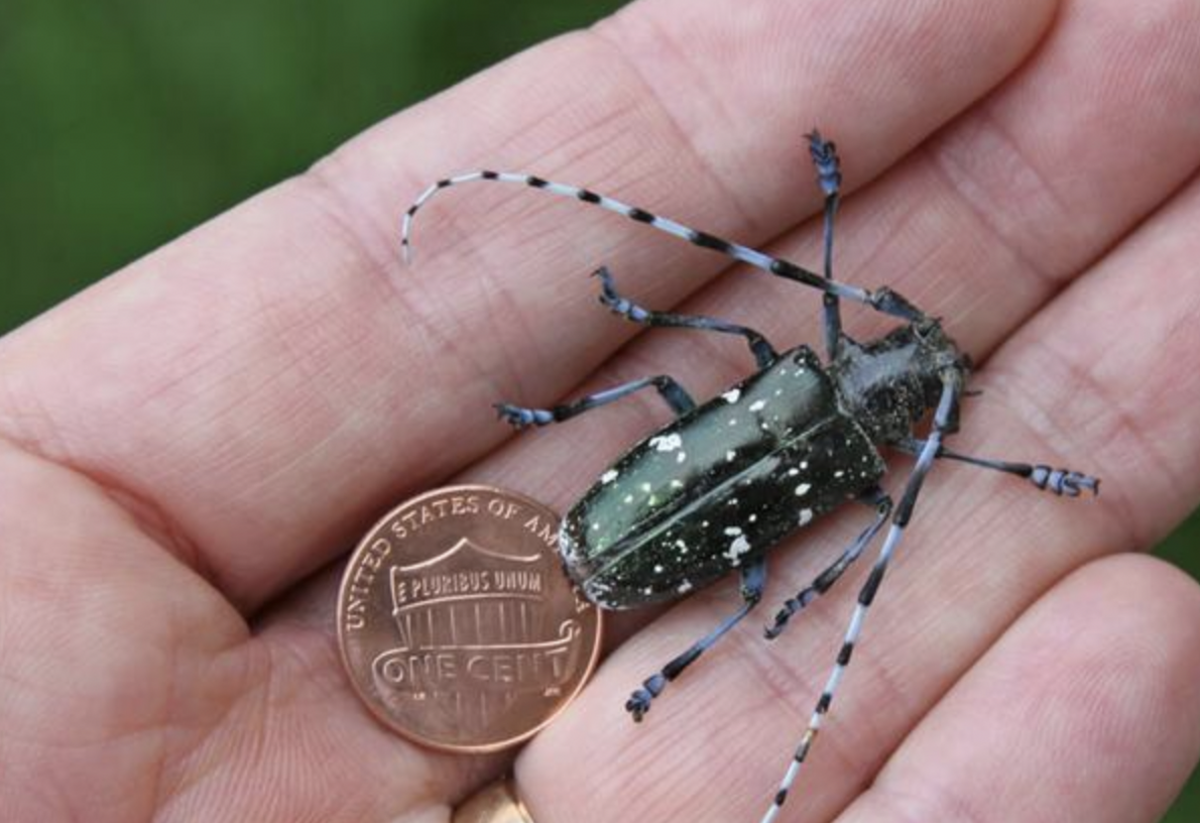
▪ At this point in their life cycle, the beetles are “large, distinctive-looking insects” that measure about one to 1.5 inches in length. They have long antennae that are banded in black and white, and their bodies are black with small white spots.
If you were to see the spotted lanternfly in the summer months, that would correspond with the pest’s nymph stages.
▪ During the early summer, or around April to June, the spotted lanternfly would be in its young nymph stage. At this point in the pest’s life cycle, they would be roughly the size of a tick and have black bodies with white spots.
▪ From mid- to late summer, or from roughly June to September, the spotted lanternfly would be in its late nymph stage. At this point, the pests grow to be about half an inch in size, and have bright red spots all over their bodies.
I own a pool. How should I check for these pests?
Because Asian longhorned beetles and spotted lanternflies are attracted to water, pool owners should be especially aware of the pests and look out for them in or around their pools, including in the pool’s filter.
▪ Oten said it’s a good practice for people with pools to check their filters for the pests every time they clean their pool, making it part of their normal pool maintenance routine.
▪ You should also keep an eye out for the pests in the pool when you’re swimming, or around the pool, such as on walkways or other areas nearby.
“We’re counting on everyone. You know, forest health specialists and experts in natural resources can’t be everywhere,” Oten said. “So having everyone’s eyes out, even when you’re relaxing by the pool, is so important.”
Other ways to prevent the spread of these pests
While the Asian longhorned beetle and spotted lanternfly are attracted to water and you may find them near your pool this summer, they could be found pretty much anywhere, and are likely to be spread through human activity.
That means everyone, not just pool owners, should be on the lookout for the pests this summer.
If you are in or near an area with a known infestation of either pest — maybe you’ve traveled there for vacation this summer — it’s important to be mindful and observant of the bugs when you’re coming and going from the area so that you can prevent the further spread of the pests.
▪ When you are leaving an area with a possible infestation, check your car, firewood and outdoor equipment for the presence of spotted lanternfly or Asian longhorned beetle at any life stage.
▪ If you are using firewood, only cut and burn it within 50 miles of your destination, or when you arrive — don’t cut it at home and take it with you. If you need to transport firewood instead of cutting it at your destination, use heat-treated or kiln-dried firewood instead. You can find more information about the importance of not moving firewood at dontmovefirewood.org.
Remember: Neither the Asian longhorned beetle nor the spotted lanternfly have established populations in North Carolina yet, but these tips are helpful if you are in an area with a recorded infestation.
What to do if you see one of the pests
If you find a spotted lanternfly or Asian longhorned beetle near your pool or anywhere else, or you think you’ve found one but you’re not sure, follow these steps:
▪ Take a picture. Your first instinct might be to kill the pest immediately, but it’s important to record and document it before you do. Try to include a size reference, such as a quarter or a paperclip, so it’s easier to tell how big the bug is.
▪ Collect a specimen. If possible, collect the bug. Long recommends putting it in a plastic sandwich bag and storing it in your freezer until Forest Service experts can take a look.
▪ Report it. Send your photo and any other relevant information, such as when and where you found the insect, to the Plant Industry Division at the N.C. Department of Agriculture & Consumer Services by emailing badbug@ncagr.gov. Use the subject line “Suspected Spotted Lanternfly” or “Suspected Asian Longhorned Beetle.”
You can also report sightings of either pest through a portal offered by the N.C. Department of Agriculture at apps.ncagr.gov/AgRSysPortal/PestReport.
▪ Kill it. After you’ve photographed and reported your find, it’s best to kill the insect so it doesn’t spread.
If the insect you found is suspected or confirmed to be either a spotted lanternfly or Asian longhorned beetle, officials will follow up with you and likely perform a survey of the area in which the bug was found to determine the plan of action for addressing it.
“We don’t want either one of these was established in North Carolina, and it would not surprise me for either one these to have a next-day response if it’s a positive find,” Oten said.
Additional information
Additional information about the spotted lanternfly and Asian longhorned beetle can be found at poolsidepests.com.
This story was originally published June 15, 2022 at 4:56 PM.