NC’s Mountains-to-Sea Trail grows a mile longer on a Civil War battleground
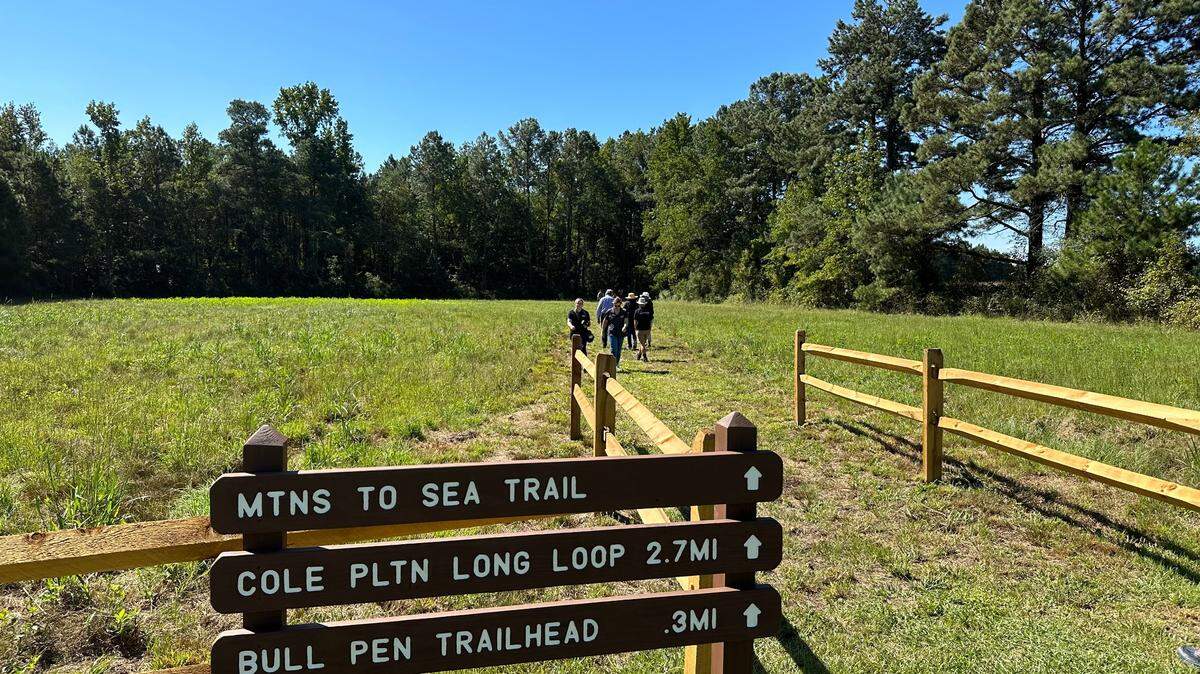
For a long time, the only way to experience Bentonville, site of the largest Civil War battle in North Carolina, was a driving tour around the sprawling battlefield, stopping to read placards and signs that explained what happened around you.
Now there is also a network of walking trails through woods and across fields that remain little changed since 80,000 Union and Confederate soldiers fought here 158 years ago.
That trail network grew by a mile on Friday with the opening of a leg of the Mountains-to-Sea Trail off Harper House Road. Visitors can follow the new trail into a pine plantation that in 1865 was a swampy, dense forest, later nicknamed the Bull Pen, where outnumbered Union soldiers held off a Confederate attack in one of the fiercest clashes of the three-day battle.
Walking through the forest, past remnants of trenches dug by Union soldiers, is a different experience than seeing it from a distance, said Colby Stevens, who manages the Bentonville Battlefield State Historic Site.
“If you’re looking to come out and really comprehend what happened here, you have to get off the hard path at Bentonville,” Stevens said before the trail’s official opening Friday. “And these trails allow us to get off the hard path.”
And for those who don’t care about history, Stevens added, it’s a pleasant and easy walk in the woods.
NC’s Mountains-to-Sea Trail
The trail is one more tiny piece of the Mountains-to-Sea Trail that extends 1,175 miles from Clingmans Dome in Great Smoky Mountains National Park to Jockey’s Ridge State Park in Nags Head. About 700 miles of the trail are off-road, on either paved or unpaved paths or on the beach, and the long-term goal is for it all to be that way. Otherwise, people must walk along the road.
There are now about 3.3 miles of off-road Mountains-to-Sea Trail in Bentonville, where the state owns more than 2,000 acres or about a third of the battlefield. The state historic site is about an hour southeast of Raleigh, off Interstate 40 near Newton Grove.
Persuading private landowners to allow a trail across their property is not easy, said Betsy Brown, associate director of the Friends of the Mountains-to-Sea Trail. Besides Bentonville, none of the trail is off-road in southern Johnston County or anywhere in neighboring Sampson County.
Working in Bentonville was easy, Brown said. From conception to ribbon-cutting, the new section took about 9 months, with a combination of professional and volunteer labor. Many who were involved were on hand Friday, including members of Friends of Johnston County Parks, who helped cut the path and will maintain it, and Friends of Bentonville Battlefield, who helped with signs to help explain the battle.
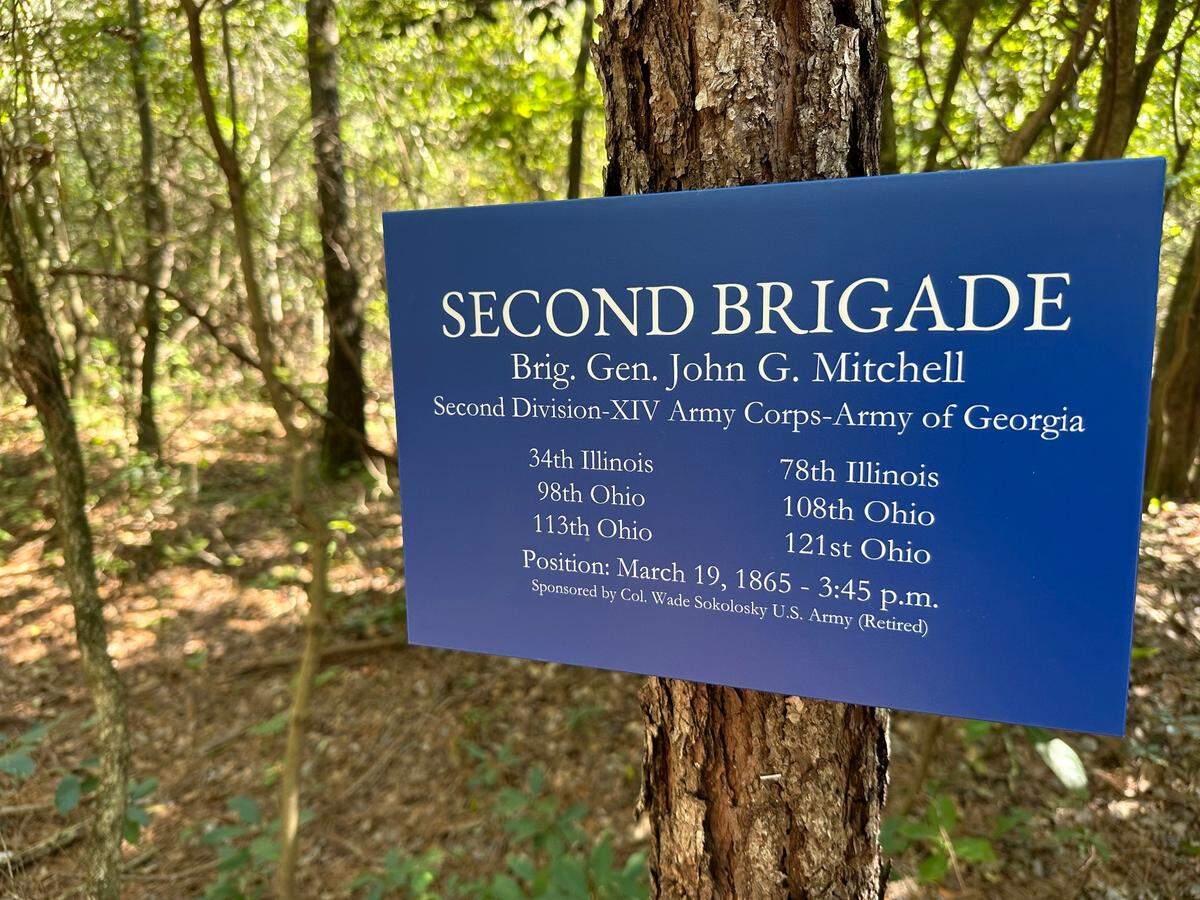
Pattie Smith, president of the battlefield friends group, noted in particular several placards on pine trees that show where different Union and Confederate brigades were located and when — something visitors ask about.
“You can see where your ancestor was,” Smith said. “That means a lot to people who come here.”
Site of more than a Civil War battle
The new trail crosses what during the Civil War was Cole Plantation. Generations of Coles — Black, white and Native American — still live in North Carolina, among them Carolyn Cole of Pinehurst, who attended Friday’s opening.
Cole, 66, remembers working on her grandparents’ farm in the area when she was young and her uncle, a Korean War veteran, taking kids into the woods to show them the Civil War trenches. She said driving through the battlefield is a little like flying over the country in an airplane; it’s better to be on the ground, to breathe the air and smell the trees.
“Being able to touch and feel things,” Cole said.
The Battle of Bentonville was the Confederacy’s last stand in North Carolina. Confederate Gen. Joseph Johnston tried unsuccessfully to stop Union Gen. William T. Sherman from resupplying at Goldsboro and then moving north into Virginia.
But as Cole notes, the battle was three days in a long history of the land that includes whites, Native Americans and enslaved and free Blacks.
“I’m really proud of what the state has done and want to encourage more people, all people, to come out and really learn more,” said Cole, who is Black. “Historic sites provide a great way for us to learn history that’s more than just the recalling of dates.”
Michelle Lanier, the state’s director of historic sites, said allowing people to walk through the Bentonville battlefield helps them understand what came before and after the battle.
“When you’re dealing with histories of violence, like war, and the story of slavery and the story of the Civil War, to me when you can experience that story in the presence of a natural landscape, it’s something that is a kind of balm for the wounds of memory,” said Lanier, who is also Black. “To be surrounded by these trees, knowing they were witness to all of this, gives me a sense of comfort and almost courage to be able to face these really challenging and sometimes painful parts of our history.”
To learn more about Bentonville, go to historicsites.nc.gov/all-sites/bentonville-battlefield. For more on the Mountains-to-Sea Trail, including maps and itineraries, go to mountainstoseatrail.org/.
This story was originally published September 18, 2023 at 5:55 AM.