
New AI tool from Duke researchers reads EEGs, could improve treatment of seizures
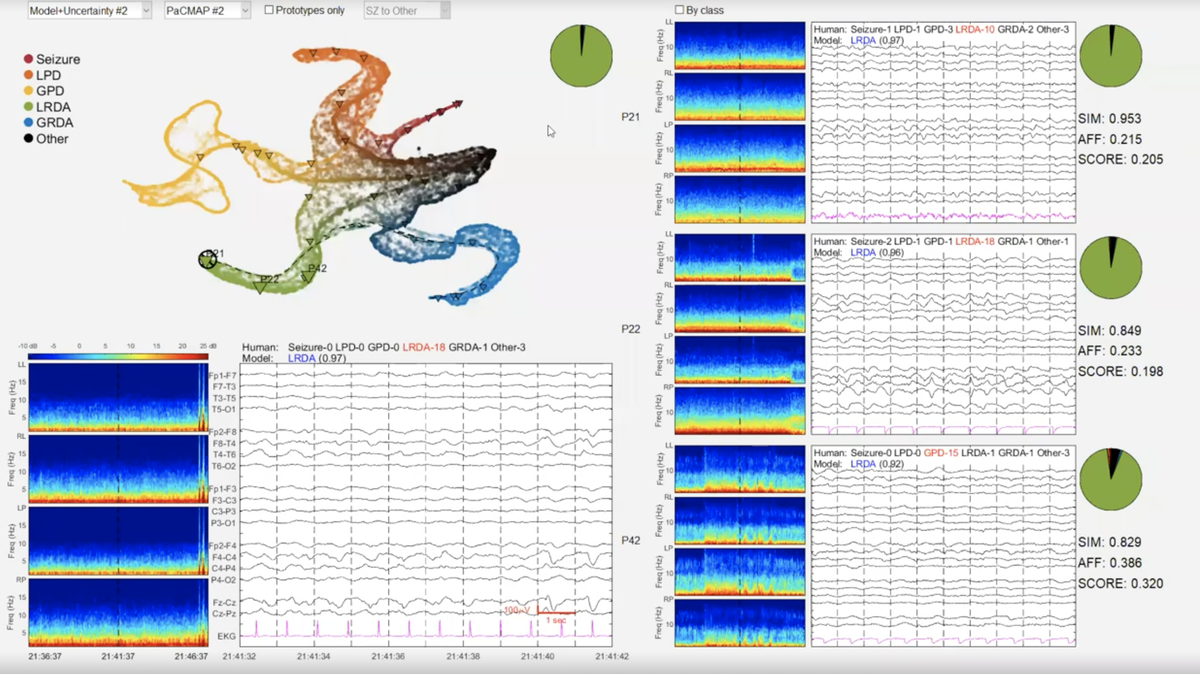
An AI model developed by Duke University researchers that can quickly interpret the complicated signals generated by electroencephalograms may help hospitals take better care of critically ill patients at risk for seizures.
This research was published in the New England Journal of Medicine AI.
The model studied brainwave patterns from 50,697 EEG samples collected from 2,711 patients at Massachusetts General Hospital over more than a decade, looking for signs that a patient was either experiencing a seizure or was at risk of one.
It then was tested by eight nurses, doctors and others who care for critically ill patients but aren’t specifically trained to read EEGs. When they used the AI tool, their accuracy in identifying signals indicating seizures or seizure risk improved from 47% to 71%.
Seizures do not always produce spasms or other physical symptoms, so an EEG is the primary way to know what’s happening. Accurately reading an EEG helps the ICU clinician quickly take next steps, like calling a neurologist with the expertise to confirm the EEG interpretation and deliver the appropriate drugs to prevent or treat the seizure.
How it works
The AI model first reads signals from an EEG, which look like the squiggly lines on a lie detector test, except they help doctors monitor signs of brain activity instead of stress responses. As it reads these signals, the AI model determines if the patient is experiencing a seizure or may be at risk for one.
The changes in those EEG patterns can be subtle or hard to identify.
“There’s no immediate symptoms to the brain patterns that we’re detecting,” said Dr. Alina Barnett, a postdoctoral associate in the Interpretable Machine Learning Lab that conducted this research and one of the authors of the study, published in the New England Journal of Medicine AI. “But [patients] can die from them, or they can sustain permanent severe brain damage.”
The AI tool can be vitally important when a neurologist isn’t available, Barnett said, and “a lot of medical centers don’t have a neurologist for their ICU — especially rural or underserved areas will not have one at all.”
Beyond classifying the EEG signal as one of four types of signals indicating the patient is at risk for seizures, Zhicheng Guo, a PhD student in the same lab, said, the model can also identify combinations of two different types of harmful signals since these signals “lie along a continuum.” This can give clinicians even more insight into how significant the potential for brain injury is and how aggressively to treat it.
What’s next?
The researchers are working on an “invention disclosure” with their collaborators — the first step in the patent process — inching closer to getting this tool integrated into ICU machines. Further testing is required, Barnett said, and “there’s several other ifs and maybes between then and now, but that’s the hope.”