Durham County judge and sheriff sued over juvenile custody hearings. Here’s why.

As Sharrocka Pettiford navigated the twists and turns of Durham County’s juvenile dependency proceedings over the past five years, she wanted the people she loved by her side. But that was denied, she said, at every turn.
Pettiford, 37, began a lengthy court battle with the Durham County Department of Social Services in 2019 after DSS removed her seven children from her home. It happened after one child told a teacher that her mother beat her, which Pettiford says was untrue.
That failed battle to regain custody involved dozens of juvenile dependency proceedings — hearings that consider where children can be placed when they don’t have a parent, guardian, or custodian taking responsibility for them, according to the North Carolina Judicial Branch.
Under the First Amendment of the U.S. Constitution and North Carolina state law, court hearings are automatically considered open to the public unless a motion is made to close the court and remove members of the public not involved in the case from the courtroom.
But cases involving minors often end up closed, removing potential supporters and advocates from the gallery during a stressful time.
“With the court being closed, I have no one in there,” Pettiford told The News & Observer. “I’m left exactly how they want me to feel – alone.”
Now, Civil Rights Corps, a D.C.-based nonprofit focused on injustices in the legal system, is suing Durham County District Court Judge Doretta Walker and Durham County Sheriff Clarence Birkhead in federal court, alleging the pair have systematically kept members of the public from hearings protected by the First Amendment.
The organization says it has tried to “courtwatch” juvenile dependency proceedings in Durham County since the fall of 2023 after receiving complaints about delays in hearings; lengthy separations of children and parents; and closed courtrooms.
An investigation by The Assembly and WBTV in Charlotte in 2023 reported that Durham County had a 22% rate of reuniting children with their parents, less than half the 46% national average.
Though Walker is the one to order a courtroom’s closure, Birkhead is being sued because he supervises the sheriff’s deputies who remove members of the public from the courtroom and keep the courtroom closed.
The complaint alleges Walker and Birkhead repeatedly kept members of Civil Rights Corps from observing proceedings, even when members of the public not affiliated with the CRC were allowed to remain in court.
Here’s what the complaint alleges and what community members say they’ve experienced.
Shut out of court
According to the complaint, several CRC lawyers and dozens of other members of the public were removed from Walker’s courtroom at least nine times in 2023 and 2024, most recently in August. All of the nine hearings cited were juvenile dependency proceedings.
“On CRC’s first attempt, on September 13, 2023, two CRC lawyers were immediately asked to identify themselves,” a memorandum written by Civil Rights Corps in support of the complaint states. “After they did so, explaining they were lawyers who would abide by any confidentiality orders, they were ordered removed, and a Deputy Sheriff escorted them out of the courtroom.”
Two days later, Walker allegedly granted a blanket motion by a lawyer with the county’s Guardian ad Litem program to exclude all CRC lawyers from future proceedings, the complaint states.
“Others ‘with business before the court’ were permitted to stay, even if they had nothing to do with the case at bar,” the complaint says.
Even when lawyers for the parents involved in juvenile dependency proceedings objected to the courtroom being closed or said the material being presented would not be sensitive information, Walker closed the courtroom, according to the complaint.
However, when officials from the North Carolina Administrative Office of the Courts — the office that oversees the state’s court systems — were present at an Aug. 5, 2024, dependency hearing, members of the public, including CRC lawyers, were not removed from the courtroom, the complaint says.
The county’s Department of Social Services appeared to believe anything related to children could be classified as sensitive information, Civil Rights Corps attorney Elizabeth Rossi wrote in court filings.
“I then asked if we could come back in after the parties were finished discussing whatever ‘sensitive’ information was being shared,” Rossi wrote. “I recall the DSS attorney laughed at my question and said, ‘Everything we say in here is sensitive because it’s about children.’”
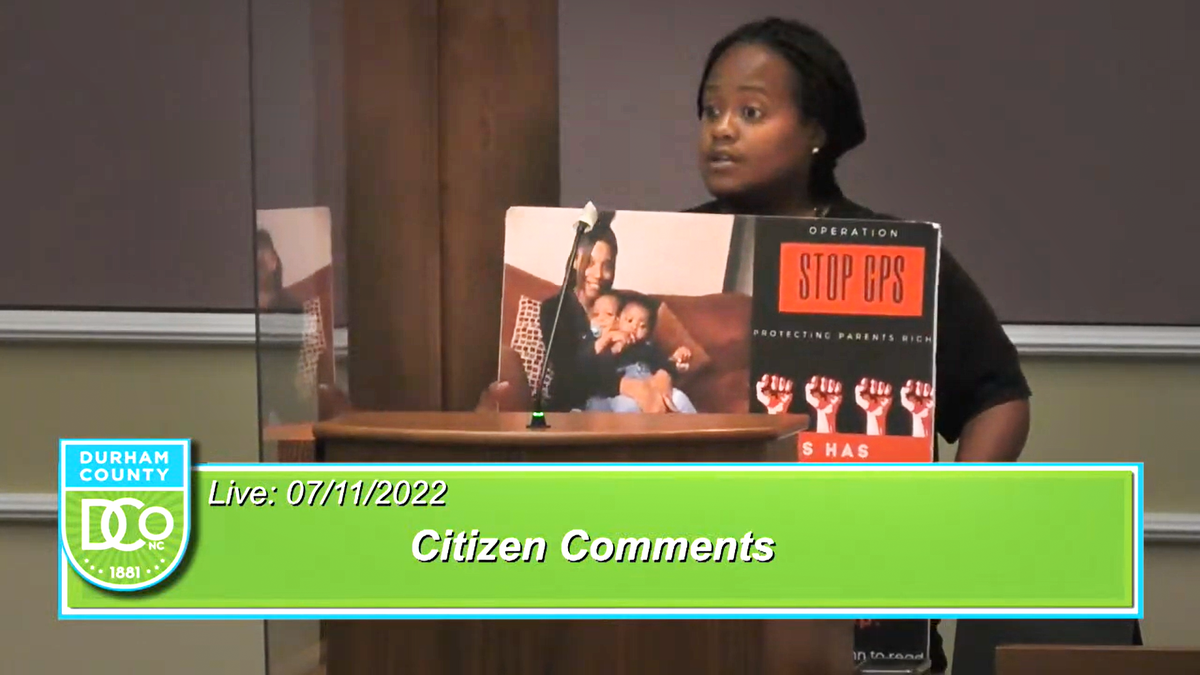
Amanda Wallace founded the Durham-based Operation Stop CPS in 2021 after leaving her job as a social worker in Wake County. In the three years since, her advocacy has included comments at Durham County Board of Commissioners meetings and led to a win in the North Carolina Court of Appeals, which threw out a protective order the Durham County Department of Social Services had sought against Wallace.
Wallace told The N&O she’s been removed from juvenile dependency proceedings in Durham County at least 20 times.
She heard of Civil Rights Corps’ work with parents separated from their children in other states and connected with the group about issues in Durham, Wallace said.
“A lot of times, parents were there by themselves with their attorneys only, because there’s a lot of shame and guilt that comes into these court proceedings, which is why courtwatching is so important,” she said. “It breaks down that shame and that guilt. It’s like, ‘No, you’re not alone.’”
Why it matters
Under North Carolina law, even in cases involving juveniles, court hearings must be open to the public unless proper cause can be shown as to why the courtroom should be closed.
According to the law, factors to be considered in whether a hearing should be closed include:
The nature of the allegations against the child’s parent, guardian or caretaker
The age and maturity of the child
The benefit of confidentiality to the child
The benefit of an open hearing to the child
If the child requests the hearing remain open, then it must, the law also states.
There are a handful of alternatives to closing the courtroom to the public, depending on the issue at hand. The Civil Rights Corps complaint questions why Walker didn’t opt for any of those measures, such as:
Prohibiting attendees from sharing information about the minors discussed
Closing portions of the hearing when sensitive information was discussed
Prohibiting audio or visual recordings
Requiring any court transcripts of the hearing be redacted
Sealing relevant court documents
Complaints from Durham mothers
Beyond the legal question at hand, some Durham mothers, including Pettiford, say courtroom closures eliminate the possibility of community support in crucial moments.
“When they were trying to close the court, I would always object,” Pettiford said. “I would tell my attorney, ‘No, we don’t need to close court,’ but, of course, it’s up to the judge, and she’s definitely gonna close court.”
Pettiford said she had a public defender who often didn’t respond to her emails and rarely answered calls.
And with her loved ones kept out of the courtroom and a gag order she said was placed on her about a year into the legal battle to prevent her from posting about her children on social media, Pettiford said she had no one to confide in about the stress of her fight to regain custody of her children.
“It’s as if you don’t matter,” she said.
At a rally hosted by Wallace and Operation Stop CPS in November, Pettiford was one of roughly 30 people there to support the Civil Rights Corps lawsuit, The 9th Street Journal reported.
In a signed declaration submitted to the court as part of the CRC complaint, Bashirah McDaniel, another mother, wrote that her supporters were consistently removed from the courtroom during a 663-day legal battle with the Durham County Department of Social Services.
The department took custody of McDaniel’s infant daughter when she sought emergency medical treatment in December 2021, but the two were reunited in September 2023, the declaration states.
“I reached out to my family and community members to support me at my hearings by sitting in the courtroom,” McDaniel wrote. “But when people showed up to support me, the judge kicked everyone out.”
A third mother, Jatoia Potts, alleged she was threatened with a contempt of court charge if she brought supporters to her Durham County DSS hearings or spoke about her case.
“Without anyone supporting me in the courtroom, I felt alone, isolated, and scared,” Potts wrote in a declaration to the court in support of Civil Rights Corps’ complaint.
Though she’s attempted to attend hearings for other community members in Durham, including hearings in Walker’s court, Potts estimated she has been removed from at least a third of those hearings.
Civil Rights Corps has filed for a preliminary injunction that would temporarily bar Walker and Birkhead from closing hearings that should be public, but a ruling has yet to be made on that motion. Birkhead and Walker have until Jan. 13 to respond to the suit, court records show.
Walker and Birkhead did not respond to requests for comment.
This story was originally published December 23, 2024 at 5:30 AM.