
He defaced a Degas exhibit to raise climate awareness. How do we judge civil disobedience?
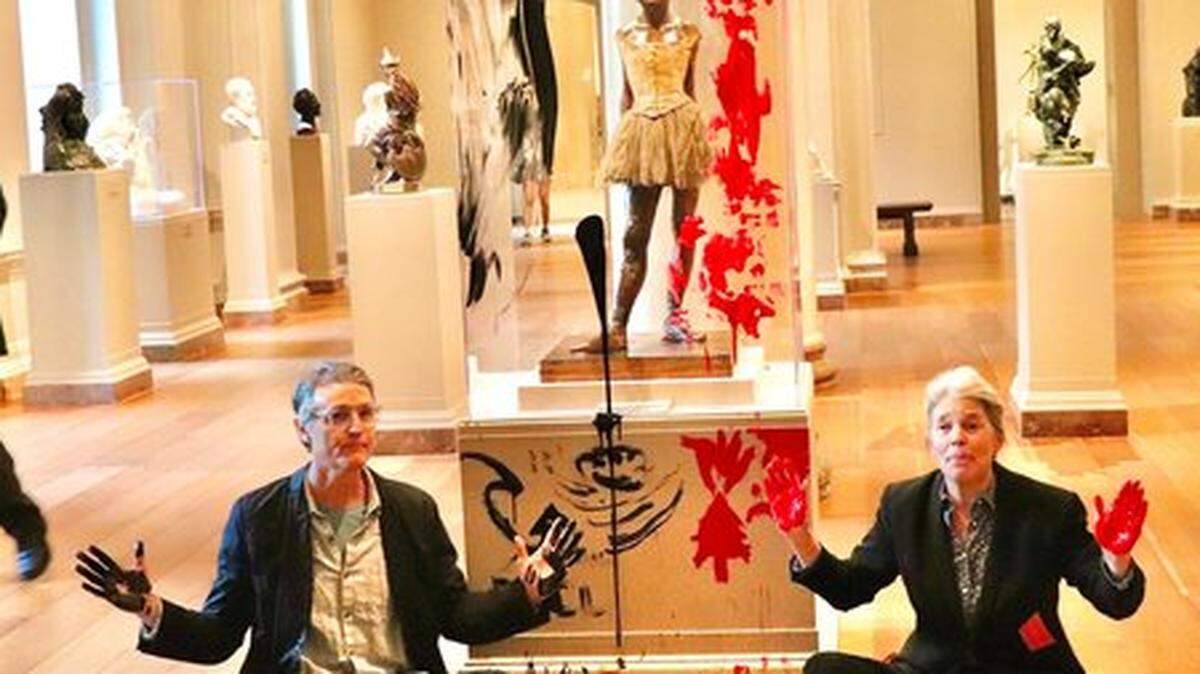
Two years ago, Tim Martin walked into the National Gallery of Art, approached a famous and beloved Impressionist sculpture and smeared black, washable kids’ paint across its display case — spattering a few drops on the floor.
Then he sat cross-legged at the statue’s base, stretched out his paint-stained hands and explained himself:
“We are worried, like most Americans, about climate and about biodiversity crisis,” he told a growing crowd. “This is all of our children, especially in the global South.”
For this act of warning-bell vandalism, Martin faces up to 10 years in prison — a prospect he mostly shrugs off.
He points to the rash of extreme weather — Hurricane Helene, the Los Angeles wildfires — as an emergency that requires civil disobedience. His point is to grab attention where more conventional and legal methods fail, and he invites everyone on Earth into his slide presentation detailing how a finite planet will not sustain infinite growth and consumption.
“Of course I’m happy to sit in jail and read,” he said last week while on house arrest in Raleigh. “Get three meals a day ... sleep and read some more ... That would be awesome!”

Little Dancer and Fairytale Matrix
Martin and fellow climate activist Joanna Smith chose to deface the exhibit for Edgar Degas’ “Little Dancer of Fourteen Years,” an original wax sculpture with its arms pulled back and its head cocked confidently forward.
In doing so they selected a ragamuffin figure of 19th-century Paris, an “opera rat” dancing for her supper to escape the streets. As Smith explained before her arrest, “She is imperfect like we are all imperfect, but she is strong, and she is not resigned.”
Smith, from New York, has already pleaded guilty and served 60 days in jail. But Martin, a Raleigh architect and father of two, awaits his trial on April Fool’s Day.
For him, the prospect of time in a cell is trifling compared to the death toll that will follow if the global temperature rises by 2 degrees Celsius — roughly 1 billion people, according to a 2023 study.
“This is the work we have to do,” he said, “to wake up, grow up and step up. Right now, we’re living in a fairytale matrix created by the American empire ... It really is a calling from our better selves that is in us, that’s been stolen from us and beaten out of us.”
‘We are killing nature’
The sculpture itself, worth untold millions, suffered no damage in Martin’s protest. Only its case was painted.
“The whole reason we used children’s washable paint was so they could clean it up!” he said.
Still, the National Gallery reported spending $4,000 to repair the exhibit, taking it off public display for 10 days. And its curators clearly felt violated.
“The protective sanctuary for this beloved girl was battered,” Kaywin Feldman, director of the National Gallery of Art, told NPR. “With increased frequency, institutions — overwhelmingly nonprofit museums for the public benefit — have suffered collateral damage at the hands of agendas that have nothing to do with museums or the art attacked.”

So what to think of this?
Days after his action, a detractor posted on Facebook, “Yeah, vandalizing art will get people on your side.”
But Martin would argue his strategy has already worked, already shifted perspectives, already drawn enough favorable news coverage to change minds one at a time — the only way.
“We are nature,” he said. “We are killing nature. Therefore, we are killing ourselves.”
Is it OK to break the law to make a political point?
Only a few years ago, activists on the political left tore down Confederate statues and splashed red paint on the rebels’ gravestones in Oakwood Cemetery.
Friends on the left: you thought this all good, yes?
Also a few years back, mobs on the political right stormed the U.S. Capitol, busting windows, looting and attacking Capitol police. They’ve since been pardoned.
Friends on the right: you thought this all good, yes?
Is there a guideline on when it’s OK to break laws to make a political point beyond whether you agree with the point being made?
What do you feel so passionately about that you would risk everything, forsake all, to see it happen — or at least, when the roll got called up yonder, know that you did everything in your power?
And once you fought for that thing, what do you see when you look back and measure the damage? Did anyone die? Is anything destroyed? Or is there a bill for $4,000?
Given Martin’s sincerity and willingness to take punishment, his message may resonate far harder than any sentence.
“If I can give them a concrete example,” he said, “when the inevitable climate shock begins to affect their families, they will have the seeds I planted. It’s one conscience at a time. Why not start with the judge?”
This story was originally published February 3, 2025 at 5:00 AM.