UNC develops cheap, easy-to-use ultrasound to help in maternity-care deserts
AI-generated summary reviewed by our newsroom.
- UNC researchers developed AI-powered ultrasound to improve maternal care access.
- Device guides untrained users and makes five basic diagnoses via FAMLI app.
- Team seeks FDA clearance to expand use of the tool beyond clinical trials abroad.
Imagine being able to walk into a hospital and perform a basic medical procedure with no previous experience.
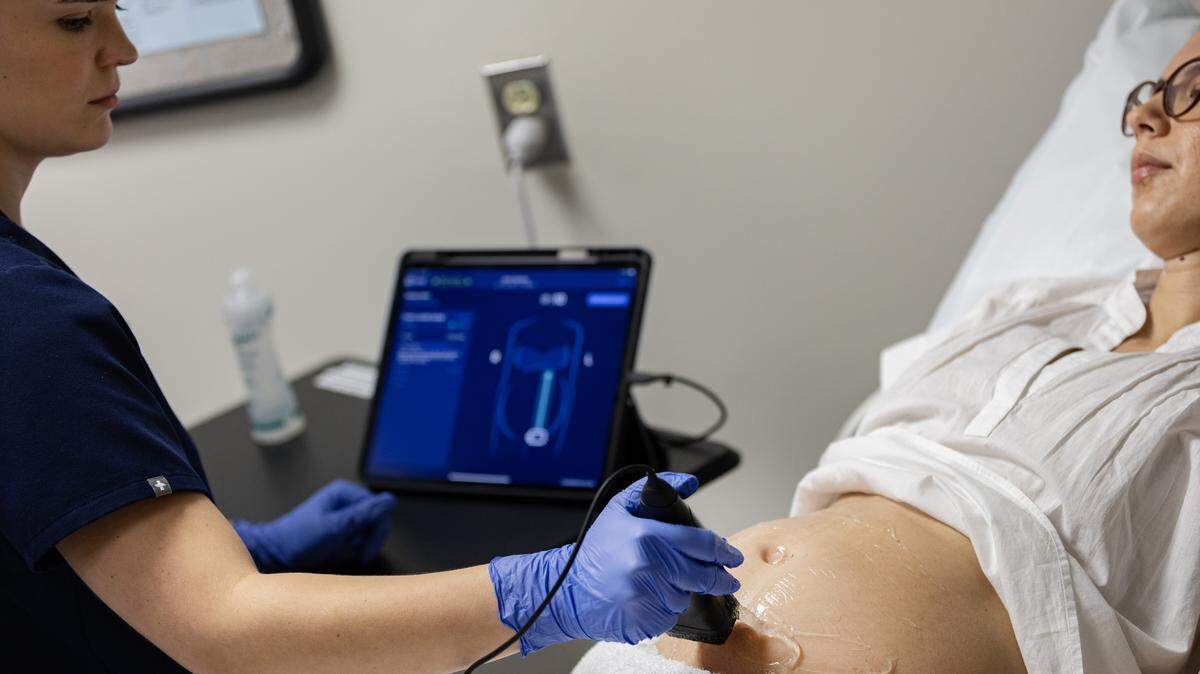
A portable ultrasound device developed at UNC-Chapel Hill is designed to be used by people with little to no training. The low-cost device guides users through taking a basic ultrasound, then uses artificial intelligence to interpret the information and make a diagnosis.
“We think that it can radically change the way that ultrasound is being performed,” said Dr. Jeff Stringer, project leader and professor of obstetrics and gynecology.
The project has received over $20 million in funding, including a $500,000 grant Stringer recently received from NCInnovation to help commercialize the product. Stringer said the device will give pregnant women in underserved areas better access to maternal care
Stringer has devoted his career to improving maternal health care for women in low-resource areas across the globe. In May, he received the 2025 Oliver Max Garner award, the UNC System’s highest faculty honor, for his work.
Why is maternal health care important?
Maternal health focuses on caring for women during pregnancy, childbirth and after childbirth. Access to high-quality care helps prevent maternal injury and death, according to the World Health Organization.
However, some women live in maternity care deserts — areas where there is little to no access to maternity care. In North Carolina, 20% of counties are maternity care deserts and 17% have low to moderate access, according to the March of Dimes.
Having access to maternal health care is extremely important because these visits help identify diseases and other conditions that may negatively impact the health of mothers and babies, said Dr. Michelle Bucknor, a regional chief medical officer at Aetna Better Health who was not involved in the project.
Ultrasounds are a vital maternal health tool that are commonly used to monitor well-being during pregnancy. Ultrasounds use sound waves to create real-time pictures and videos of the inside of the body. The noninvasive test is performed by sonographers, who typically have two to four years of training.
“The average patient gets between four and five [ultrasounds] per pregnancy,” Stringer said. “We use it to measure all manner of abnormalities and to ensure that babies are healthy, and that’s simply not available in many parts of the world.”
Stringer said he realized the critical need to revamp ultrasounds while he was in Zambia, combating an HIV/AIDS epidemic. Traditional ultrasounds require bulky and expensive equipment, sonographers and expert interpreters, none of which are available in Zambia and other low-resource areas, he said.
His team’s new ultrasound device could help overcome these barriers and provide greater access to expecting mothers in North Carolina and beyond.
“If you live in a county that qualifies as a maternity desert in North Carolina, and you don’t have access to this, you may have to travel for two or three hours to get your basic dating scan,” Stringer said. “If our technology can replace that, you can imagine what convenience that’s going to be for the patients and providers.”
How does the ultrasound device work?
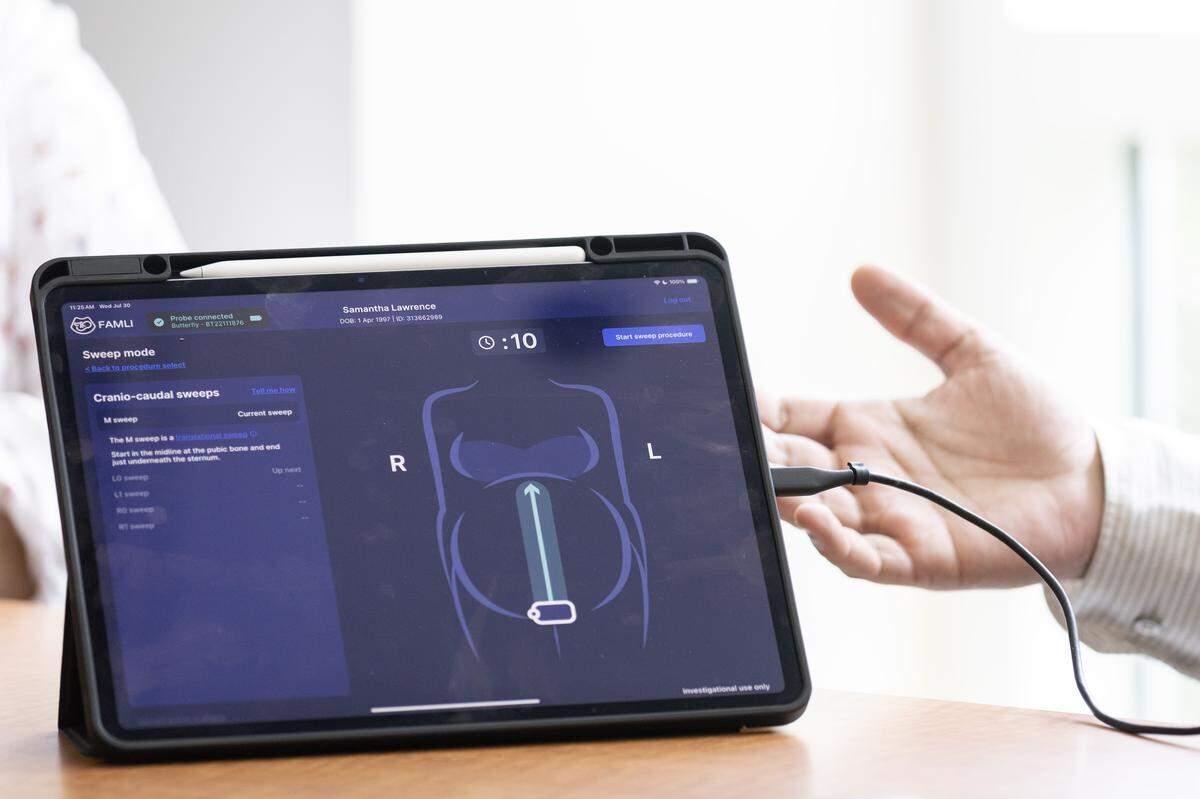
The device consists of a low-cost probe that plugs into a smart device, such as a tablet or smartphone, and the FAMLI app. FAMLI was developed by UNC and external collaborators and runs on the Apple iOS system.
The app uses cartoon animations to show users how to measure belly size and move the probe across the stomach. Each pass is called a sweep and collects 10 seconds of video that contains 200 individual images. The app runs through five vertical sweeps, then three to four horizontal sweeps, Stringer said.
“You don’t need to know exactly what you’re seeing” when you do the sweeps, said Srihari Chari, research project manager. “It’s really meant to just have animations to guide the user through that acquisition.”
Afterward, the FAMLI app uses AI that was trained on sweeps collected by the team and their collaborators from over 60,000 women in several countries. The app can make five basic diagnoses, including how far along the pregnancy is and the estimated weight of the fetus, Chari said.
Stringer said a traditional ultrasound makes many more diagnoses, 18 in some cases, so their device is not meant to replace that robust process. Instead, he said, the device lets providers plan future visits and diagnose certain high risk conditions like twins.
“We’re not trying to completely put sonographers out of a job or anything like that,” Stringer said. “But one thing that’s very clear is that even here in North Carolina there’s a critical shortage of sonographers.”
Using AI to outsource basic scans will allow sonographers to devote more time and energy to complicated cases that require expertise, which is in everybody’s interest, he said.
The device is cleared for limited clinical use in Zambia, where much of the team’s data was collected. It is not yet being used in the U.S. because it has not been cleared by the Food and Drug Administration.
“You really cannot make clinical decisions from a medical device in the United States without having FDA clearance,” Stringer said. “So that’s a really critical milestone for us in the development of this technology.”
They hope to use the NCInnovation award to get the device through the FDA approval process, he said.
This story was originally published August 2, 2025 at 9:36 AM.