AI helps NCCU nursing students learn to treat patients in a ‘safe’ environment
The gray virtual reality headset transforms the typical classroom into a busy virtual hospital.
Gamers are not the only people benefitting from virtual reality. VR is being used by nursing programs across the country to create realistic, interactive training experiences. N.C. Central University’s nursing program started using the vrClinicals platform last summer.
Their version of vrClinicals uses a headset and two hand controllers. Students navigate around a hospital floor, administer medication and even speak directly to patients and get a real-time response.
The technology is the next step in preparing students to be safe practitioners who care for the diverse patient populations, said Tina Scott, director of experiential learning in the department of nursing.
Simulations create a safe space for learning
Hands-on experience is vital for future nurses and other health care workers to learn how to treat patients. However, everyone makes mistakes — especially when learning something new — and mistakes in medical centers can be dangerous for both patients and staff.
Simulations that recreate health care environments let students gain experience in a low-stakes setting. At NCCU, simulations take place in the Clinical Learning Resource Center, also known as Eagle General Hospital. Simulations are important because they provide a “psychological safe space” that facilitates learning, Scott said.
“Before we start any simulations, [we] let that student know that this is a learning experience,” she said. “If that student misses doing something and it causes them to have a wrong or unsafe behavior, they’re not penalized.”
Traditional simulations include life-sized human mannequins called human patient simulators that students practice on. The human patient simulators can “come alive” and speak to students, but their vocabulary is very limited, so faculty have to supplement the conversation, Scott said. Students are assigned roles and work together in groups to take care of the patient simulators.
There are huge differences in the capabilities and overall experience of using computerized human patient simulators versus vrClinicals, which uses artificial intelligence, Scott said.
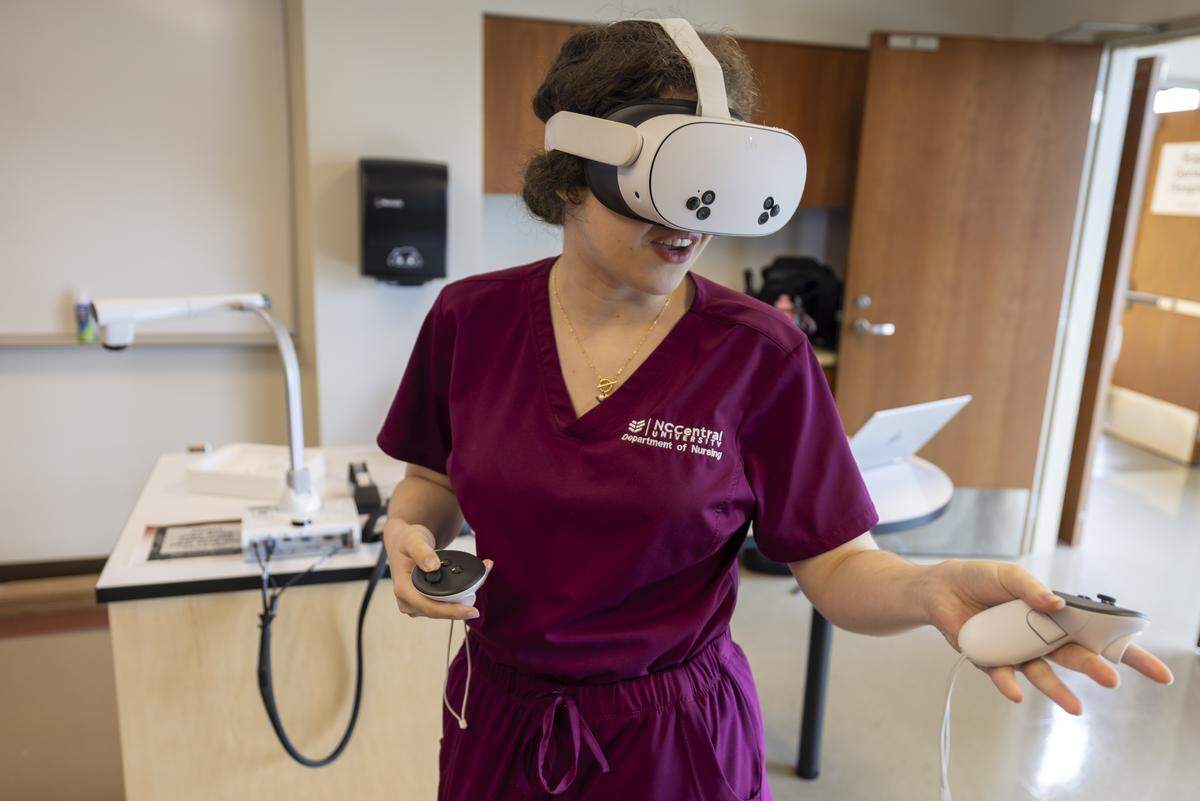
Students complete their vrClinicals assignments independently during hourlong sessions. The headset transports students directly into a virtual hospital, where they are the nurse responsible for certain patients.
The virtual patients listen to the student’s voice and craft specific responses generated by the conversational artificial intelligence feature. Each patient has a unique personality and can “carry on a conversation just like you and I,” Scott said.
Students use patient feedback, electronic health records and other tools to perform necessary care. At the end of each session, vrClinicals generates individualized reports that professors and students review. These reports align well with other assessment tools used in the nursing program, Scott said. The students are not graded on their performance, however, because the main goal is to gauge progress while building confidence.
“We don’t use it for any type of testing, but we do use it to identify gaps in learning,” she said. “We use it as a teaching, learning, innovative, interactive, fun learning strategy.”
Nursing students like the experience
Noa Leger and Kathryn Chapman, senior nursing students, were among the first to use vrClinicals at NCCU. They said the technology has substantially progressed over the past year.
“At first we had a drop-down box, so the questions were already picked out for us, we just had to answer them,” Leger said.
This meant the students could not ask follow-up questions as they would in a real hospital setting. So the addition of conversational AI was a pleasant surprise, Leger and Chapman said. Both students participated in the test run of this feature last fall.
“We talked and the patient talked back to us,” said Leger. “We were shocked.”
Now, the patients have varying preferences and tolerances, which has improved the experience quite a bit, Chapman said.
Real life clinical experience is irreplaceable, but both students said vrClinicals helped build their confidence and prepare them for their future careers.
This story was originally published August 18, 2025 at 7:30 AM.