
New species of T-Rex discovered in Raleigh museum, rocking the dinosaur world
The most ferocious predator of the ancient world had a smaller, lightweight cousin: a new species of tyrannosaur uncovered in a Raleigh laboratory.
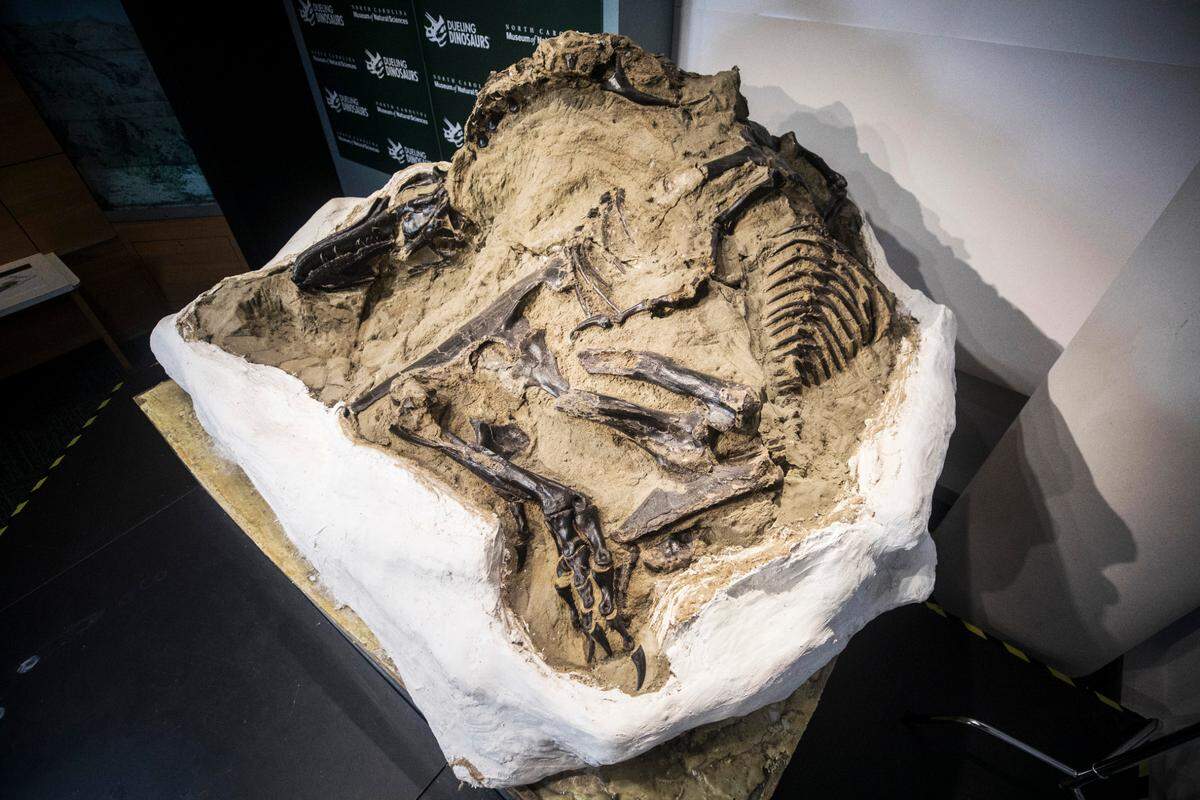
For years, paleontologists at the NC Museum of Natural Sciences thought its “Dueling Dinosaurs” exhibit featured a prehistoric battle between a triceratops and a hungry T-Rex — probably only a teenager.
But new research in the Raleigh museum’s lab shows the creature is actually an entirely different species of tyrannosaur: a fully grown relative of the T-Rex now known as nanotyrannus.
“This is the biggest dinosaur discovery of the decade, and I am proud that it is happening right here in North Carolina,” Gov. Josh Stein said in a news release Friday. “North Carolina’s public universities and public museums are continuously on the forefront of scientific research and advancement.”
In 2020, the museum announced a new $6 million acquisition: what it thought was the world’s first complete T-Rex skeleton encased in rock, detailed down to the foot bones and shark-like teeth, locked in what appeared to be a feud with a triceratops.
Along with the flood of visitors “Dueling Dinosaurs” would bring the museum, it offered the chance for the museum to start research on a treasure chest of a specimen in full view of the public. The results of the first round of that research appeared in the journal Nature this week.
Not a teenage T-Rex
In the Nature article, NC State University paleontologist Lyndsay Zanno noted that Raleigh’s new arrival was half the length and had one-tenth of the body mass of an adult T-Rex, leading researchers to think it was a teenager.
But as they studied the growth rings in its fossilized bone, they found they had “slowed down and sped up with the seasons, creating layers like a tree trunks annual rings.” The nanotyrannus was actually 20 years old and fully grown.
Their finding impacts decades of research on T-Rex growth, now known to be based on similar species coexisting in their last days before extinction.
“This fossil doesn’t just settle the debate,” Zanno said in a Friday news release. “It flips decades of T. rex research on its head.
“The best part of this discovery is being able to share it with the world,” she continued. “Anyone who wants to see a 100% complete Nanotyrannus can come to the museum, speak directly with the scientific team, and stand next to the real skeleton.”
Uniquely NC is a News & Observer subscriber collection of moments, landmarks and personalities that define the uniqueness (and pride) of why we live in the Triangle and North Carolina.
This story was originally published October 31, 2025 at 11:22 AM.