Duke Energy earned nearly $5B in 2025. It is still requesting a rate hike.

AI-generated summary reviewed by our newsroom.
- Duke Energy reported $4.9B revenue in 2025 while seeking multi-year rate hikes.
- Critics say incentives encourage costly centralized and fossil projects.
- Proposed 2027–28 increases would raise residential rates by about 16–18%.
Duke Energy’s new earnings report shows strong returns for shareholders in 2025, but advocates for clean and affordable power say the profits come at the expense of individual North Carolina rate-payers and the environment.
According to the company, Duke Energy investors earned $6.31 per share for the year, up from $5.90 per share in 2024. The company attributed the strong showing — $4.9 billion in revenue, a 7% increase over 2024 — to the “recovery of growing infrastructure investments to serve customers and growth in our service territories.”
The earnings report landed with a thud among watchdog groups who have been arguing against Duke Energy’s request for a rate increase, which state regulators have not yet ruled on.
Duke Energy, a Fortune 150 company with headquarters in Charlotte, is one of America’s largest energy holding companies. Its stock is traded on the New York Stock Exchange and is held mostly by institutional investors at companies including Vanguard and Blackrock.
Regulators allow Duke, the state’s largest electric utility, to earn about 10% on equity for new power generation. The arrangement has helped the company build a large network of relatively reliable power plants across North and South Carolina, and N.C. customers pay rates that are lower than the national average.
But critics say the arrangement also incentivizes Duke to continue to build big, costly, centralized plants that rely on non-renewables such as nuclear power or the burning of natural gas or coal. Clean-energy advocates have said Duke must shift from the burning of fossil fuels to reduce carbon emissions, which scientists say are the biggest cause of climate change. Environmental groups also say solar and wind energy are far less costly to produce.
Duke can recoup construction costs or, under a state law passed in the summer of 2025, can charge customers in advance for power plants it wants to build. Duke is allowed to pass 100% of fuel costs along to consumers.
Duke announced this week a $103 billion capital plan through 2030 to meet increasing power demand coming from population growth, industrial expansion and the development of data centers prompted by the AI boom, according to the Charlotte Observer. Proposed projects include a natural-gas plant in Davidson County, a new nuclear plant at Belews Creek, grid upgrades and some solar installations. The company also wants to extend the life of coal-generating plants that had been scheduled for phase-out.
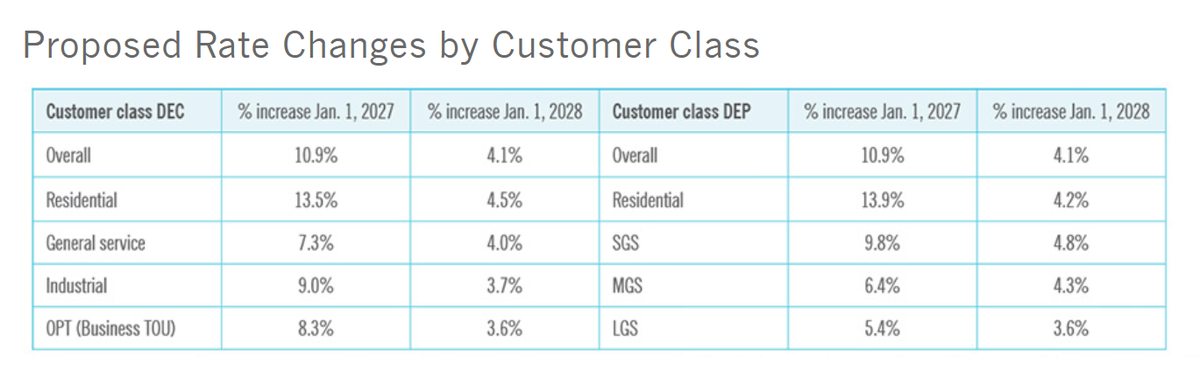
Duke also has requested from the N.C. Utilities commission two rate increases, one in January 2027 and another in 2028. Together, they would raise residential rates for Duke Energy Carolinas customers by 16% and for Duke Energy Progress by 18%, the company says.
The utilities commission will hold public hearings on the request beginning March 30 around the state and online, and will make a decision by the end of the year.
Gov. Josh Stein has said he opposes the rate hikes.
Olive Burress, the Sierra Club’s Beyond Coal campaign organizer, said, “Duke’s decisions to delay investments in affordable renewable energy, while keeping aging coal plants running and building out massive expensive gas infrastructure may mean profits for Duke’s global shareholders, but it means higher monthly bills and more risks for residential customers and communities.
“In its pending NC rate cases, Duke is asking for approval for a higher [return on equity] just to increase their profits. Duke Energy executives and N.C. decision makers must prioritize customer affordability by delaying this proposed rate increase for North Carolina customers until after their merger is completed, which will allegedly save customers billions.”
Will Scott, director of Southeast Climate & Clean Energy for the Environmental Defense Fund, found the earnings report jarring on the heels of a request by Duke to its customers to reduce their power usage during a Feb. 1 cold snap in order to avoid blackouts.
“Duke Energy is celebrating profits with shareholders at the same time it is texting households to conserve power during freezing temperatures,” Scott said. “As customers are being asked to help mitigate the company’s risk, Duke itself is enjoying being more insulated than ever from risk. Because of provisions the legislature passed in Senate Bill 266 last year, our monopoly utility benefits from profit perks like Construction Work in Progress and Multi-Year Rate Plans. When utilities are gifted profits ahead of time it reduces their risk and that means profits should be going down, not up.”
This story is available free to all readers thanks to financial support from the Hartfield Foundation and Green South Foundation, in partnership with Journalism Funding Partners, as part of an independent journalism fellowship program. The N&O maintains full editorial control of the work. If you would like to help support local journalism, please consider a digital subscription, which you can get here.
This story was originally published February 12, 2026 at 8:44 AM.