Which Triangle county bears heaviest housing strain? How does your county rate?
AI-generated summary reviewed by our newsroom.
- 29% of North Carolina households pay over 30% of income on housing.
- Orange County shows the highest strain: 33% of households cost‑burdened.
- Wages for core service jobs fall tens of thousands short of housing needs.
A new report from the North Carolina Housing Coalition confirms what many residents have been feeling on the ground: Nearly a third (29%) — 1.2 million — of the state’s 4.1 million households are paying an outsized share of income on housing.
Defined as “cost-burdened” by the federal government, these households spend more than 30% of their income on housing costs, like rent or mortgage payments, property taxes, insurance and essential utilities. That’s up from 28% of households in 2025.
Among them:
- Nearly 1 in 2 renters (49%) are cost-burdened, the coalition found. That’s 638,780 households — 23,199 more than 615,581 households in 2025.
- And 1 in 5 homeowners (20%) are cost-burdened, it found. That’s around 552,003 households — 29,291 more than 522,712 households in 2025.
Meanwhile, not a single county offers housing that is affordable to minimum-wage workers. On average, an individual needs to make $22.32 per hour — just over three times the state and federal minimum wage of $7.25 — to afford a two-bedroom apartment.
“These aren’t just data points. These numbers represent North Carolinians pressured to make impossible choices between rent and groceries, mortgage payments and medical expenses,” Stephanie Watkins-Cruz, the coalition’s director of housing policy, said in a release.
“The housing need in our state is growing faster than our response,” she said.
But let’s look more closely at the greater Triangle; what does the data show across Wake, Durham, Orange, Chatham and Johnston counties?
Here are some quick takeaways:
The Triangle’s affordability crisis is no longer confined to the urban core
Johnston and Chatham counties, once rural outposts, now show housing costs and wages that look more like the Triangle’s urban core in Wake and Durham counties.
In Johnston, nearly half of renters (48%) are cost-burdened. That’s 9,066 households, up from 7,943 in 2025. It also ranked No. 22 statewide for eviction filings with some 2,009.
Johnston’s homeowner burden (19%) is also among the highest, signaling mortgage strain as well. Some 299 families faced foreclosure this year, the report said.
Chatham County also shows signs of strain. Roughly 48% of renters are cost-burdened, around 2,686 households. Meanwhile, 19% of homeowners — 5,085 households — have difficulty affording their home.
Roughly 24% — 7,771 households — out of the county’s 32,017 households are cost-burdened, up from 7,633 households in 2025.
Orange County is the region’s extreme case
Overall, Orange County is facing the biggest financial squeeze with 33% — 18,191 out of 55,848 households — cost-burdened.
More than 58% of renters (11,290 households) and 19% of homeowners (6,891 households) are struggling to afford their homes, driven by UNC-related demand, limited supply and high land costs.
Compare that to Durham (31%), Wake (28%), Johnston (26%) and Chatham (24%) counties.
Wake carries the largest volume of housing stress in the Triangle
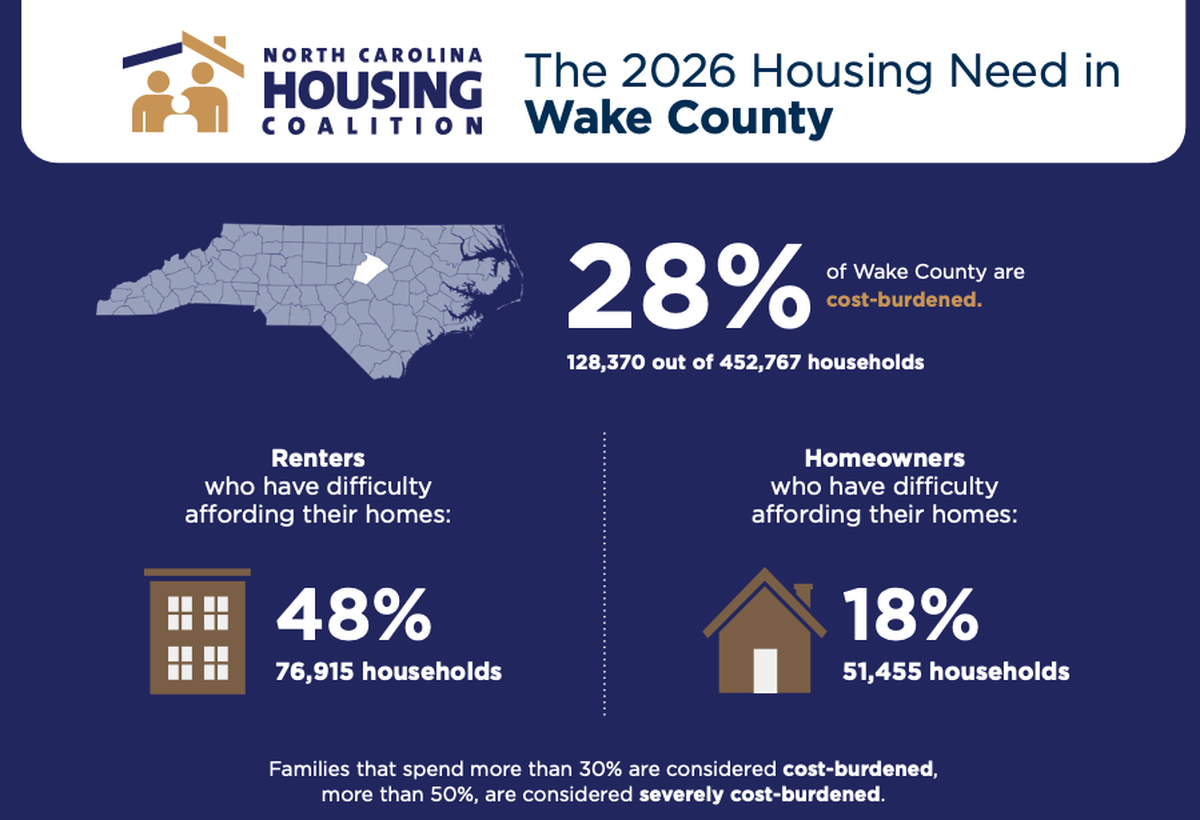
Wake County’s 28,369 eviction filings and 76,915 cost‑burdened renters make it the epicenter of the region’s affordability crisis.
Even if its percentages resemble Durham and Johnston, the scale is unmatched. Wake County has more than three times the population of Durham County and more than five times that of Johnston County.
Overall, nearly 28% — 128,370 out of 452,767 households — are cost-burdened. It ranked No. 10 for eviction filings among renter households (the highest in the region). Some 18% of homeowners (51,455 households) are also struggling to afford their homes, up from 48,177 households in 2025. Some 861 families faced foreclosure this year.
Durham renters also feel the strain
Meanwhile, Durham County mirrors Wake’s renter strain but with a smaller profile.
Durham had 29,136 cost-burdened renters and ranked No. 20 for eviction filings, showing a market where growth and displacement pressures are tightly linked.
Overall, nearly 31% — 43,236 out of 138,684 households — are cost-burdened, up from 41,318 households in 2025.
Some 6,763 households faced an eviction filing, and 271 families faced a foreclosure.
Across all five counties, wages do not come close to housing costs
The numbers vary slightly by county, but the pattern is identical everywhere: Wages earned by core service workers, such as teachers, firefighters and those in construction, fall tens of thousands of dollars short of what it takes to afford even a modest two-bedroom apartment.
Take, for example, a full‑time construction worker in Orange County, often earning around $18 to $22 an hour. That translates to roughly $37,000 to $45,000 a year.
To afford a typical two‑bedroom apartment at fair‑market rent, they’d need a “housing wage” that is significantly higher: around $32.90 per hour, or $68,440 a year to avoid being cost‑burdened. That means a construction worker would need to work 50 to 70 hours a week to afford that rent without strain.
In Wake County, it’s even higher. They’d need to earn closer to $33.65 per hour, or $70,000 a year, to afford their housing.
The coalition’s county profiles provide a snapshot of housing needs for each of the state’s 100 counties.
The profiles are updated annually to reflect new data from the most recent American Communities Survey, FY 25 HUD Fair Market Rents, U.S. Bureau of Labor Statistics, Civil Issue Filing and Order Results – NC Administrative Office of the Courts, and Hurricane Helene Designated Disaster Areas.
For statewide findings, go to www.nchousing.org.
This story was originally published March 3, 2026 at 2:32 PM.