
NC sheriff honored for saving birds in ‘cockfighting hub’ of East Coast
A North Carolina sheriff has received a national award for saving dozens of birds from cockfighting — an illegal blood sport that pits roosters with knives attached to their feet against one another in often fatal combat.
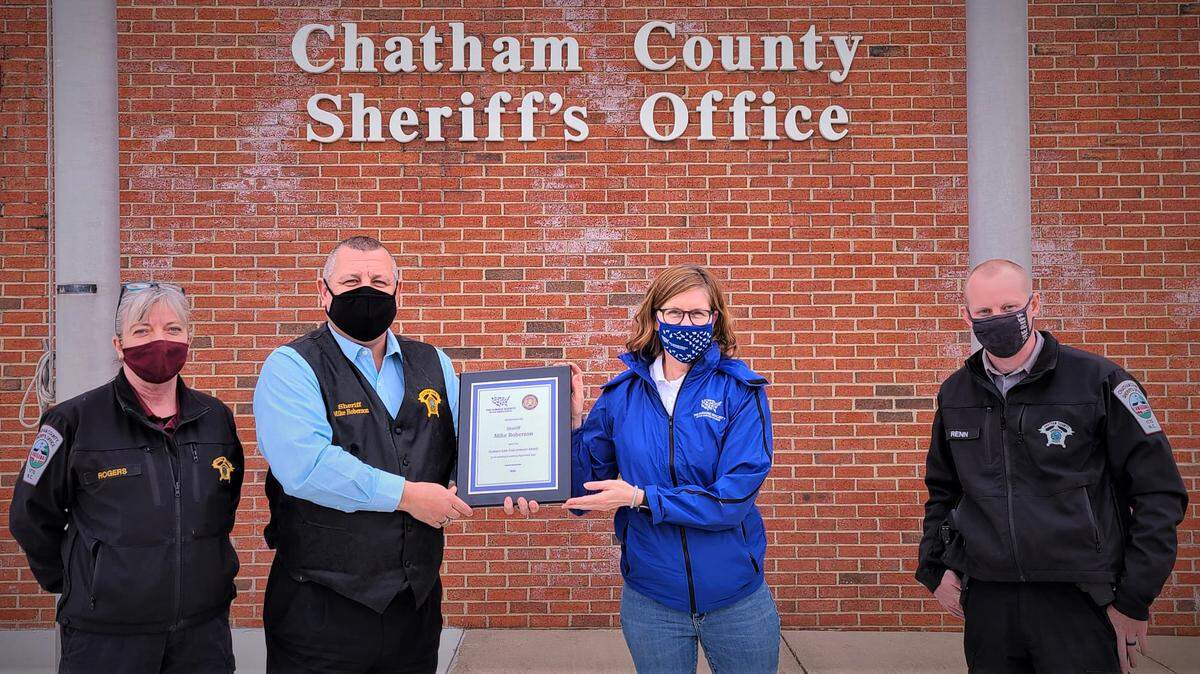
Chatham County Sheriff Mike Roberson received a 2020 Humane Law Enforcement Award from the Humane Society of the United States this month for busting a cockfighting operation in New Hill, near southwest Wake County, in February of last year.
Cockfighting is illegal in all 50 states and became a felony in North Carolina in 2005. Still, it is widespread in the state, where legal loopholes make it hard for law enforcement to crack down, said Gail Thomssen, the North Carolina state director for the humane society.
The HSUS has uncovered game fowl farms in at least 70 of the state’s 100 counties.
“Sheriff Roberson sees that it is a problem, and he chose to do something about it,” she said. “He sees it not only as being animal cruelty, but as being detrimental to the community.”
Deputies rescued dozens of birds, many injured, sick
On Feb. 23, 2020, a tip led Chatham deputies to a home on Old U.S. 1 in New Hill, where they discovered a cockfighting exhibition in progress, according to an incident report obtained by The News & Observer.
The property owners, Margarita Juarez and Jesus Ibarra, were charged with felony cockfighting and misdemeanor cruelty to animals.
In a statement, Roberson praised the entire Sheriff’s Office and its partnerships within the community and animal care and rescue organizations.
“It’s about all of us working together to make significant, necessary advances in animal welfare in Chatham County and across the state,” he said.
HSUS said dozens of birds were confiscated in the operation, many of which were sick or injured. Sara Pack, a spokeswoman for the Sheriff’s Office, did not respond when asked how many birds were found on the property.
But Thomssen added that even among those saved, many birds had to be euthanized. The close quarters the birds are held in, along with the mixing of blood that occurs during fights, allow diseases to spread rapidly among the roosters, she said.
Some diseases, like the highly fatal Exotic Newcastle disease, pose a threat to other birds — while others, like Avian flu, are dangerous to humans.
Pack also did not respond to an N&O request for the number of rescued birds that were euthanized.
Thomssen said the HSUS has helped care for the surviving birds, which are being held as evidence while the case remains pending.
NC breeders illegally shipped hundreds of birds to Guam, group says
In January, a pair of nonprofit rescue groups asked U.S. attorneys in North Carolina to launch an investigation into animal cruelty after their analysis found breeders in the state had illegally shipped hundreds of fighting birds to Guam, The N&O previously reported.
North Carolina was among the top five exporters of the roosters to Guam, according to the report by Animal Wellness Action.
It is against federal law for any person in the United States to knowingly sell, buy, possess, train, transport, deliver, or receive any animal for purposes of having the animal participate in an animal fighting venture. The sport was outlawed in U.S. territories, including Guam and Puerto Rico, in 2019.
AWA President Wayne Pacelle called cockfighting a “barbaric and inhumane practice” and “one of the most widespread forms of animal cruelty in the world.”
He said it has “been invoked by cockfighters as a cultural practice,” especially in Cajun, Mexican, and Filipino communities — but added he believes the claims are “without foundation.” Cockfighting dates back thousands of years, across cultures that span the globe he said.
He added that AWA has conducted polls in Guam, Puerto Rico and Louisiana that found widespread support for laws prohibiting cockfighting.
“Clearly, you have small numbers of people of Puerto Rican descent, or Romanian descent, or Mexican descent, who do believe in it, and are ardent,” he said. “But I think they’re mistaking their passion for it, for general support among people of that nationality or ethnicity.”
In North Carolina and other states, cockfighting has made breeding highly profitable for those who illegally ship their birds for as much as $2,000 a rooster to buyers across the globe.
“Of states on the eastern seaboard, it is the cockfighting hub of the United States,” Pacelle said of North Carolina.
Breeders regularly participate in cockfighting competitions in order to build up reputations for “good bloodlines.”
“They’re inseparable activities,” he said. “No one’s interested in your birds if you’re not a cockfighter.”
A spokesman for the U.S. Attorney’s Office in Raleigh said it could not confirm or deny the existence of any ongoing investigations.
Advocates call for legal, administrative changes
Thomssen said outlawing the possession of birds for fighting, and the manufacturing and sale of animal fighting paraphernalia would help state law enforcement agencies arrest and prosecute those engaging in cockfighting.
“Unless there is a cockfight in progress, there’s nothing that they can do (now),” she said. “They can go and find hundreds of these roosters, they can find the blades that are attached, they can find any of the paraphernalia that’s used — but unless they actually catch them in a fight, their hands are tied.”
According to The American Society for the Prevention of Cruelty to Animals, the possession of birds for fighting purposes is prohibited in 39 states and the District of Columbia. North Carolina is not among them.
Thomssen has spoken to state legislators and hopes the HSUS will be able to get a bill introduced this legislative session.
But Pacelle said “the biggest problem is not the federal or state statutes, it’s the lack of enforcement.”
He added that AWA has launched a new legislative initiative, seeking the establishment of an animal cruelty crimes division at the Department of Justice. Cockfighting and other animal cruelty violations are currently under the Environment and Natural Resources Division, which has 10 subsections within it.
A dedicated animal cruelty crimes division, Pacelle said, would provide the resources to crack down on cockfighting and other illegal activity across the country.
The bipartisan Animal Cruelty Enforcement Act was introduced in the U.S. Senate last year, and again in the U.S. House in February. It would establish the new division, and require the Department of Justice to report annually on progress made in enforcing animal cruelty statutes.
“We need enforcement,” Pacelle said. “But it’s not enough just to have the will; you have to have the capacity. You have to have a signal from a legislative body that this is important, and we’re going to give you dedicated resources to address this problem.”
Staff writer Tammy Grubb contributed to this report.
This story was originally published March 26, 2021 at 11:29 AM.