Think you could make it after prison? NC simulation shows the real-life challenges.
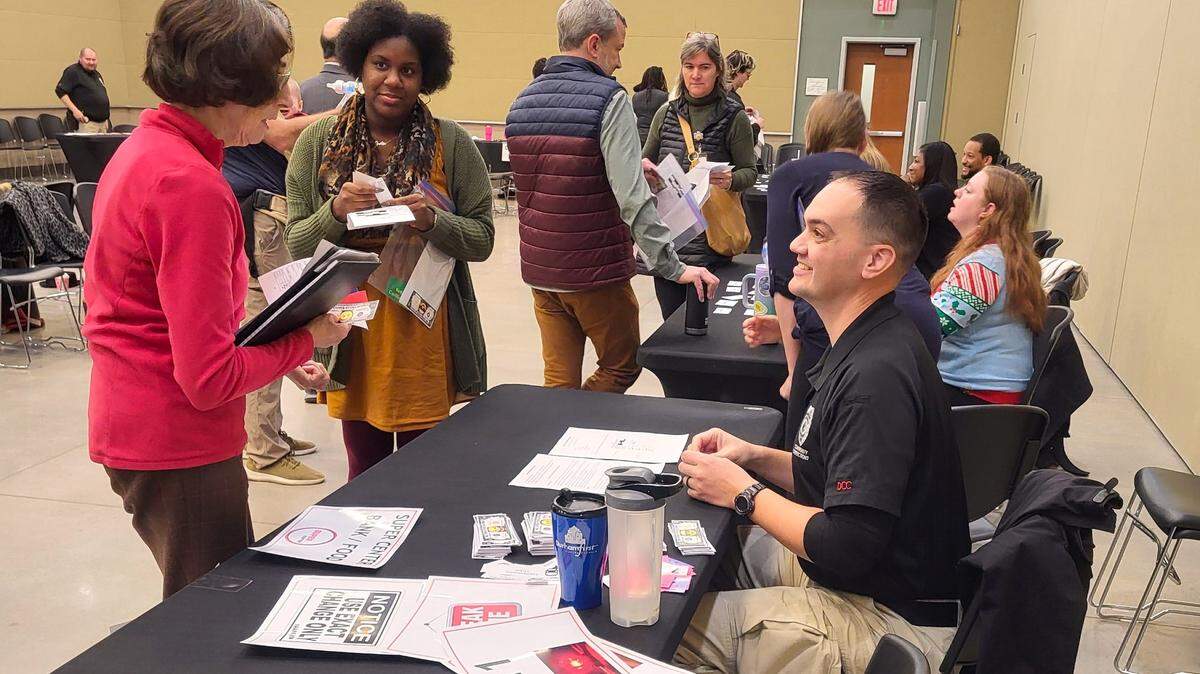
For a few hours Tuesday morning, Judge Todd Roper experienced a bit of what life is like when a person is released from prison.
During a simulation event in Pittsboro, the Chatham Orange District Court judge traded his robe for the role of a man on probation who is trying to re-enter society after a prison sentence.
He had to meet with his probation officer, but he had no car and no way to get there.
He was jailed for violating probation but had no money to post bail. The little bit of money he received in disability checks went to housing and food costs. He also had to find a way to get to the DMV to get an ID.
“It was one of the most humbling experiences I’ve been a part of,” Roper told The News & Observer.
About 45 people — court clerks, nonprofit workers, judges, assistant district attorneys, law enforcement and county officials among them — participated in the re-entry simulation at the Chatham County Agricultural Center. The exercise was hosted by Chatham County Court Programs, in collaboration with the Middle District of the U.S. Attorney’s Office, Vaya Health and Chatham Drug Free.
It was the first such simulation there, similar to an event hosted at N.C. Central University in September by the Task Force for Racial Equity in Criminal Justice, established by Gov. Roy Cooper in 2020.
How the simulation worked
The simulation was held in 15-minute increments over three hours, with each segment presenting participants with a different set of challenges for people returning to the community.
Make-believe money was used in the program. A pawn shop and a plasma donation center gave participants the opportunity to come up with funds to pay court costs, post bail, or get an ID.
Participants had to complete several tasks during a simulated four-week post-release period that demonstrated the obstacles faced when transitioning back into society.
“You have all of these obligations, things you need to survive, court demands ... it was impossible to complete the tasks,” Roper said.
The participants visited 15 stations that represented the jail, the department of social services, the bank, an employer, a health clinic, probation, the DMV, church and other places.
“I would like to think that everyone that participated is probably going to extend a little more compassion to those that they’re serving,” said Renita Foxx, who is director of Chatham County Court Programs. “To see what it’s like to walk in the shoes of clients of court programs.”
The county is working with the Department of Public Safety and local nonprofits to develop a Reentry Council in 2024, Foxx said. She drew ideas and support from the Lee County District Attorney’s Office for the reentry simulation.
“We want our stakeholders to understand the importance that we get this established and to be able to provide resources to our community,” Foxx said.
Public officials react
“We need to elect (legislators) that want to take care of North Carolinians and it shouldn’t be left upon counties,” said Chatham County Commissioner Katie Kenlan, who participated in the event. “But the county is going to do everything that we can.”
One thing that stood out to Kenlan were the issues that make it difficult for people to avoid reoffending post-release, such as trespassing while being homeless, or spending time with someone with a criminal record while on probation.
For Roper, the simulation made him reflect on his job, which involves sentencing people convicted of a crime to prison.
“Re-entry-level people, they are part of our community; how do we help them get a new start without being hopeless?” he said. “From a judge’s perspective, we have to think about before we sentence somebody: what are their main struggles? What do we want to achieve in our sentence?”
Identifying ways to support people in re-entry and reducing recidivism will be better economically for counties that don’t have to foot the bill for jailing more people, he said
“Once you put yourself in that person’s shoes, it can dramatically change your perspective,” Roper said.
This story was originally published December 20, 2023 at 10:02 AM.