Britanny Brown stood outside Building 41 and pointed out the reality of living in McDougald Terrace.
Brown, 28, pointed to apartment A, occupied by a mother grieving the death of her 20-year-old son in May. He was shot around the corner and on the edge of the 25-acre public housing complex covered with monotonous brick buildings.
In apartment B, another mother is grieving the death of her 18-year-old son who was fatally shot in August on Chapel Hill Road.
And then there was Brown, who lives in apartment C. Her son Britain, who was five weeks old, died Dec. 8.
She put him down in a baby seat after feeding him at 2:30 a.m. When she picked him back up around 6:30 a.m., he was cold.
“Everything is more deeper than what really people (are) thinking about this situation,” said Brown, who wears Britain’s green pacifier on a chain around her neck. “It goes way farther than just the carbon monoxide situation. This whole building is corrupt.”
Brittany Brown, 28, left, and Damaris Burnette, 27, stand for a portrait on Friday, Jan. 3, 2020, outside their apartment at McDougald Terrace, the largest public housing community in Durham, N.C., where they believe their infant son Britain Brown died of carbon monoxide poisoning on Dec. 8, 2019, soon after another infant in the community also died suddenly on Nov. 20, 2019. After the deaths and several other poisoning reports, housing officials conducted inspections of all units, held a community meeting, then ordered an evacuation of all residents to nearby hotels. Casey Toth ctoth@newsobserver.com
Brown believes carbon monoxide and the apartment’s poor condition — mold, roaches, mice, and aging gas appliances — killed her son.
Britain is one of two infants who have died at McDougald Terrace since Nov. 20. The infants are at the center of the concerns at the complex.
Initially, residents say Durham Housing Authority and city officials dismissed the reports of gas and concerns about carbon monoxide.
But that changed after the authority’s CEO, Anthony Scott, learned Dec. 26 about an unusual number of carbon monoxide calls at the public housing complex on Lawson Street. The authority did a three-day inspection of the complex and began evacuating residents to hotels last week.
There have been roughly 10 incidents possibly involving carbon monoxide exposure since Nov. 20, 2019, according to an email Friday from Jim Groves, the Durham County fire marshal and emergency management director. Seven involved children.
A Durham EMS official said carbon monoxide can’t be ruled out in the babies’ deaths.
The North Carolina medical examiner’s office is still investigating the deaths and tests are incomplete, according to a Department of Health and Human Services statement.
Brittany Brown, 28, left, and Damaris Burnette, 27, stand for a portrait on Friday, Jan. 3, 2020, outside their apartment at McDougald Terrace, the largest public housing community in Durham, N.C., where they believe their one-month-old son Britain Brown died of carbon monoxide poisoning on Dec. 8, 2019, soon after another infant in the community also died suddenly on Nov. 20, 2019. After the deaths and several other poisoning reports, housing officials conducted inspections of all units and held a community meeting. Casey Toth ctoth@newsobserver.com
City Council meeting
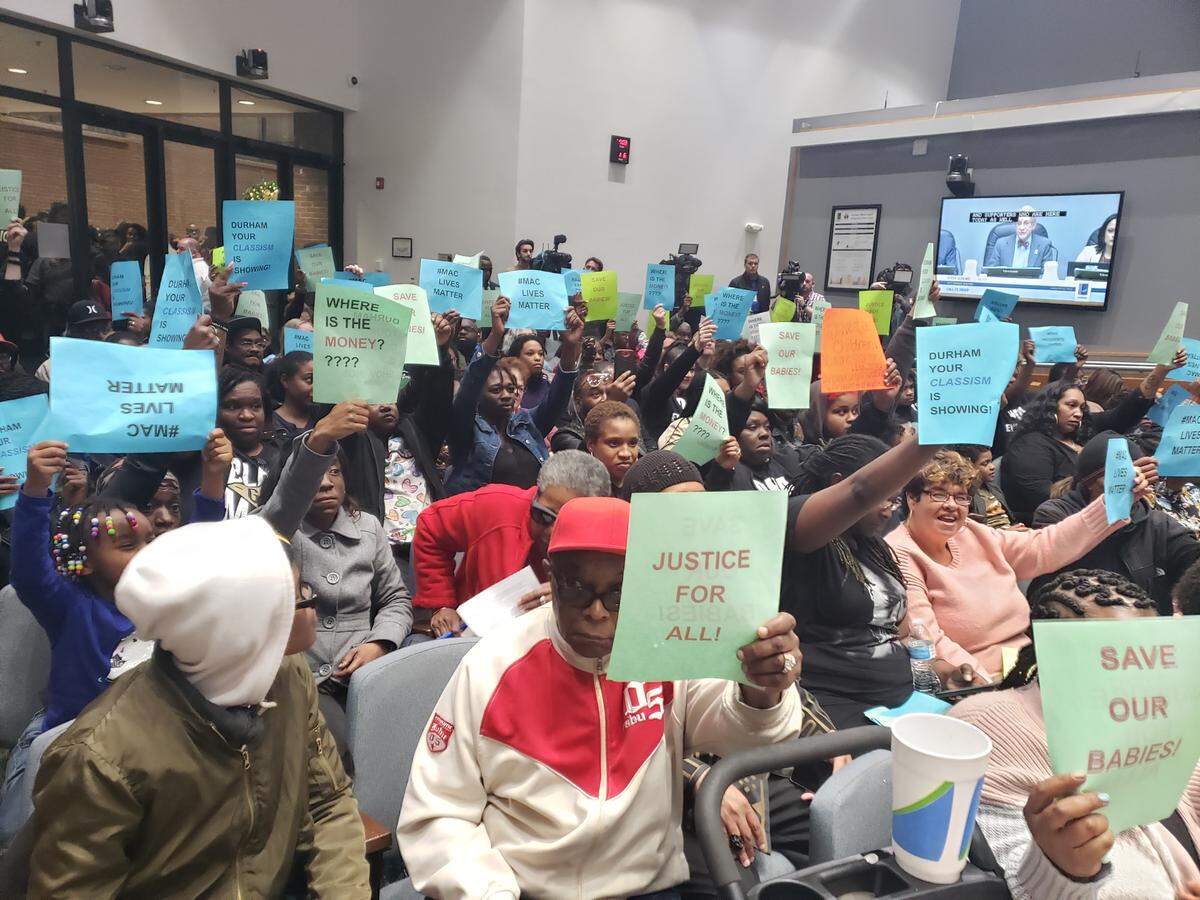
On Monday night, DHA residents and their supporters filled City Hall and told stories of mold on their walls, holes in their walls, and roaches falling from their ceilings.
They are scared to fall asleep, they told the elected leaders, and they stand over their children to make sure they are still breathing.
“My question is to the city of Durham: Have you ever had to look in your babies (eyes) in fear of death because of the condition of your living situation?” asked Samanther Crowder, 34, as she held her 6-month-old daughter.
She calls in work orders to the Durham Housing Authority but said it takes months to get help.
And now, she is staying at hotel, where at least 171 McDougald Terrace families have been evacuated, trying to figure how to get most of her five children to different schools.
“This is really stressful on another level,” she said.
Shaunkyra Douglas, 32, said she wants to know how she will know it is safe for them to return.
“What proof can we have that it is safe for us to go home, because we thought it was safe to live there,” said the mother of two.
Black mold painted over
Mamie Beal brought a cup to show the City Council the mysterious substance that keeps showing up on her plates, her cups and on her refrigerator.
Others told stories of black mold being painted over and described the situation as Durham’s Hurricane Katrina — a disaster, they said, that could have been prevented.
Still others asked for Scott’s resignation, for new representation on the authority board and why McDougald Terrace, the city’s largest public housing complex with 360 apartments, wasn’t included in the $95 million affordable housing bond that Durham voters passed in November.
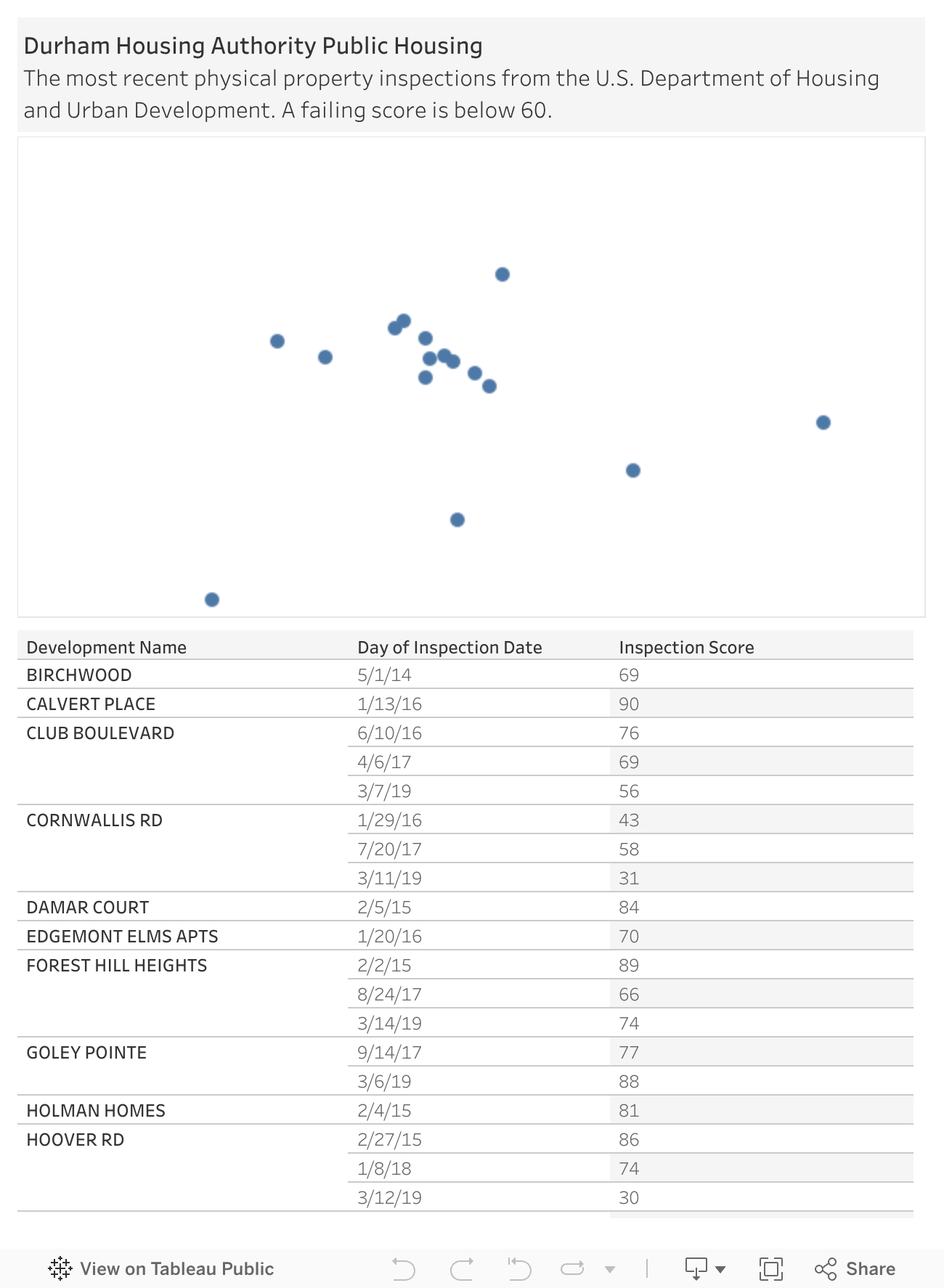
The U.S. Department of Housing and Urban Development inspections gave the complex failing scores on inspections in 2017, 2018 and 2019 according to HUD inspection data. Six out of the 13 DHA properties inspected in 2019 fell below 60, according to HUD inspection data.
“You have done nothing again, and black children have died,” said activist Victoria Peterson. “You could have done something.”
Durham Housing Authority residents and supporters hold up signs at the Durham City Council meeting on Jan. 6, 2019. Residents at the meeting expressed outrage about the conditions of their apartments and carbon monoxide concerns. Virgina Bridges vbridges@heraldsun.com
Infants’ deaths raise concern
Resident Council President Ashley Canady said people have been raising concerns about gas leaks and carbon monoxide since at least the summer.
Residents already scared to go outside because of shootings are now afraid to heat their homes, take warm showers and cook their food.
Among their requests, residents asked for proper documentation of maintenance requests, a thorough inspection of all units and compensation for Canady who has worked more than 200 hours, she said, communicating and organizing to help the residents.
Neither infant’s death was reported to be related to carbon monoxide exposure. The Durham Fire Department has said there was no indication of CO in the incidents. Emergency Medical Services said at a meeting with residents last week that CO could not be ruled out until autopsies determine the babies’ official cause of death.
On Dec. 26 Scott received a call about unusual CO levels at McDougald Terrace, he told the council. He then called for inspections of all the units to ensure CO detectors and fire alarms were working. Four people were found with elevated levels of CO. Six apartments had elevated levels but below the detection levels of the CO detectors.
Repairs were made to those apartments as well as in 14 apartments that reported gas leaks.
On Friday, Jan. 3, Scott learned of two more residents with elevated levels of CO and decided to start a voluntary evacuation.
More than 171 families have been relocated to 11 hotels and 30 families are on a waiting list, he said. Officials have arranged transportation to schools and are working to provide stipends to the families, some of whom don’t have a kitchen in their hotel rooms.
Scott said they are having issues obtaining the bank cards for stipends, but he hopes to have that resolved by Tuesday morning.
Next steps include having all the inspected units repaired by an independent contractor, which started Tuesday.
In the long term, Scott said, DHA wants to rebuild McDougald Terrace along with other aging communities. He said he has reached out to congressional representatives about any possible federal dollars to help. He has also asked for state and local assistance, he said.
Scott, who started at the authority in 2016, attributed the decline to a long-term reduction in federal funding and not responding properly to residents’ concerns. He said the recent hiring of Emanuel Foster as director of housing operations will also be key in the effort to address the issues.
The News & Observer requested an interview with Scott and additional information from DHA on Tuesday but had not received a response by late afternoon.
‘I need these things done pronto’
Brown and her two children, now 2 and 6, moved into McDougald Terrace on May 1, 2018. She pays about $50 a month for the two-bedroom home.
About seven months later she started having concerns about her refrigerator not staying cold enough to keep her food from spoiling.
Her stove, with the top stained black, smoked and only one burner worked. Her neighbor’s refrigerator kept leaking into her apartment. Brown could smell in her kitchen the mold in her neighbor’s cabinets, she said.
Then there was the smell of sewage in her backyard that tortured her and her neighbors over the summer that was finally fixed in the fall, she said.
She started going to the office every month to complain, and someone would put it in a computer and charge her from $25 to $100, but the issues were never addressed, she said.
“I am a month away from having a baby,” she said she told someone in the office. “I need these things done pronto.”
Macaroni noodles boil on the stove that Brittany Brown, 28, believes to be leaking carbon monoxide and the cause of her infant son Britain’s death on Dec. 8, 2019, in Brown’s apartment at McDougald Terrace, on Friday, Jan. 3, 2020, in Durham, N.C. Casey Toth ctoth@newsobserver.com
Staying safe
Before her nearly 5-month-old was found dead Nov. 20, Brown had created a system she hoped would keep her family safe.
She kept the air on and sent her family upstairs when she used the ancient gas oven and stove. She never used the furnace, which is stacked with clothes. Instead her family relies on three floor heaters.
Brown and her boyfriend, Damaris Burnette, 27, constantly checked Britain, who was usually in her Dad’s arm.
But on Dec. 8, Brown said, she wasn’t consistent in following her strategy. She and the baby stayed downstairs after she fed the baby and then made a hot pocket in the oven for herself and cleaned.
“I wasn’t checking, checking, checking,” she said.
Water boils to cook macaroni noodles on the stove that Brittany Brown, 28, believes to be leaking carbon monoxide and the cause of her infant son Britan’s death on Dec. 8, 2019, in Brown’s apartment at McDougald Terrace, on Friday, Jan. 3, 2020, in Durham, N.C. Casey Toth ctoth@newsobserver.com
When she did check, he didn’t move. She called 911 and started CPR. A paramedic took over and then picked Britain up and ran.
Brown and Burnette said the apartment was tested hours after they returned from the hospital, but conditions had changed as many people had left the apartment.
After the second baby died, The News & Observer requested the most recent Department of Housing and Urban Development inspection of McDougald Terrace.
The one provided was done in May 2018, which Scott and Foster said was the most recent report.
In it, McDougald scored a 34 out of 100 in a system that considers a 60 failing.
Online documents indicate that the housing complex scored a 31 in a March 2019 inspection.
On Monday, a reporter again asked Scott whether 2018 was the most recent inspection and he said it was but he would double check.
The funeral announcement for Brittany Brown’s infant son Britain who she believes died, on Dec. 8, 2019, from carbon monoxide poisoning, decorates the in their apartment at McDougald Terrace, on Friday, Jan. 3, 2020, in Durham, N.C. Casey Toth ctoth@newsobserver.com
City Council, DHA relationship
The Durham City Council appoints the DHA board, which includes City Council liaison Jillian Johnson.
In an interview after Monday’s meeting, Mayor Steve Schewel said over the past eight years the council’s relationship with DHA has transitioned from “holding them at arm’s length” to working together very closely.
In addition to the $95 million bond that will support housing authority projects, the city has dedicated millions of dollars to plug funding gaps to renovate Damar Court, Morreene Road, and Laurel Oaks.
Schewel said “all of us” should be held accountable for the conditions.
Funding for public housing has declined since the 1980s as low income housing tax credits and other tools helped privatize the creation of affordable housing.
“What I have seen even in my time on the City Council is the continual shrinking of just the most basic maintenance funds,” he said.
For 40 years the housing authority has been patching up McDougald Terrace because there is no money to replace it and “precious little money” to repair it, Schewel said.
“I think we as a community looked away from that because the people who lived there were poor and African American, and I think it is the legacy of racism,” he said.
Scott said McDougald wasn’t included in the bond because renovating the complex, which was completed in 1953, will take a lot more planning and studies.
Durham Housing Authority Chief Executive Officer Anthony Scott answers questions during a meeting held after seven carbon monoxide poisonings were reported at McDougald Terrace within in 30 days and two infant deaths reported, which were unrelated to the carbon monoxide according to the Durham Fire Department, at Burton Elementary School on Thursday, Jan. 2, 2020, in Durham, NC. Casey Toth ctoth@newsobserver.com
Unanimous support
Council members called for action locally and on the national level.
“I look forward to the housing authority letting us know what the price tag is, and I suspect at that time we will be working with our state and federal partners to figure out how to pay that bill,” Council member Charlie Reece said.
Johnson said the city has approved every request the housing authority has made for funds and will continue to support requests, she said.
The situation reminded council member Mark-Anthony Middleton why he ran for office as he pointed to some of constituent issues his fellow members have supported.
“This is bike lanes for me. This is tree canopies for me. This is climate change for me,” he said. “And they are all important issues, but, but this. Our babies no one can … protect except us. It starts here. It has got to be unequivocal. And it is has to be every day.”
Staff reporter Will Doran and data editor David Raynor contributed to this report.
This story was originally published January 7, 2020 at 11:31 AM.
Virginia Bridges covers what is and isn’t working in North Carolina’s criminal justice system for The News & Observer’s and The Charlotte Observer’s investigation team. She has worked for newspapers for more than 20 years. The N.C. State Bar Association awarded her the Media & Law Award for Best Series in 2018, 2020 and 2025.

 "RAL_20200103_brittanybrown_(2)")