‘Give us a chance,’ says resident after Durham Housing Authority gets $2.3M jobs grant
Connell Green has worked a lot of jobs in his 55 years. At one point, he went from Pizza Hut dish washer to Pizza Hut manager in just a short time, even training other managers on how to do their jobs.
But when a support beam fell on his head in the early 2000s during a small construction job, everything changed. The accident fractured his skull and temporarily paralyzed him
“I had to learn how to do everything all over again,” Green said. “Like a baby, for real. I had to learn how to talk, walk, eat, everything.
“It took about seven years for me to get back.”
Now he lives at McDougald Terrace, the Durham Housing Authority’s largest public housing property, where he’s been the past seven years. During baseball season, he works in the Durham Bulls Athletic Park kitchen, washing dishes. In the offseason, he’s unemployed, living solely on his disability benefits.
DHA recently announced it’s receiving a $2.3 million grant from the U.S. Department of Housing and Urban Development to help McDougald Terrace residents find jobs. Green hopes to be one of them.
Durham public housing history
McDougald Terrace opened on Lawson Street in 1954 as the “local Negro project” after the white Few Gardens project a couple of years prior. The properties were built for low-paid, local factory workers who couldn’t find or afford housing after the Federal Housing Act of 1949 provided money for “slum clearance,” according to the DHA website.
In the early 2000s, the housing authority received a $35 million revitalization grant to redevelop Few Gardens and the surrounding area. It’s since been demolished and replaced by a number of town homes and rental units.
Meanwhile, the monotonous, brick buildings at McDougald Terrace look much like they did in 1954, despite multiple plans over the past decade. Until recently, many units still had original stoves and heating appliances leaking carbon monoxide that forced DHA to evacuate 285 households in January. The authority began allowing people back last month and now hopes to return everyone by April.
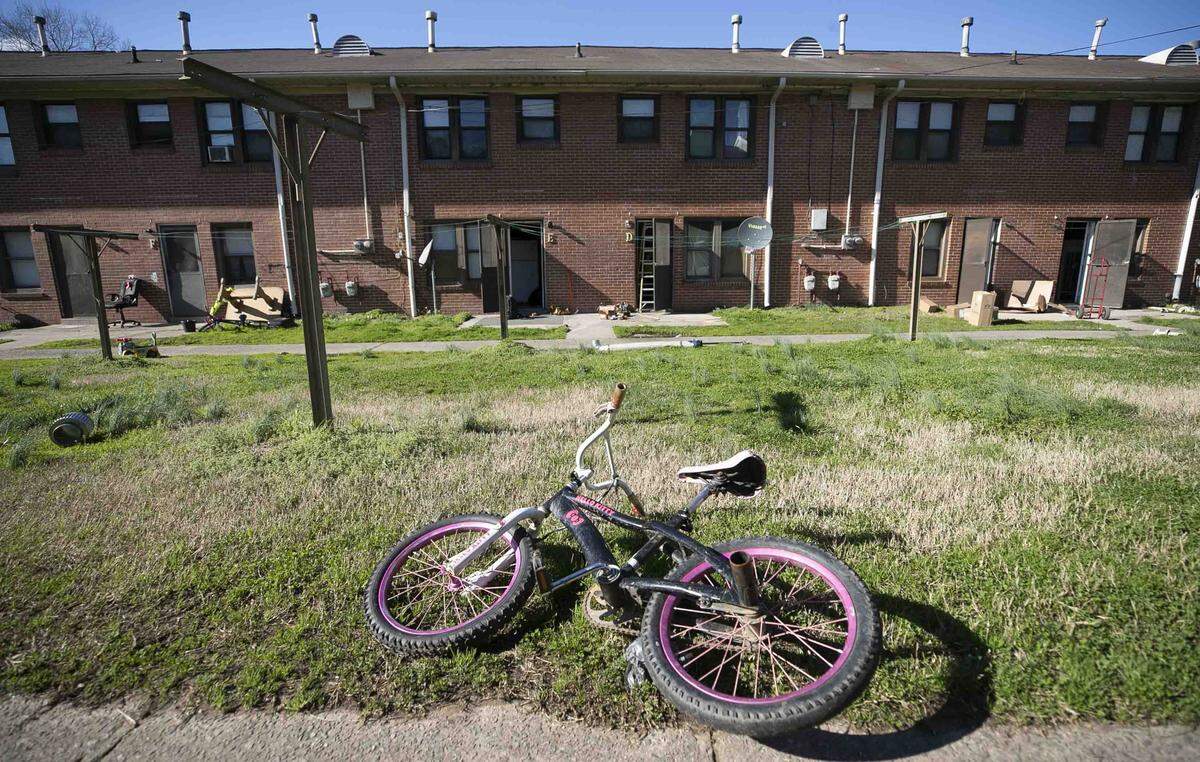
Today many McDougald Terrace residents are in the same situation as their predecessors more than 60 years ago: black and poor.
According to DHA’s CEO Anthony Scott, residents at the housing authority’s 13 different communities, who are majority African American, earn about 12% of the average median income. Around 500 households on DHA properties have no income at all, and a significant portion are seniors on fixed-incomes or people with disabilities.
The employment grant from HUD will help some residents, but DHA says the point of public housing isn’t about moving people out, but offering them housing they can afford.
“It was once the motto of most public housing authorities to work on an ‘up and out’ strategy, but the thinking on that subject has changed considerably, and maybe even is reversed in some ways,” general counsel Carl Newman wrote in an email. “Stressing an ‘up and out’ plan furthers the stigma that attaches to receiving public benefits.”
Employment and income goals
The Jobs Plus program awards about seven grants a year across the country. The DHA grant is only for McDougald Terrace.
HUD says the grant is meant to promote work readiness, employer linkages, job placement, educational advancement, technology skills and financial literacy. In a press release, Scott said it will also pay for services like child care, youth activities and transportation.
The most prominent feature of the grant is the Jobs Plus Earned Income Disregard (JPEID), which guarantees people’s rent will not increase, even if their incomes go up, during the four years of the grant. Public housing rent is typically calculated at 30% of income, but some residents pay a minimum rent of $50 because they have no consistent source of income.
DHA estimates that 352 adults will qualify for the program, out of 1,051 total residents. and that roughly 100 will participate. DHA said this could cut the property’s 66% unemployment rate in half.
The grant will prepare residents for jobs in food preparation, retail, construction, home health care and manufacturing, among other areas.
Green, currently living at RTP Extended Stay, said he and other public housing residents face job discrimination because of where they live, even if they have performed similar work in the past.
“I have experience,” he said. “But because of the words they put on us when we live at McDougald Terrace, it makes them not want to look at us for those jobs. ... You never know what potential a person has if you don’t give them a chance.”
‘C.D’s Recovery’
Antonio Hampton, also currently at the RTP Extended Stay, said moving into his own house is part of his 5-year plan. Before moving into McDougald Terrace in 2018, he spent more than 16 years selling children’s books and magazines. Now he pays minimum rent and says he has a license and a car, and just needs a job.
Hampton, 40, has been filling out applications for FedEx and UHaul because they offer benefits. He once did housekeeping at a hotel and said he’s “willing to work on whatever I need to do.”
When asked if he’d want to stay in public housing if he had a steady income, he said, “No, why would I?”
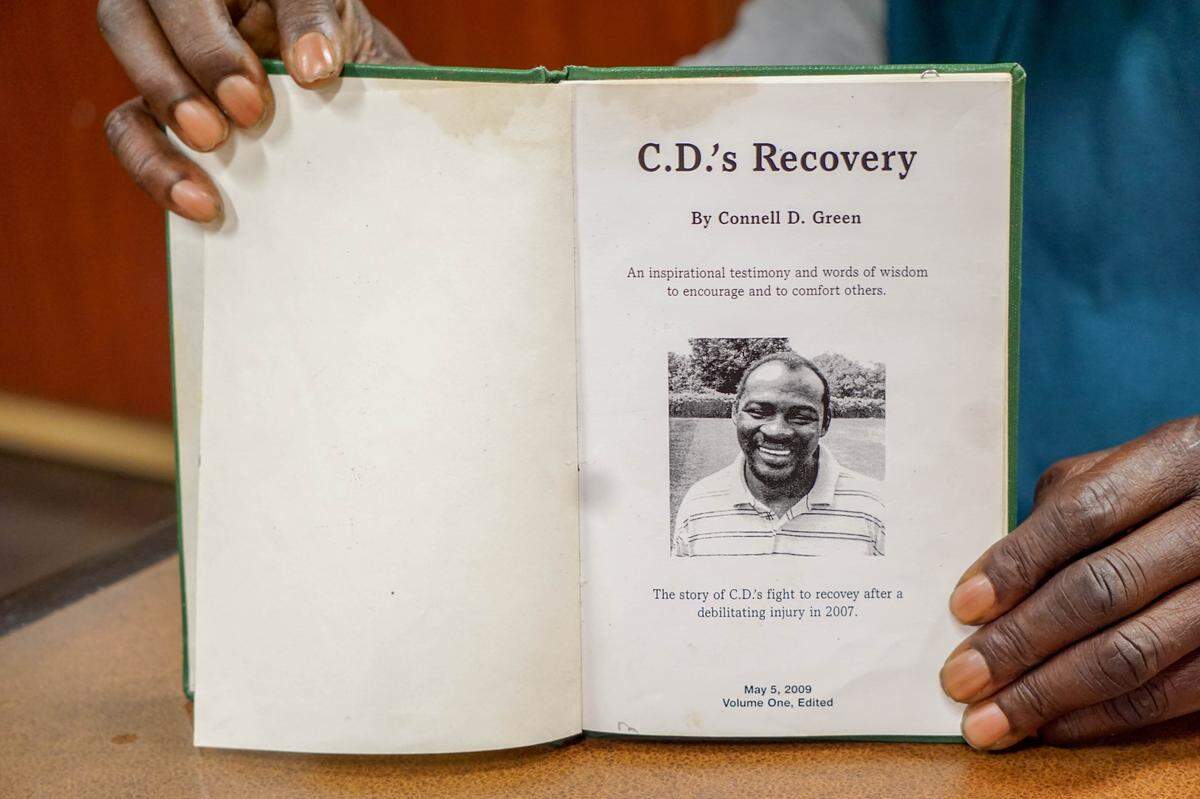
Connell Green can’t do construction work since his injury but said he’s willing to learn new skills. In a book of poems and short essays he wrote called “C.D.’s Recovery” he describes using the right tools for a job. He wrote it after a doctor suggested keeping notes on his thoughts; a woman working the front desk at the Extended Stay is currently reading it.
“In order to get the right tool for the job, it is not to use every tool that you see.
No, it is not to choose the one that gets the job done the fastest.
No, the tool that brings satisfaction to your mind is the one to use, because every hammer does not pull a nail,
some nails have to be pulled by a crowbar.”
He said he’d like to get a year-round part-time job, so he too can move from McDougald Terrace. He wants to move into a home supported by a Housing Choice Voucher, a program that gives low-income families the opportunity to rent in the private market.
“I’m used to having a house with a yard to cut,” he said.
Staff writer Virginia Bridges contributed to this story.
This story was originally published March 2, 2020 at 11:59 AM.