
‘You’ll never see it coming’: Did Durham County sheriff’s ‘ghost car’ tweet backfire?
This story was updated Feb. 16, 2021, to clarify state law regarding ticket revenue.
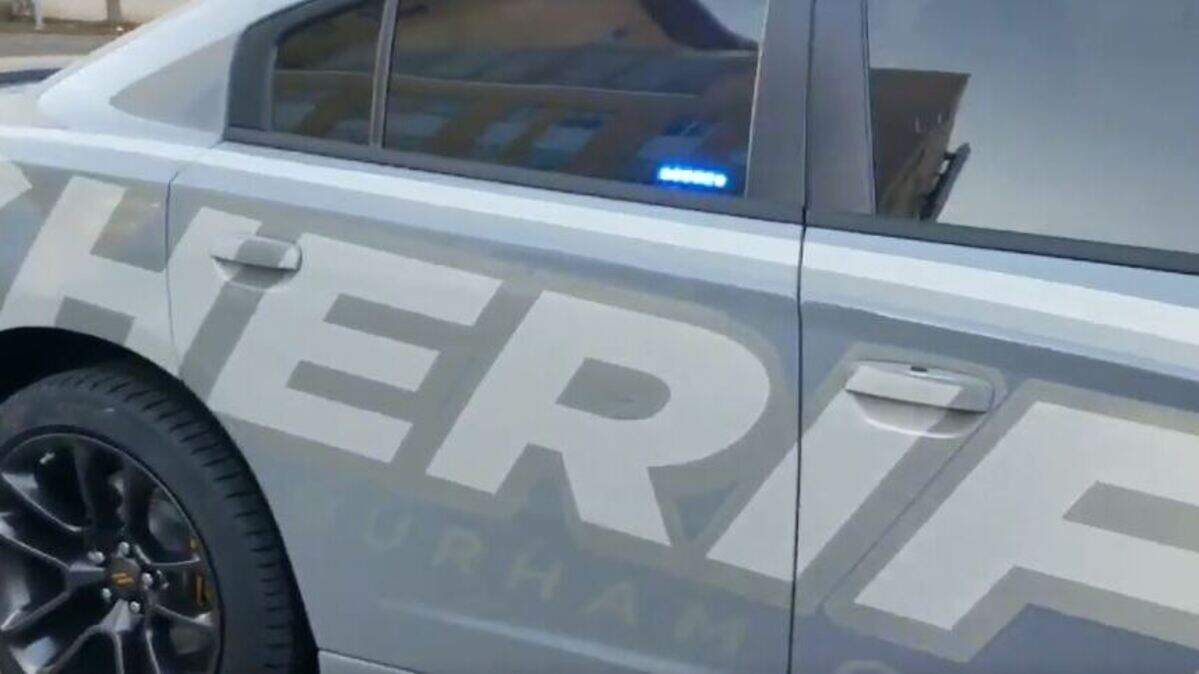
The Durham County Sheriff’s Office says it never expected the response a recent tweet about its so-called “ghost car” received.
Most of the Sheriff’s Office’s posts attract a handful of responses, and sometimes none. Its Jan. 13 tweet unveiling the car with muted graphics that make it harder to identify as a law enforcement vehicle got nearly 10,000 engagements.
“You’ll never see it coming, especially at night,” the Sheriff’s Office wrote in the tweet. “Make sure you’re not speeding, wear your seatbelt, and stay sober behind the wheel.”
AnnMarie Breen, a spokeswoman for the office, said the term “ghost” refers only to its graphics, and that “the car itself is the same as our other patrol cars.”
“Its purpose is to be used for traffic enforcement and at special events,” she said, adding it was part of the Sheriff’s Office’s ongoing effort to crack down on reports of speeding and unlawful street racing.
The vehicle cost $29,248, Breen said. That’s slightly more than the $27,477 she said the office’s standard vehicles cost.
Five days after users on Twitter lashed out at the office for its tweet, the Sheriff’s Office said it “never expected such a large response to this video.”
“Its intent was to be a lighthearted look at a tool our traffic unit uses to keep roads safe but it was taken out of context for some,” the office wrote in a tweet. “DCSO values your thoughtful feedback and will continue to be engaged with the community it serves.”
Duke law professor explains wariness
Brandon Garrett, a Duke Univerity law professor who has done extensive research in the field of criminal justice, says he understands why some community members may be wary.
“There’s a long history of abuse of fines and fees in North Carolina, and over enforcement of traffic offenses — particularly against the poorest communities,” Garrett said.
“It’s not that traffic rules aren’t important,” he added. “But if the goal is to deter and punish really serious driving offenses, then you don’t need a secret vehicle.”
Garrett said he shares community concerns the vehicle could be used primarily to issue more tickets.
“Particularly during an economic downturn, we don’t want law enforcement to be trying to plug their budget gaps on the backs of our poorest community members,” he said.
But Sherri Rosenthal, a former deputy city attorney for Durham, said many people in the state — including practicing attorneys — don’t know North Carolina differs from others in how its law allocates ticket revenue.
According to a provision in the state’s constitution, proceeds from forfeitures and fines issued due to breaches of state law go to public schools.
“I know that everyone is very concerned about equity and systemic racism,” Rosenthal said. “And that’s a very valid concern.”
She cites Virginia as a neighboring example, where Rosenthal says law enforcement agencies have a financial incentive to set up “speed traps” and issue hefty fines. But in North Carolina, localities have “very little to gain by doing that,” she said.
“When you understand the constitutional provision — that that’s not North Carolina’s laws — it puts a different frame on it,” she added. “And I think it’s very important for people to understand that that framework is there to protect citizens precisely from an abuse of the enforcement authority that might be used to gin up revenue.”
Other agencies also use ghost cars
Durham County is not alone in its use of ghost cars.
The Orange County Sheriff’s Office has had a ghost car for several years, Sheriff Charles Blackwood said. The vehicle is used for special events and for ordinary calls, he added.
“We heard a few remarks about being sneaky and not playing fair but we didn’t allow that to take us off track or deter us from doing the job we are entrusted to do,” Blackwood said. “It is nothing more nor less than a patrol car.”
Eric Curry, a spokesman for the Wake County Sheriff’s Office said it put a similar vehicle into service nearly a year ago. While the office has heard some concerns, Curry said it had not received “an outpouring of complaints.”
Brian Higgins, a former police chief and professor at the John Jay College of Criminal Justice in New York, says that law enforcement officials should never use ghost vehicles for ordinary patrols.
”If you’re patrolling in an area where there’s a need for the police — whether it’s a high crime area and you’re adding more officers or just routine patrol — you should have high visibility,” Higgins said. “Let people know that there’s a police officer available.”
He added that there may be value in using a ghost car to crack down on illegal racing, but he said the continued use of such vehicles could potentially worsen ties with the local community.
“We have to build relationships back up between the community and the police,” Higgins said. “And if this is something that the community is pushing back on, I would ask the sheriff: Is it worth it?”
This story was originally published February 10, 2021 at 3:41 PM.