‘Negro Durham Marches On’: Library to preserve 1940s film documenting Hayti’s prime
Former state Rep. Henry “Mickey” Michaux was a student at North Carolina College (now N.C. Central University) in 1948 when the talk of the town was that Don Parrisher would be making a film about Hayti, Durham’s historic Black neighborhood.
Parrisher was a white filmmaker known for his reels documenting towns and cities across the country. The Durham Business and Professional Chain, the city’s oldest Black business advocacy group, commissioned the film to highlight the “thriving” and “self-contained” community, as Michaux calls it, and its lively business district known as “Black Wall Street.”
“In Hayti, during that era, we didn’t have to cross the tracks for anything,” he said.
That’s exactly what, in 28 minutes, Parrisher and his crew captured in “Negro Durham Marches On.” The film, narrated over an organ soundtrack, takes viewers back to a long-gone, bustling business district largely wiped out by the development of the Durham Freeway in the late 1960s that removed hundreds of homes and dozens of the businesses featured.
Clips of a fully stocked Smith’s Grocery, washers running at Royal Cleaners, and lines that spilled out onto the sidewalk at the Regal Theater next to the Biltmore Hotel are part of a testament to Hayti’s heyday, other than the memories of those who experienced it.
“I remember,” said Michaux, now 91 years old. “I remember them all.”
To anyone’s knowledge there were only two existing copies of the film in circulation in the Durham Public Library’s North Carolina Collection. But in 2015, staff discovered one more.
‘Interesting Durham history’
When Tom Whiteside moved to Durham in 1998, he brought his love of filmmaking with him. There, the experimental filmmaker and film history buff learned of the library’s 16 millimeter film collection. And he had to see it for himself.
One of the films was a print of “Negro Durham Marches On.”
“I watched it. And it was a really beat up print,” Whiteside said. “But it was really interesting Durham history.”
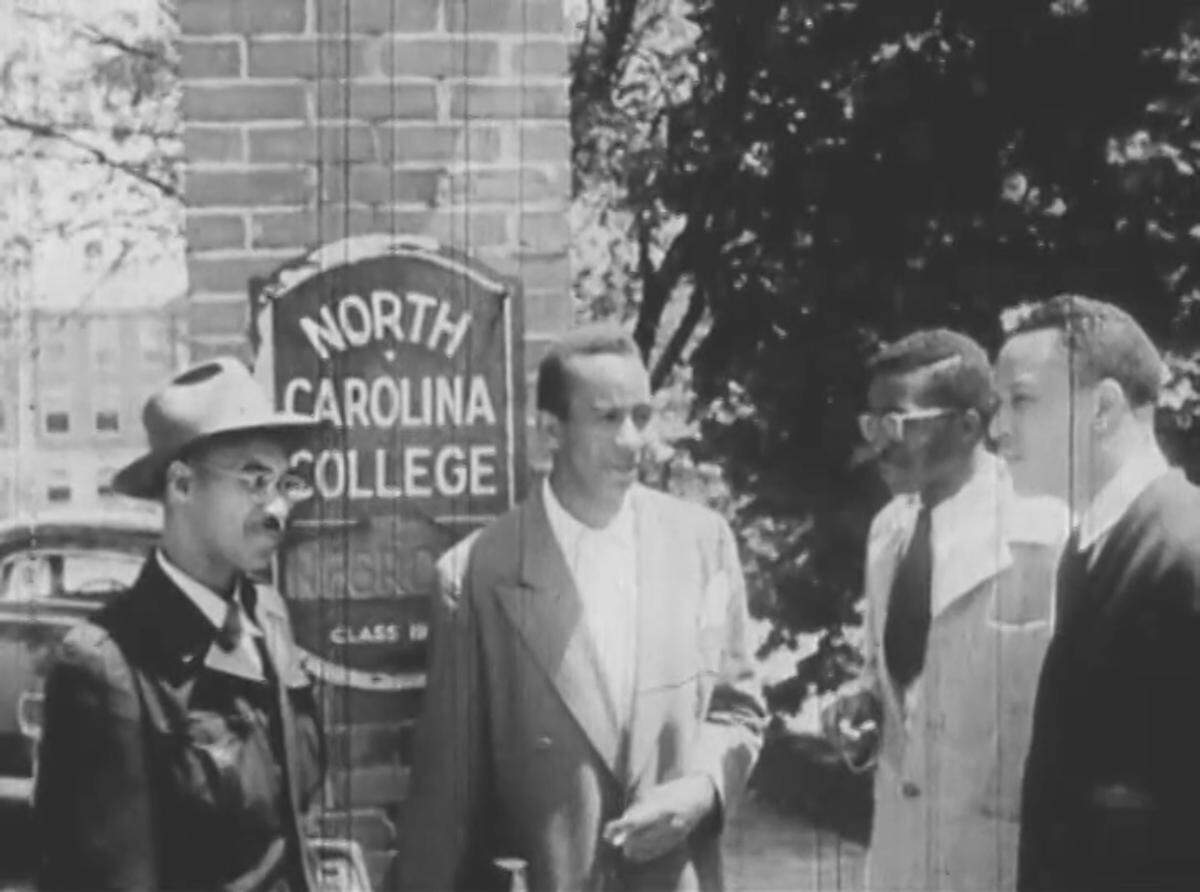
Reproducing audiovisual recording materials makes them go through a very physical process, especially ones like 16mm film, Whiteside explains. In order to run through a projector, film comes into contact with light and human hands, it’s placed on metal parts that allow it to roll and have to be started and stopped while spinning at fast speed.
“Plus, when film gets old, it can shrink, which causes a problem,” he said. “It’s like your bicycle chain. If it’s not on the gear, it doesn’t work.”
Whiteside decided to speak with the audiovisual department’s staff and volunteered to make some repairs to the film. And they agreed.
Because the prints were available for anyone to check out, he checked them out often and hosted screenings around Durham and “all kinds of places,” Whiteside said.
The film library closed in the early 2000s and the prints of “Negro Durham Marches On” were moved to the North Carolina Collection where materials may not leave the branch without special permission. Whiteside’s gentle handling and expertise of 16mm film allowed him to continue checking out the prints for his screenings.
One day in 2015, he called to set a time to pick up a print for a screening. Once there, the librarian asked him which print he wanted to pick up and showed him one he hadn’t seen before.
“I didn’t know what (that) one was. So I went and looked at it. And (it) is an original print from which the two other prints had been made,” he said.
Local historian R. Kelly Bryant, who died in December later that year, donated the original print along with his vast collection of historic artifacts and documents of Durham.
“He was a prominent person in Durham and worked for (N.C. Mutual Life Insurance Co.) for decades,” said Lauren Menges, current manager of the North Carolina Collection. “He was a leader in the Black community.”
The print was in pristine condition.
Had copies not been made and the original saved, who knows how much longer the film would’ve been playable, Whiteside says. Even the digital versions available are low quality because they were made from the copies.
“If film is stored in the proper conditions, and not used or projected over, and over, and over, it can last,” said Menges, a certified archivist. “It’s much, much more stable than paper, you know, if it’s stored in the right way.”
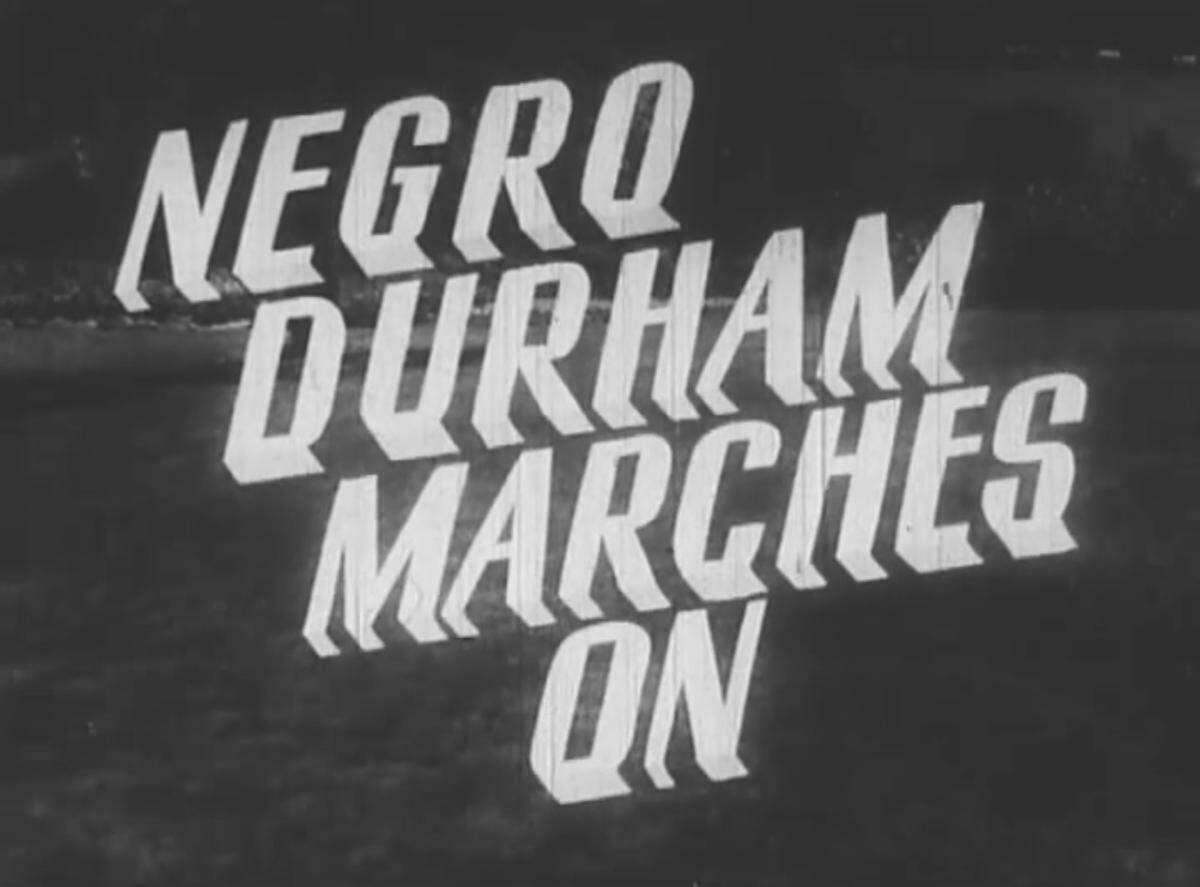
Preserving Negro Durham
Since the discovery, Whiteside, Menges and other staff have sought funding to preserve the original print.
Earlier this year, they applied for a grant from the National Film Preservation Foundation for laboratory preservation work on the film, and won.
“We described (the film) as best we could, what we knew about it and what condition it was in, and what we wanted,” Menges said.
In the proposal, the library requested a 4K scan, an archival negative and soundtrack (or archival master), an answer print, and a Blu‐ray of the original. Once produced, that master, R. Kelly Bryant’s original print, and an access copy (or reference copy) will be stored at the Duke University Library Storage Center where the North Carolina Collection houses part of its materials at the facility.
Durham county commissioners approved a budget ordinance amendment in July officially recognizing the $7,270 grant for the project.
Menges and her team signed the contracts with the laboratory, ColorLab in Maryland, and shipped the print in November. She says it could take a few months before everything is returned and available to the public because the lab has a long queue.
When it does arrive, the film will be uploaded to the library’s online digital content management system, Islandora. It’ll be for free to anyone who wishes to view it, Menges said. With its recent renovations, the Durham County’s Main Library new building includes a large auditorium and the staff anticipate collaborations with community partners to host screenings of “Negro Durham Marches On.”
Michaux, who has attended some of Whiteside’s screenings of the film, looks forward to the new and improved version.
“The clips I’ve seen have been sort of grainy and that type of thing, but it’s enough to jog my mind and my memory right now as to how we existed, how we lived, how we interacted with each other,” he said.
This story was originally published December 21, 2021 at 10:56 AM.