Will Durham residents’ concerns send Fayette Place project back to the drawing board?
Residents of the historic Hayti community told the Durham Housing Authority a second time this week they aren’t being heard in plans to redevelop the former Fayette Place property south of downtown.
Since plans for the vacant 20-acre site were announced in January, residents have accused DHA of not sufficiently involving them.
They repeated those concerns during a special City Council meeting Monday and again in a meeting Thursday night with the housing authority and Durham Development Partners (DDP), the group DHA has picked to build hundreds of new housing units on the site
DDP is a joint venture among F7 International Development, Greystone Affordable Development, and Gilbane Development. F7 and Greystone are both based in Raleigh, while Gilbane is based in Virginia.
The developers anticipated residents’ concerns Thursday, the second of four planned community meetings, said consultant Bridget Wall-Lennon.
“We want to consult [local residents] to really get an understanding of what the area was before,” F7 President James Montague told the N&O. “We first have to understand the past to move forward into the future. And we can only do that together.”
Fayette Place history
Fayette Place was once home to the Fayetteville Street public housing complex, built in 1967. Once sold to developers, the complex was demolished, The N&O previously reported. The land is now owned by the housing authority.
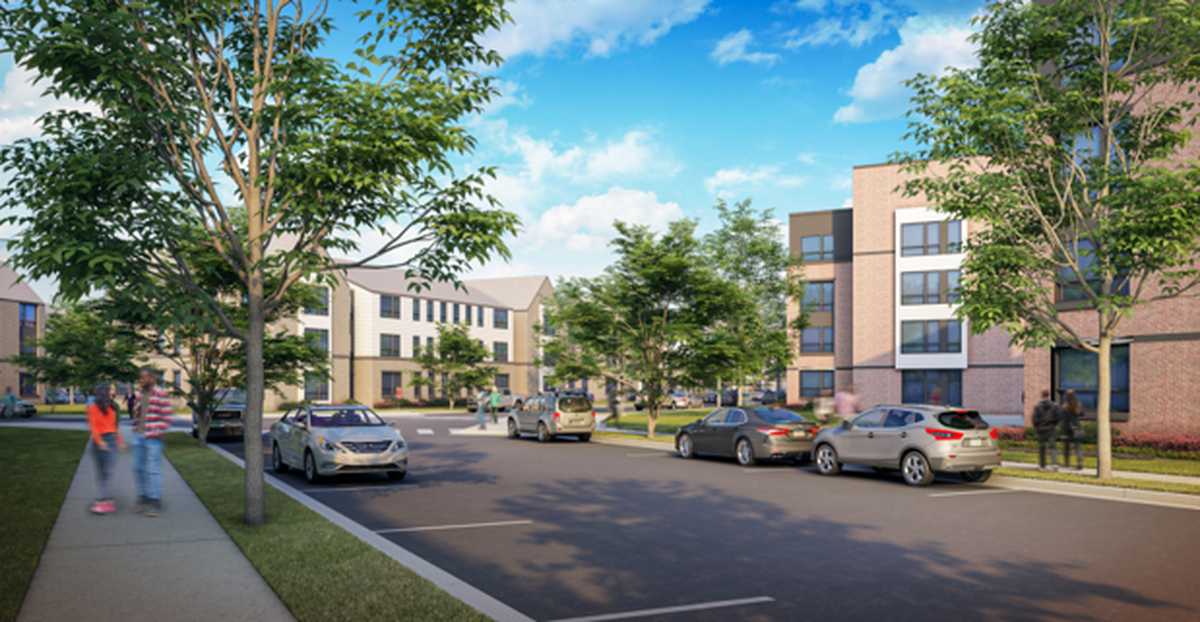
Funding to redevelop the site has not been fully secured and will depend on what is actually built, said Greystone senior developer Will Eckstein. DHA estimates the final project will cost around $189 million.
The current plan calls for mixed-income housing, with 18% of units reserved for residents earning 30% or less of the area median income, said Anthony Scott, DHA’s chief executive officer. Units at or under 50% AMI would account for 34% of new units, with another 22% at 80% AMI and 26% at market rate.
Several dozen residents attended Thursday’s meeting. Some expressed concern about affordable housing units being resold as market-rate housing in a few years. Scott acknowledged he’s seen this switch happen in Raleigh and other cities.
Rental units are currently set to make up all of the planned housing at Fayette Place. DHA’s 99-year lease on Fayette Place is intended to hold the property as affordable housing, he said, supported by additional income from the market-rate units.
Understanding local priorities
Emotions ran high as community members challenged developers’ understanding of local priorities for Fayette Place.
Some continued to question how the development will honor the Black-owned businesses and residences displaced from Hayti when the Durham Freeway was built in the 1960s, as previously reported by the N&O.
Constance Wright wondered how willing developers would be to start from scratch if residents continue to express priorities during upcoming meetings that totally contradict the current plan — or even if community feedback echoes a proposal from Hayti Reborn, a group led by N.C. Central University professor Henry McKoy.
Hayti Reborn unsuccessfully submitted a proposal in January to turn Fayette Place into a mixed-use development that would combine housing with a Black business and equity research hub. The group strongly opposes the current plan and has asked DHA to reconsider its choice of development partners.
“I grew up in Hayti, lived around Hayti,” said Wright. “We had businesses, we had all of that. So why can’t we build a better Hayti building on ideas of what the people from Hayti want?”
Resident Faye Calhoun said the parts of Fayette Place identified by developers as ideal for business use could be too small for meaningful commerce.
“If we put everything we want in that little box,” Calhoun said, “and you price it out and somehow use the word feasible — for you to make the money that you need to make? That’s not ‘feasible.’ Feasible by whose standards?”
One resident asked if DDP would consider partnering financially with Hayti Reborn.
Developers replied they would need a more detailed plan from the group when evaluating potential investors.
Affordable housing, commercial space
When community feedback was last collected four or five years ago, affordable housing was far and away the top priority for Fayette Place, Wall-Lennon said.
“Now there is a really strong interest to have commercial space,” Wall-Lennon told The N&O. “We may have to literally go back to the drawing board.”
And yet, the development team wasn’t surprised by the shift. Montague said. DHA ownership of Fayette Place limits the property to mostly housing. In affordable housing projects previously by F7 Development, Montague says he’s heard residents pitch museums, hotels and even theme parks as neighborhood must-haves.
Montague said the team is considering erecting statues to honor famous Hayti residents. Wall-Lennon added they plan to analyze commercial space requests to see where opportunity exists for supporting local vendors.
“Do you want a coffee shop? Yes, but do you want a Starbucks? Or do you want a coffee shop that’s owned by a person of color, that happens to sell coffees grounded down and made by Black distributors?” Wall-Lennon said. “It’s that type of drilling down.”
WHAT’S NEXT
DHA will hold two more community meetings July 14 and 28 and compile feedback at the end of the summer.
Eckstein said the group hopes to have funding sources by 2023 so that 14 to 18 months of construction can begin in 2024.
Laura Brache contributed to this report.
This story was originally published June 17, 2022 at 3:13 PM.