Residents call out affordable housing crisis. Here’s what they want an NC city to do.
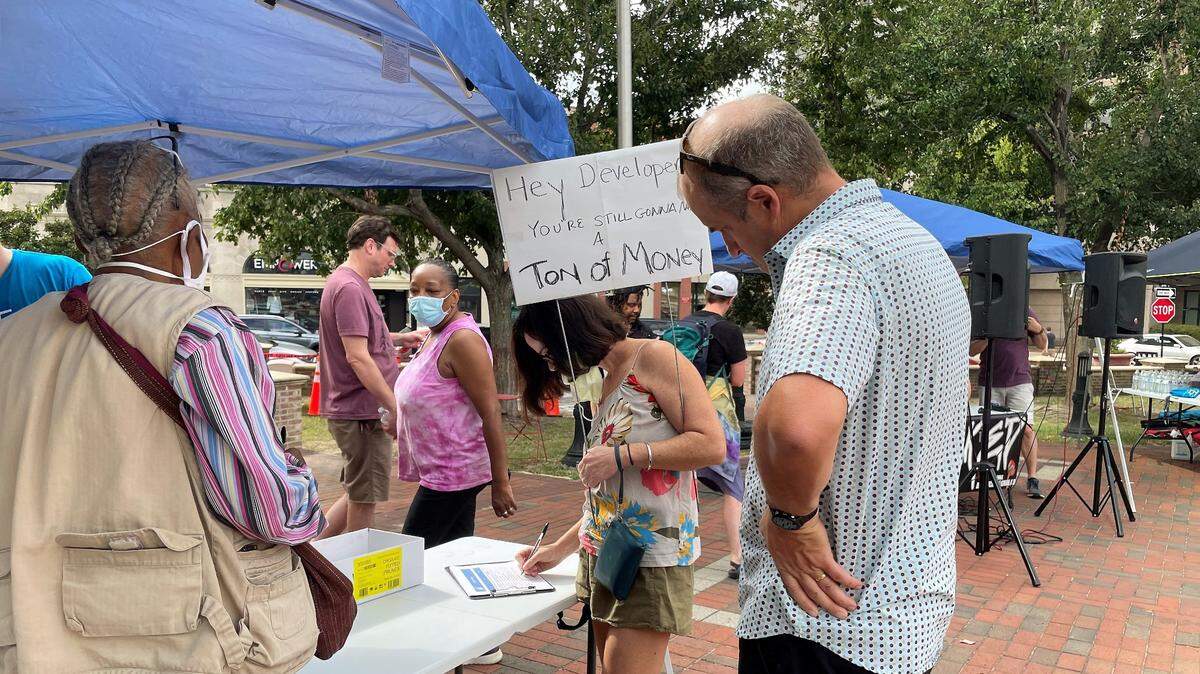
A diverse crowd gathered Saturday in downtown Durham for a Thirty for Thirty rally and cookout challenging the city’s leaders to push harder for safe housing that is affordable for lower-income families.
“Housing is a human right, and it is a thing that we should be able to have in Durham,” said Heeya Sen, a community organizer with the nonprofit Community Empowerment Fund, one of the Thirty for Thirty rally sponsors.
While listening to stories of homelessness, housing insecurity and discrimination, the crowd ate free hotdogs and homemade banana pudding. They signed petitions asking for 30% of new, affordable housing to be priced for people earning less than 30% of the area median income, which is $95,500 this year for Durham and Chapel Hill.
The U.S. Department of Housing and Urban Development defines the AMI each year for metropolitan areas across the country. The income levels are used to determine which families and individuals are eligible for housing assistance.
In Durham, HUD defines 30% of AMI as a single person earning $20,100 a year or a family of three earning $25,800 a year — a single parent of two children earning $12.40 an hour working full time, for example.
At that hourly wage, the parent of two children would have to work 74 hours a week to afford housing and still have money for other expenses, such as transportation and childcare, based on based on salary and rent data from the National Low Income Housing Coalition.
Financial experts recommend that families spend no more than 30% of their annual income on housing costs.
Rapid development, affordable housing
The Thirty for Thirty rally, also hosted by Southern Vision Alliance, grew out of a conversation about Durham’s biggest priorities and problems, the most critical of which is housing, Sen said.
Data show that rent prices rose by at least 50% in the Triangle since 2021, The News & Observer has reported.
No city leaders were invited to Saturday’s community-led rally, Sen said, and none appeared to be in the crowd.
While some CEF members have very little faith that Durham’s City Council will address the problem, Sen said, the group will keep advocating for solutions.
The council currently is wrestling with, among other ideas, whether to use its former Durham Police headquarters and the four-acre lot on West Chapel Hill Street for an affordable housing project. Meanwhile, the Durham Housing Authority is moving ahead with a plan for 1,700 affordable housing units in and near downtown.
“I think it’s important to advocate for what you want regardless of whether anyone is listening, whether anyone can make it happen. You need to make your needs known, because you know what you need,” Sen said. “You know that housing is a human right and it is a thing that we should be able to have in Durham.”
Developers who include affordable housing typically offer no more than 15% of their units, however, those units are only affordable most of the time to someone earning 80% or more of the area median income. That’s an annual salary of $53,500 for a single person, well out of reach for food service and retail workers, police officers, teachers, firefighters, and many other working people.
The rapid pace of development and gentrification in Durham, combined with the rising cost of construction materials and labor, is making the problem even more acute, Sen said. Meanwhile, very little money is being invested in shelters for the homeless, affordable apartments for families and critical repairs to older private and public housing.
“We see a lot of mostly property management companies coming in and buying; we even see people getting evicted because they are on a month-to-month lease, and someone comes in to buy their apartment complex and renovate it and upscale it and sell it for way more (money),” Sen said.
‘Rock bottom,’ advocating for others
Regina Mays was on a waitlist for nearly eight weeks before she got a spot in 2017 at the homeless shelter for her and her children.
Although she was a single mom caring for two children, one with special needs, and working full time, they weren’t a priority, because they could stay with family who didn’t want to see them on the street, she told the crowd.
“It’s like you’ve gotta hit that bottom that is below bottom before you can get any assistance,” Mays said. The crowd replied, yelling out “Amen,” “That’s right,” and “It’s broke.”
“That’s the reality. You’re sweating, you’re in the rain, you’re cold, for someone to tell you you’re not trying hard enough,” Mays said. “And then when you go to the doctor, because you have a child who has needs, they say you don’t care enough.”
When she finally got the call that there was a place for them, it sparked in her a desire to help others, she said.
“Now I stand here to advocate — not only for CEF, because there are multiple organizations that’s out here every day with great people trying to do the work — but that Thirty for Thirty, it can change somebody’s life,” Mays said.
This story was originally published August 21, 2022 at 10:37 AM.