
Why Durham said no to 700 new homes in fast-growing southwestern county
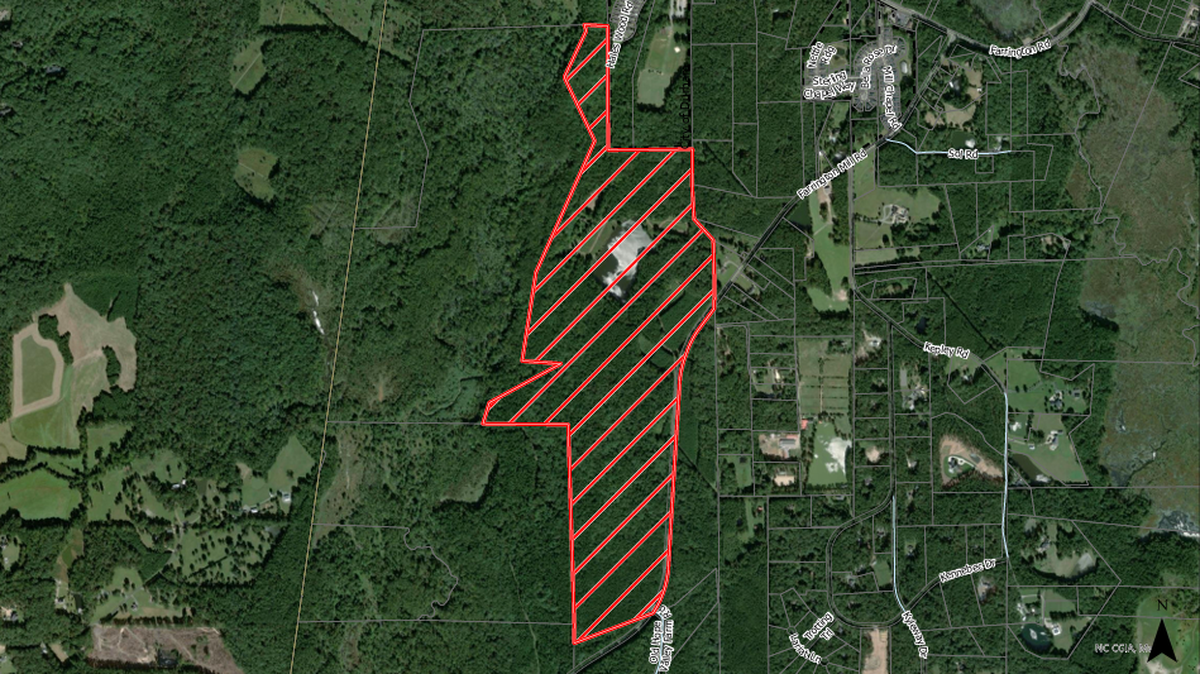
The Durham City Council rejected plans Monday night for 700 new homes in the fast-growing southwestern part of the county.
The council voted 5-2 against the Sheffield Farms project after dozens of people expressed concerns about traffic and the environment if the project was built on 218 acres of rural land at 8422 Farrington Mill Road, about 15 miles from Jordan Lake.
The area is currently zoned for low-density housing on large lots. Developer M/I Homes, based in Raleigh, wanted to change that in order to build 350 townhomes and 350 single-family detached homes.
Monday’s request asked the city to annex the land to bring it into the city limits, which the City Council denied.
The developers said they would contribute $65,000 to Durham Public Schools, extend city water and sewer lines to the rural area, and price 5% of the for-sale homes for people making 80% of the area median income, their attorney Nil Ghosh said.
About a half-mile north of the project site is the 751 South development with over 1,700 planned homes, 150,000 square feet of commercial space, and 150,000 square feet of office space.
The council members split on the project, which some said did not meet city requirements for new development.
Council members Nate Baker, Javiera Caballero, Chelsea Cook, DeDreana Freeman and Carl Rist all voted no.
Mayor Leonardo Williams and Mayor Pro Tem Mark-Anthony Middleton cast the only votes for the project.
A family’s quest for inclusion
Ghosh said the project promised $10 million in public sewer infrastructure that would benefit a rural family that has lived in the area for over 100 years.
At the center of the discussion was the owner of land across from the site, 71-year-old Andrea Quinn, whose family, the Nunns, passed down the home she lives in. She recalled the Ku Klux Klan burning down the part of the property years ago where her grandfather’s business was.
“We moved out here back then because there were not many places for people like us,” she said. “I live on four and a half acres of land, but without access to water and sewer, only my house can fit on this [land]. My septic system requires a lot of maintenance and a lot of room.”
Annexation would have let M/I Homes run a sewer line run through Quinn’s property, which would have allowed her family to tap on and build other homes so she could “plan for a real future for my kids,” she said.
“I believe we can co-exist with this development,” she told the council. “All we’re asking is for the city to finally allow water and sewer to come down our road so we can join the prosperity [others] around us are enjoying.”
Freeman asked why the family had to wait for the project to get the sewer line. In 2023, the city approved Quinn’s property remaining in the urban growth boundary, which made the possibility of getting the utility lines more of a reality.
“I know you are spending a lot of money to maintain your current system, which does not feel fair at all,” Freeman told her.
Middleton said people like Quinn should “be able to do what they want with their land,” and if there are opportunities to “make some money,” they should take them.
“The bonus is we get to help an American family make some money as we’ve done for others from this dais,” Middleton said. “There’s nothing really exotic for this case for me.”
Quinn could ask to have her property annexed into the city limits, but without the proposed new development, there would be no nearby sewer line to connect to, and there are no current programs in the city that help families with this request, according to city staff.
Williams agreed with Middleton that not giving the family a chance to have the sewer line was too “technical.”
“I don’t know if there’s anything I can say to change my colleagues’ minds, because we all have our own individual reasons why we voted,” Williams said. “We have very complex things we have to measure here.”
Preservation Durham supported M/I Homes’ plan to preserve former slave quarters and a farmhouse at the historic Hutchins Farm property, which is on the site.
Residents speak out, council responds
The Sheffield Farms site is in the Morgan Creek Floodplain Forest natural area, home to hundreds of plants and wildlife species.
Sarah Young, director of the city’s Planning Department, said state-designated Natural Heritage Program alerts municipalities when there is biodiversity or other natural resources worth protecting.
Residents raised concerns about harming the environment and increasing traffic. The project called for widening Farrington and Stagecoach roads.
Holt Farley, who lives off Farrington Mill Road, said the project’s traffic analysis was “fundamentally flawed and unreliable for planning decisions.”
“Residents will experience severe traffic delays with no viable alternatives. M/I Homes profits while the Durham community pays the price,” Farley said.
Marlena Hun, a student at nearby Jordan High, said the school is already over capacity and more students would worsen issues.
“In one of my classes at Jordan last semester, there were 36 students with one teacher,” she said. “Due to these large class sizes, there is less of a relationship with the teachers. There is also not enough desks. … Jordan High school has no room to expand.”
Resident Astrid Cookdale said approving the project would show the council’s “willingness to sacrifice state and locally recognized areas deserving of protection.”
The Durham Planning Commission voted 7-2 in January to recommend the council deny the annexation proposal.
Ghosh said the property is “not in the critical watershed.” He also responded to one resident who opposed to the project in order to retain the “legacy of the South.”
“The South has a lot of legacies, and keeping Black people out of prosperity is one of them,” he said. “This project is going to help a long-time Durham family in achieving more prosperity on land that they’ve owned and cultivated for over a hundred years.“
Caballero said by 2050, there will be 1.5 million people in the Durham area She said she voted against the project because it did not have enough affordable housing.
Growth is coming to the county’s rural areas, but Rist said he is concerned about the infrastructure and not ready to change the area’s zoning.
“Especially in terms of transportation and in terms of water and sewer,” he said. “I think eventually growth is going to happen out there, but for right now [I’m] leaning against this case.”
This story was originally published April 8, 2025 at 3:34 PM.
CORRECTION: The Sheffield Farms project is located at 8422 Farrington Mill Road