
Durham’s Hayti was nearly destroyed by urban renewal. Would new project help or hurt?
Days after residents rallied against redevelopment plans for a vacant shopping center in Durham’s Hayti neighborhood, an advisory board has recommended the city deny a rezoning the project needs to move forward.
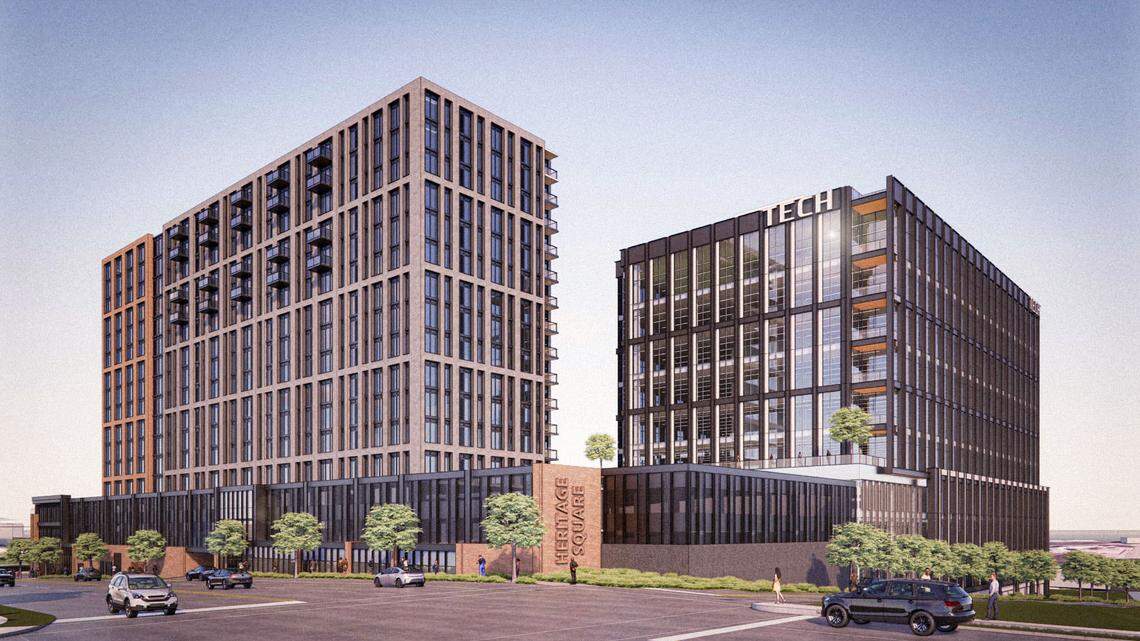
Sterling Bay, a Chicago-based developer, wants to rezone the nearly 10-acre Heritage Square property on East Lakewood Avenue and Fayetteville Street to build an apartment building, an adjoining life science building, and retail space, with buildings over 175 feet tall.
But many Durham residents oppose the plan, saying it threatens the fabric of the historic Black neighborhood, as Sterling Bay offered no affordable housing units or opportunities for Hayti residents to be part of the project. The developer has also proposed changing the property’s name from Heritage Square to Carolina Research Park.
After hearing concerns since 2022, Sterling Bay offered to install a marker honoring the community, designate 2,500 square feet as discounted retail space, and create life science jobs and other occupations residents could apply for.
Critics said that wasn’t enough.
“I don’t believe anything about this particular development as designed and as presented will help generate reparative wealth, and that’s what we need,” resident Angel Dozier said at the Durham Planning Commission’s meeting Tuesday night. “Rezoning means we are at risk of repeating a devastating past in the Hayti community.”
The Hayti neighborhood was once called “Black Wall Street” for its thousands of Black-owned homes and businesses, but in the 1960s, the community was mostly destroyed during urban renewal and the construction of the Durham Freeway. Residents say Hayti still needs help to rebuild.
The Planning Commission voted 10-0 against the request after hearing from Parker Poe, the Raleigh-based law firm representing Sterling Bay, and over a dozen residents.
Its recommendation now goes to the Durham City Council, which will hold a public hearing and vote on the rezoning request at a future meeting.
Sterling Bay states their case
According to Sterling Bay, the project would generate $190 million in annual economic impact and create 1,500 new jobs with an average $80,000 salary.
Jamie Schwedler, a representative for Parker Poe, said the project would create “generational wealth” opportunities in a community “that has been forgotten and has been dis-invested over time.”
The current zoning lets Sterling Bay build a mixed-use development but caps building heights at 175 feet. The proposed change would allow 300 feet, and city staff said with affordable housing, a green roof, or storm-water capture systems the company could build up to 500 feet.
Sterling Bay is considering the community’s concerns, including affordable apartments and the name change, Schwedler said.
There are no plans for a 300- or 500-foot building, Schwedler said. The project calls for two buildings joined by a slab, with retail and parking. The company wanted to build parking underground but couldn’t due to bedrock.
“If we could reduce the total number of floors and avoid rezoning, we would,” Schwedler said. “It’s not an easy thing to do. ... It was something that became necessary in order to make sure [Sterling Bay] could deliver the program.”
Local advocacy group Hayti Reborn asked Sterling Bay withdraw its rezoning request for 90 days to allow for more community meetings and a revised proposal.
“An additional 90 days, I don’t believe, will produce a different result.,” Schwedler responded.
A good neighbor?
After Tuesday’s public hearing, the Planning Commission questioned Sterling Bay’s incentives and asked if the company would consider a scholarship endowment for students at Durham Technical Community College and N.C. Central University or a fund for the Hayti community to invest in the development.
Schwedler said the developer would need to get permission from its lender to allow community investors and that so far, Sterling Bay has invited an NCCU student to Chicago to learn about the real estate firm.
The project would increase property values in the neighborhood, said Commissioner Zuri Williams, who asked if Sterling Bay had any options to “offset” future property tax hikes.
Brenda McCormick said her family has lived in Hayti since the 1920s and was displaced during urban renewal when their home was torn down. She said they remain members of St. Mark AME Zion Church on South Roxboro Street, just steps from Heritage Square.
“Anything that happens in this area should be representative of the spirit of Hayti,” she said.
Julian Pridgen, the pastor of St. Mark, said residents are not against development and that congregation members have held conversations with Sterling Bay but “remain unconvinced that Sterling Bay will be productive to the Hayti community.”
“We believe that a good neighbor would come and walk with us and embrace our culture before asking to change,” he said. “Does the voice of the community matter in decisions like this?”
Mimi Kessler said the city doesn’t need any new life science buildings and that there is a “tipping point” between gentrification and revitalization.
“It happens when someone else other than the community decides to build something they think would be good to the community,” she said. “Once it’s started, it’s hard to stop the train.”
This story was originally published April 9, 2025 at 1:46 PM.