
Durham just agreed to annex 300+ acres in Brier Creek. Here’s what it means
AI-generated summary reviewed by our newsroom.
- Durham approved annexation of 308 acres, enabling 1,750 new residential units.
- Beacon Partners pledged $1M for housing, 175 affordable homes, and road upgrades.
- Project forecasts $39.5M investment, 1,800 jobs, and $15M in annual tax revenue.
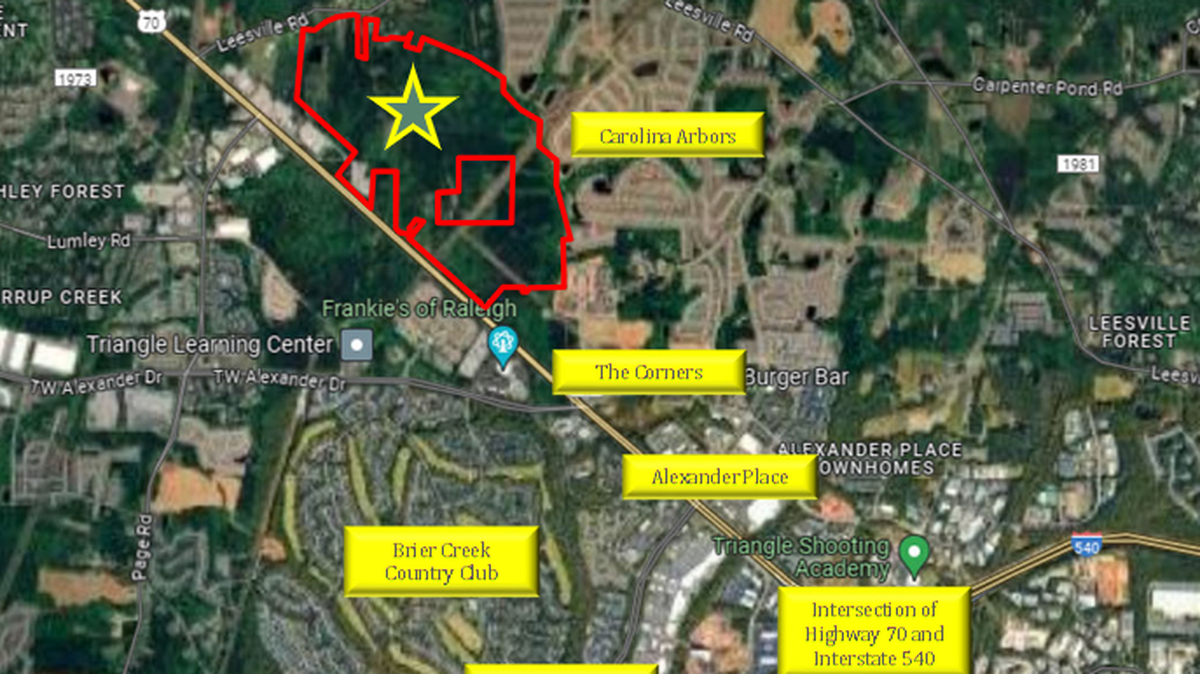
Durham County’s side of Brier Creek is set for a major transformation after the Durham City Council approved a plan for 308 acres of mostly forested land on the north side of U.S. 70 between Leesville Road and T.W. Alexander Drive.
Durham Gateway at Brier Creek will bring 1,750 housing units — apartments, townhomes, detached row houses, and single-family homes — to an area near the shopping center that spans both Wake and Durham counties.
Plans also call for 1.4 million square feet of commercial development for an industrial park, warehousing, medical offices, and retail space, plus a 1-acre park. The total footprint slightly exceeds The Streets at Southpoint, which is 1.3 million square feet.
Mayor Leo Williams and council members Javiera Caballero, Mark-Anthony Middleton and Carl Rist supported the annexation, while Nate Baker and Chelsea Cook opposed it. Councilwoman DeDreana Freeman was absent from Tuesday’s meeting.
Beacon Partners, a Charlotte-based real estate group behind the Knightdale Gateway project in Raleigh, requested annexation, a utility agreement, and a zoning map change to move the Brier Creek project forward.
“If this is not a better case than most, then I don’t know what the heck is,” Williams said. “The opposition to it is what I hear on every single case. ... I think we need to come to reality here and actually start focusing on what makes common sense, what is realistic in the society in which we live in.”
Debate over growth and impact
The four-hour public hearing drew dozens of speakers. Opponents warned about blasting, traffic congestion affecting first responders, and harm to wildlife and the environment. Supporters praised the developer’s outreach to nearby neighborhoods and highlighted the benefits of new housing, jobs and infrastructure.
Jamie Schwedler, an attorney for Beacon Partners, outlined the project’s road improvements, housing, job creation, and contributions to public safety. The developer plans to help build a Northern Durham Parkway connecting the site to Leesville Road, install a new traffic signal, contribute $350,000 toward county fire and EMS, and set aside land for a trail.
Kim Crossman, a nearby resident who supports the project, told the council “this is the best use of this land that we could hope for.”
“I’ve been impressed with how [the developers] have listened to our concerns,” he said. “These guys are offering to put commercial restaurants and other activities in this area, which I find very attractive.”
Still, many others remained unconvinced. Members of Preserve Rural Durham argued the project threatens environmental sustainability with limited protections for tree canopy and biodiversity.
“How can the city allow mass grading and building without intervention for infrastructure?” asked resident Vickie King. “Our environment is hurting; our quality of life is diminished.”
Pamela Andrews, the founder of Preserve Rural Durham, emphasized concerns about delayed response times for fire and EMS in southeast Durham due to traffic and a lack of employees. She argued that the city agreed to build a new fire station in southeast Durham with construction beginning in 2026, but there have been no updates.
“Residents’ and firefighters’ lives are at risk when we do not have adequate equipment and fire staff,” she said, adding that Station 17 on Leesville Road has fewer than ten firefighters, and Station 8 on Lick Creek Road doesn’t have a ladder truck.
Affordable housing concerns
The Durham Planning Commission, which advises the City Council, voted 9-1 against the project in June, citing weak commitments to affordable housing, a lack of transit options, and the impact on a private landowner who declined to sell.
Beacon Partners said it is committed to building 175 affordable housing units on a 7-acre parcel once half the market-rate homes are complete.
The affordable units will be in a separate building, set aside for households earning 80% of the area median income, and kept affordable for 30 years. The developer also pledged $1 million to the city’s housing fund.
In response to the Planning Commission’s recommendation, Beacon Properties agreed to increasing tree buffers and stormwater runoff. It also agreed to
- increase the tree buffer around the site from 10 feet to 75 feet
- donate $1 million to the Durham Dedicated Housing Fund
- preserve at least half the site where there are stream buffers, wetlands, flood plain and steep slopes
Caballero acknowledged concern about putting the affordable housing in a separate building and that her vote for the project would upset many residents.
“You have been elected to make a decision; that decision’s going to be hard sometimes,” she said of being an elected official. “You’re just never going to make 300,000 people happy. There’s no possible way.”
Baker argued the proposal needed more work from city staff and criticized the scale of the annexation.
“It’s a half a square mile, it’s five times the downtown loop, it’s 77 times the controversial [former Durham police headquarters] here in downtown,” Baker said. “Durham, since 2017, has annexed half the area of Manhattan into our city limits. The vast majority of that has been completely car dependent and car oriented and it has not all been built.”
Schwedler said the project would have a “lasting impact” on Durham, generating $39.5 million in public and private infrastructure investment, more than 1,800 construction jobs, and $15 million in annual property tax revenue.
The project is expected to be completed in 2029.
This story was originally published September 3, 2025 at 5:22 PM.