
Durham OKs thousands of new homes near Chapel Hill in split votes, despite petition
AI-generated summary reviewed by our newsroom.
- Durham council approves 81.75‑acre Leigh Village Center in a 5‑2 vote.
- Plan includes 2,100+ apartments, 40 townhomes, office, retail and transit talks.
- Developers pledge affordability, $250K park gift and phased TIAs; neighbors oppose.
Within the next decade, or two, 81 acres between Durham and Chapel Hill will be a bustling community with thousands of homes, retail and office space.
The Durham City Council approved plans for the Leigh Village Center development in two, 5-2 split votes Monday night.
Mayor Leo Williams and council members Nate Baker, Javiera Caballero, Matt Kopac and Carl Rist supported the project’s annexation and rezoning.
Council members Shanetta Burris and Chelsea Cook opposed them.
The plan, presented Monday by Patrick Byker of Morningstar Law Group, will meet Durham’s goal of creating more walkable communities. The proposal was submitted by Dan Jewel of architect firm Thomas & Hutton and a California-based team with family ties to the property.
To secure the approval, the applicants offered several last-minute commitments, including a $250,000 donation for a public park and a pledge to meet with GoDurham and GoTriangle leaders for potential transportation.
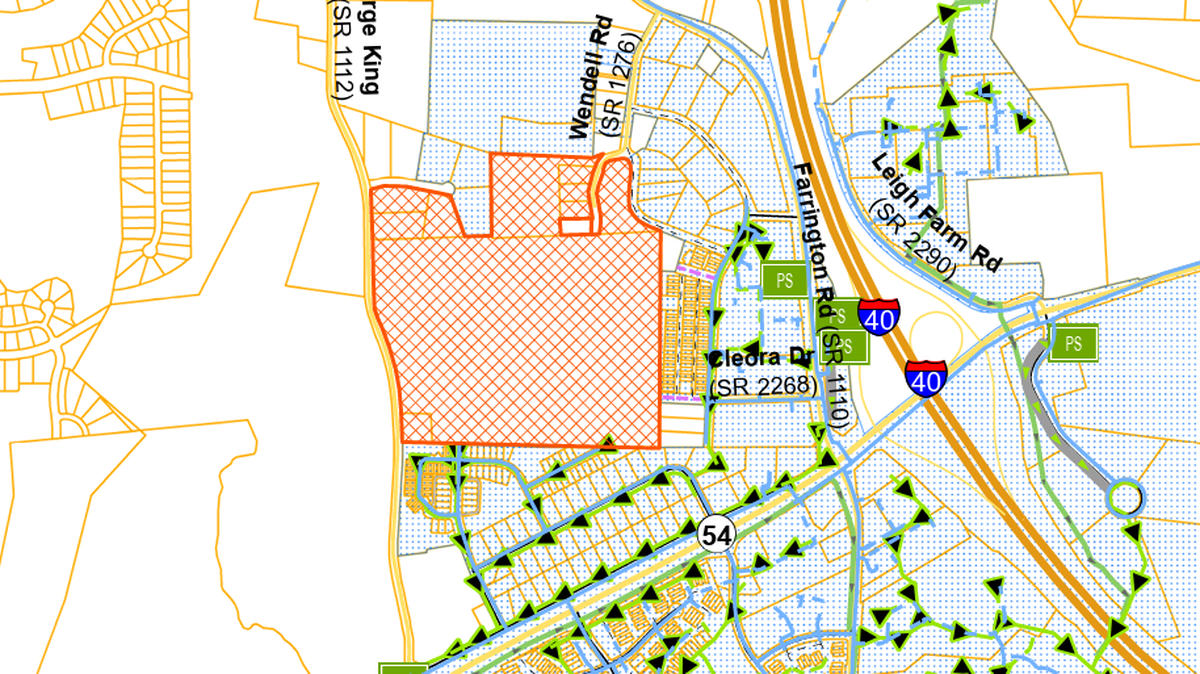
In the end, the Leigh Village Center, located off Interstate 40 at Exit 273, will span 81.75 acres across 10 parcels of land and include
- Over 2,100 apartments and 40 townhomes
- An additional space for a daycare or hotel uses
- About 675,000 square feet of office space and 8,000 square feet of retail space
- A traffic impact analysis, or TIA, for the site at each construction phase
- A Falcon Bridge extension and a Farrington Road extension
- A 30-foot buffer between the development and the Chapel Run neighborhood
‘Generational wealth’
During the meeting, the council negotiated higher affordability tiers for the project’s rental units. Byker agreed to reserve 6% of the apartments for renters earning 60% of the area median income (about $36,850 for a single person) and 3% for renters earning 80% area median income. That’s about $92,500 for a household of four. This will stand for 30 years.
Baker praised the project, saying it was “the best case that I’ve seen since 2018” for annexation. Even though he often critiques development proposed outside the city limits, he said the Leigh Village Center’s commitments to green building and affordable housing set a new bar for Durham.
“It always hurts to see outward expansion when I know that we have land in our city that we can develop already,” Baker said. “I do think that the applicant has brought this case to an elevated standard that we haven’t seen as long as I’ve been observing rezoning annexation cases.”
Byker said the project is also an opportunity to create generational wealth.
He presented a plan for a 20-year price restriction on the for-sale townhomes, arguing that the standard 30-year term would prevent low-income families from getting the property appreciation required to build wealth. Byker didn’t say what price the townhomes would be selling for.
Some council members liked a 30-year period to preserve affordability for future buyers. Kopac and Williams argued homeowners shouldn’t be “beholden” to a deed but empowered to “do better for the next generation.”
The affordable town homes will have the 20-year price restriction, while the apartment affordability will be held for 30 years.
“What we’re trying to do with the town homes is start to create on-ramps for generational wealth,” Byker said. “If you deed restrict it for 20 years, that family that lives there really doesn’t create a lot of generational wealth. ... It’s a delicate balance.”
Community concerns over ‘bad planning’
The Leigh Village Center approval came despite a petition that residents presented with 469 signatures opposing the project.
“Replacing mature canopy with pavement and traffic fundamentally alters the livability of our homes,” said Shannon Gaylord, a neighbor to the site. “We are now facing the prospect of traffic headlights and roadway noise directly behind our backyards with no substantial buffer proposed.”
Chris Selby, a resident of Durham’s Eastwood Park, said the project lacked direct links between its internal collector roads and N.C. 54, which would force “very heavy traffic to traverse our neighborhood.”
“It’s just bad planning,” he said. “I think there’s a right way to develop Leigh Village and a wrong way.”
Byker and the applicants, whose family owns part of the 81 acres, did not submit the TIA before Monday’s vote. The traffic analysis is often a critical part of development proposals because it evaluates the impact a project will have on existing neighborhoods.
Holly Shen told the council that approving the project without the analysis would have “inevitable consequences on kids and properties.”
Earlene Thomas, an engineer with the city’s Department of Transportation, said Byker had “committed” to submitting a TIA with every new site plan submitted, “which is above and beyond normal ordinance requirements.”
A divided council
The council was split on the annexation and rezoning votes.
Burris said there were “too many unknowns” regarding infrastructure and expressed deep skepticism about the timing of the TIAs.
“While I appreciate the proffers and your concern about generational wealth, I will be unable to move for this project,” she said.
Cook said she was “not going to look too much at the quality of the project,”
“I still believe that the TIA needed to be done prior to this getting to the council,” she said, adding it was mandatory, not discretionary, on how the council feels “about when a TIA should best be done.”
Williams and the rest of the council remained focused in both votes on the need to increase the city’s housing supply.
“Pros outweigh the cons,” Williams concluded before the final vote, emphasizing that the project aligns with Durham’s needs. “It makes the most sense to me.”