
A single mom in Durham needed help. Now, she offers free childcare to families.
AI-generated summary reviewed by our newsroom.
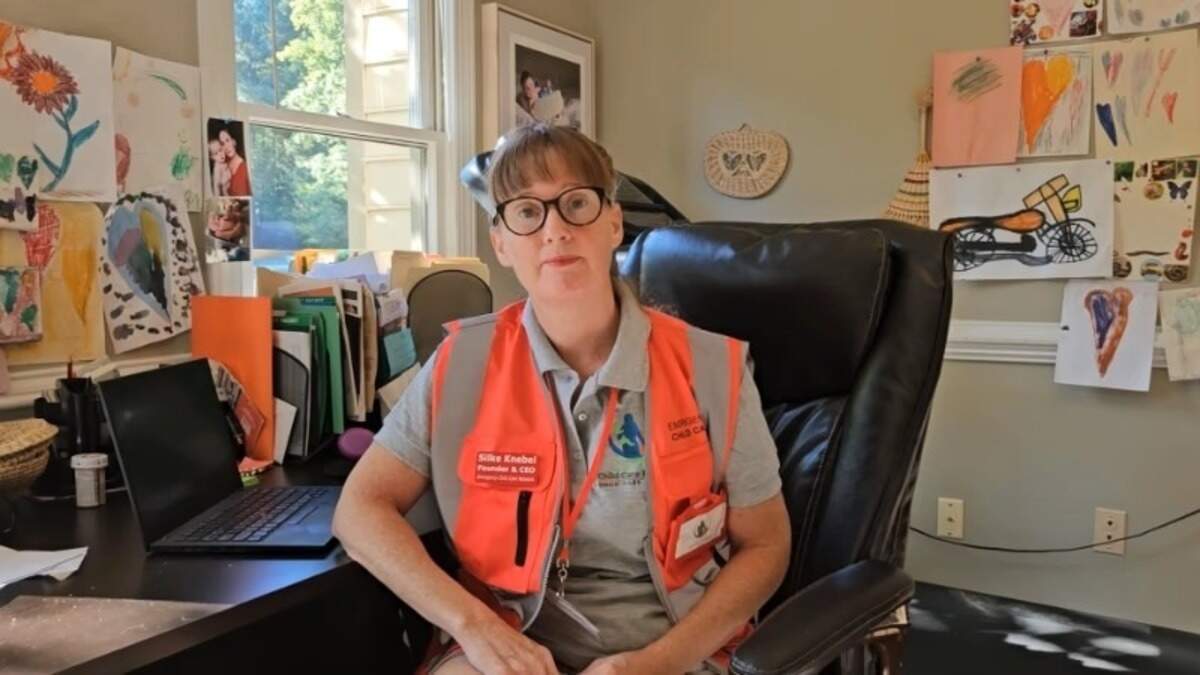
- Silke Knebel founded the National Emergency Child Care Network.
- NECCN uses vetted volunteers to provide immediate child care during emergencies.
- The network provides free respite to caregivers without paperwork or judgment.
Days after delivering her second son, Silke Knebel got an infection from her C-section scar that kept her in bed. She had no one nearby to call to hold her baby, get medicine, or help her stand up.
“I didn’t want any parent to have to experience this. I couldn’t drive; I couldn’t get to my physician. ... This happens all the time across our country,” Knebel said, describing the realities of raising two sons as a single parent in Durham, one with severe ADHD and autism, and a serious conduct-disorder diagnosis. “And just having a child with a disability as a single parent is very difficult to manage.”
Knebel, who grew up in California, turned those years of scrambling to care for her children and herself into the National Emergency Child Care Network (NECCN), a volunteer organization that responds when parents have no one else to call for child care during a medical emergency, disaster or job interview — or when they simply need a few hours of respite.
NECCN was built to help give families a reliable village. The model is simple: Vetted and trained volunteers sign up to help families who ask for it.
“We don’t ask them what their insurance is; we do not create barriers. I don’t care if they are rich or poor, because a crisis does not choose a family,” Knebel said. “We know that if they are reaching out to us, they need help.”
In May, Knebel, who doesn’t get paid for this work and works another full-time job, was recently honored for her work with the network through The Courage Project. NECCN has provided over 8,000 hours of free emergency childcare, supporting 60 families and over 100 children across the country since 2024.
Childcare and when disaster strikes
Knebel’s definition of emergency is intentionally broad. Families don’t have to prove they’re in the worst possible situation to get help.
That broad lens matters in the Triangle, where childcare costs are high, and many families are far from relatives who might step in. In Durham, daycares charge $1,300 to $1,800 per month for infants and $1,100 to $1,500 for toddlers. A private babysitter or nanny could cost a family over $2,629 a month, according to Care.com.
During major disasters, the need and cost can explode.
A childcare-focused playbook compiled by Inclusive Disaster Recovery researchers notes that after hurricanes and wildfires, childcare centers often close, leaving parents with “minimal to no options for care.”
In western North Carolina, the playbook reports over 200 childcare facilities in 25 counties were impacted by Hurricane Helene, including 55 centers with severe damage that prevented reopening. In the aftermath, families were often left trying to manage insurance claims, FEMA paperwork, and work without care for their small kids.
NECCN is free for families. Its volunteer services, which include trauma-informed care providers, are supported through donations and partner organizations, Knebel said.

For families, help that feels immediate and human
Brittany Davis, a Durham social worker, found the network during a difficult period with one of her children, who has special needs and can exhibit challenging behaviors. The family didn’t qualify for respite care (or short-term relief) from Medicaid of Medicare, and the services that do exist can be hard to find.
“It’s just been this kind of ongoing frustration for years of feeling like I should know how to access resources — and I feel like there should be resources — but just not finding them,” Davis said.
With NECCN, she said, the repose was immediate.
“This was kind of a miracle,” Davis said, explaining that she and her husband didn’t feel it was safe to leave the house with one caregiver alone, even with trusted babysitters. Through the network, multiple vetted volunteers came to their house several times, helping the family get to a more stable place. Davis and her husband were able to rest, reduce their anxiety and leave their children with trusted caregivers.
“There are families who deal with things where there just aren’t many resources available in the community to help, and this fills a gap by not having some of the bureaucracy,” Davis said. “You can be on a waiting list for a year and a half ... 10-12 year waiting lists for some of them. And when you are drowning, it can feel so overwhelming and defeating.”
Volunteers ready to help
Breanna Maddox, a psychologist and mother of two, volunteers with the network and has been deployed to families across in the state.
Volunteers go through screening and training that includes a trauma-informed lens. They also attend a 90-minute orientation, complete a 10-year criminal history background check, and are screened for sex-offender registries. They provide proof of valid driver’s license and insurance, and answer questions that reflect psychological and first-aid care.
When a family request goes out, volunteers in the area receive an email with basic information: ages of children, special considerations, and times that the support is needed. Then the protocol is that two volunteers go out at the same time.
“For many people these days, they don’t really have a village easily accessible to them,” Maddoxx said. “Financially, they may not be able to afford childcare, or have that support network already in place to lean on when some type of emergency hits.”
“What emergency means is different for everyone,” she added. “There are so many other things that can happen in a family’s life that are so disruptive. They need more support to help them bridge that tricky time.”
Knebel hopes more families will learn about NECCN and understand they can get support.
“We’re not going to ask for anything in return. We’re not going to charge them a fee,” she said. “We just want to simply be there for them, and that’s what I needed.”
To learn more about NECCN, donate, or to request help, visit emergencychildcare.org.