
Closing the gap: Can the Neuse River Trail be extended from Clayton to Smithfield?
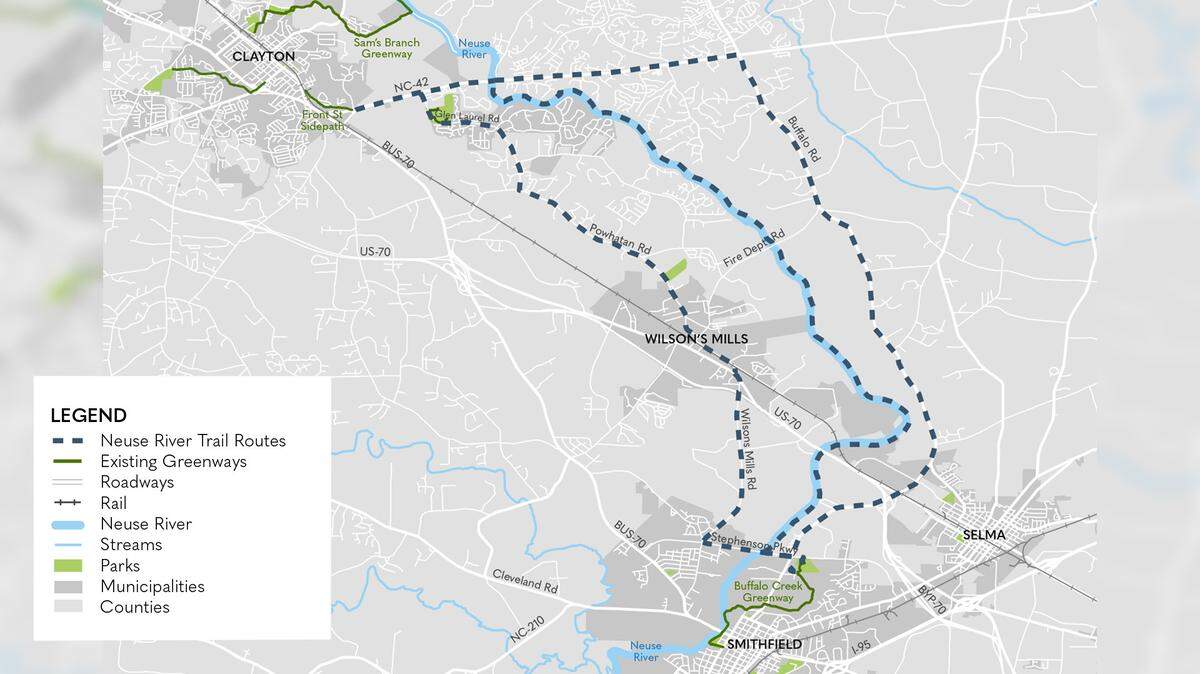
Cyclists and walkers can follow the Neuse River Greenway Trail from Falls Lake all the way to Clayton, where a spur called Sam’s Branch will take them up into town.
From there, though, the trail goes cold. Continuing on to Smithfield requires sharing narrow country roads with cars going 55 mph or more.
Now there’s an effort to change that, by charting an off-road route into the heart of Johnston County. The county parks department, the N.C. Department of Transportation and several other groups are doing a feasibility study to determine how the Neuse River Trail might be extended and who would use it and how.
The goal is to find a potential route that separates cyclists and hikers from cars, said Adrian O’Neal, the county’s parks, greenways and open space coordinator.
“We want to get them so that they’re safe and so that people feel comfortable using it,” O’Neal said. “And so that it can be used as an alternate form of transportation when feasible.”
As part of the feasibility study, NCDOT and the county have created an online survey to find out how people would use the trail and where they’d like to see it go. The survey can be found at publicinput.com/NeuseRiverTrail-ClaytontoSmithfield#1 through April 8.
In addition to connecting Clayton with the Buffalo Creek Greenway in Smithfield, the greenway would be part of two longer trails — the statewide Mountains-to-Sea Trail and the East Coast Greenway, a planned 3,000-mile path from Florida to Maine.
About 700 miles of the 1,175-mile Mountains-to-Sea Trail are completed off road, with big gaps like the one in Johnston County. The trail crosses the Triangle from near Hillsborough east to Clayton, and extending it to Smithfield would create the longest uninterrupted stretch outside of the mountains, said Brent Laurenz, executive director of Friends of Mountains-to-Sea Trail.
Laurenz said said the survey is an important step.
“The majority of users of the MST are day hikers, not the folks that are actually walking from the mountains to the ocean,” he said. “So really having that community input and feedback will be important to see what the community would like to see in a trail there.”
O’Neal said the survey and feasibility study are also meant to let landowners along the route know about the possibility of allowing the trail over their property. The development of the trail will depend on landowners who are willing to sell easements, he said.
“You’re working in conjunction with those landowners to get the best laid trail you can get, and you have to be very flexible,” O’Neal said. “You have to be very respectful of their ideas and what they’d like to see happen through there.”
O’Neal said as much as possible the county would like to see the trail follow the Neuse River, as it does between Clayton and the Wake County line. Alternately, parts of the trail could veer away from the river or follow roads, with proper separation from traffic.
Johnston was the state’s fastest growing county over the last decade, and many of those new residents will be looking for parks and trails nearby, O’Neal said.
And all those new subdivisions create both challenges and opportunities for trail builders. They may close off some potential routes while opening up others, as developers decide access to a public trail is a selling point for future residents.
“We’re kind of racing with development,” O’Neal said. “But we’re also looking at opportunities when development comes through, to let them be a part of building the Mountains-to-Sea Trail and the East Coast Greenway. So that’s what this study is all about.”
For more information about the Neuse River Trail extension feasibility study, go to bit.ly/3JoayDr.
This story was originally published March 21, 2022 at 5:30 AM.
