Would Chapel Hill development bring transit-friendly housing or gridlock?
Update: A quote from Lake Forest homeowner Wayan Vota was corrected at 4:50 p.m. May 14.
A Texas developer got some support Wednesday for more housing, plus a restaurant, shops and public spaces, at one of Chapel Hill’s busiest intersections and a future stop on the North-South bus-rapid transit line.
The Town Council, after hearing from residents and offering its own thoughts, will continue the public hearing on the Aura project May 26. A decision is tentatively set for June.
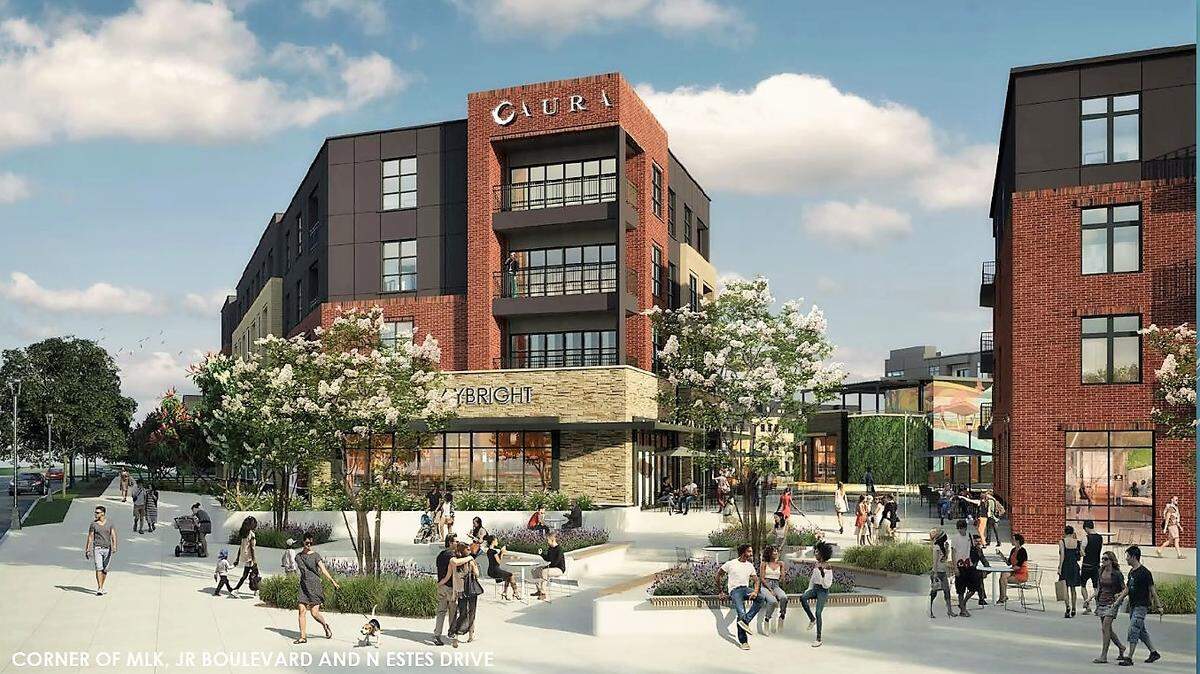
Trinsic Residential Group wants to replace a 16-acre tree farm at Martin Luther King Jr. Boulevard and Estes Drive with 361 apartments, 57 for-sale townhouses and over 15,800 square feet of restaurant, retail and office space in three- and four-story buildings.
Over three acres would be dedicated to public green space, including a central plaza with fenced-in playground, a Central Park for holding activities and events, and a Woodlands natural area around a stream on the site.
The site, in addition to housing a North-South bus-rapid transit stop, could include 650 surface and underground parking spaces on a corner where traffic already is a major concern, backing up for half a mile at times and making it a challenge for drivers to turn left.
On Wednesday, the public hearing revealed a clear split between younger apartment dwellers, who sought more affordable housing and less parking, and older homeowners, some of whom formed a new group Estes Neighbors to push for fewer apartments and more homeownership options.
Linda Brown, a Summerfield Crossing resident with the group Chapel Hill Alliance for a Livable Town, said Aura, as planned, is not affordable, provides few options for homeowners to build equity and doesn’t contribute much to the town’s economic well-being.
“Density doesn’t have to mean apartments,” Brown said. “In addition to townhomes, Aura could have duplexes, triplexes, quads, condos, that could be purchased while providing the appropriate density and green space compatible with surrounding communities, while retaining the town’s character.”
Lake Forest homeowner Wayan Vota disagreed with critics, saying the complaints “sound like hypocrisy to me.”
“These people moved here from somewhere; we all did at one point,” he said. “People who drive vehicles, often multiple vehicles, like we all do. People who added to the town’s size with their kids, like I have. Even quite outspoken people who actually live in flood zones, unlike many of us. These people now find the voice to complain about traffic, complain about runoff, demand we stop newcomers from moving here.”
Affordable apartments, homes
The plan: Aura has 47 of the apartments priced to be affordable to those earning 65% and 80% of the area median income — up to $48,400 a year for an individual and up to $69,120 a year for a family of four. Trinsic offered to sponsor five affordable, for-sale homes in Habitat for Humanity’s Weavers Grove project in northern Chapel Hill.
Suggested changes: Council members and the public asked for more affordable housing, priced to serve only up to 65% of the area median income — up to $39,325 for an individual and $56,160 for a family of four. Residents also pushed for more options for families who use federal housing vouchers.
There was no support for sponsoring homes off site. The town’s inclusionary zoning ordinance requires developers to set aside 15% of any for-sale housing for lower-income homebuyers.
What they said: “A mixed-use development in close proximity to existing and planned future transit connectivity represents the type of housing many current and future renters in Chapel Hill need and want,” resident Dara Morgenstern said. “It will also give residents in nearby apartments and homes access to more restaurants and shops within walking distance.”
Meeting the Central West vision
The plan: Aura would be the second development for the Central West District, roughly 97 acres east of the boulevard, from north of Estes Drive to Mt. Bolus Road. A public process defined expectations for the district in 2013.
Aura has the public green spaces, transit and pedestrian connections, and a mix of uses outlined in the Central West plan, but also has twice the number of housing units allotted to its part of the district — and nearly two-thirds of the housing units planned districtwide. It also has much less commercial space.
The town and its needs have changed, Mayor Pam Hemminger said Wednesday. A recent Mini Market Study showed that residential development and live-work space is better suited for the site because of limited visibility for businesses and the number of gas stations, convenience stores and other businesses nearby.
Aura’s team has asked for flexibility to increase the commercial space if residents don’t need as much parking.
What they said: “I think it’s important for all of us to remember that those plans — they are living documents … based on information that we have (at the time),” council member Hongbin Gu said. “I do think Aura represents the vision that the town is trying to move toward.”
Traffic, transit, pedestrian safety
The plan: A town traffic consultant said drivers will see longer wait times at the Estes Drive intersections with Somerset Drive and with East Franklin Street regardless of whether Aura is built. A separate traffic study showed Aura could add nearly 1,500 more cars and trucks to surrounding roads.
The developer’s plan would add new turn lanes and high-visibility crosswalks, as well as a full-service intersection on Estes Drive. A right-in, right-out driveway is expected on MLK Jr. Boulevard, and traffic signals would be adjusted.
The project’s retail could complement a future North-South bus-rapid transit station. Construction also could start this year on pedestrian and bicycle improvements on Estes Drive, from MLK Jr. Boulevard to the elementary and middle schools. Additional sidewalks, bike lanes and trails are planned.
Suggested changes: Council members and residents shared a desire for safer pedestrian and bike connections. Council member Amy Ryan suggested allowing right-in, right-out access only on Estes Drive until the town can look at adding a traffic light at the Somerset Drive intersection to the east.
Environmental concerns
Several residents shared concerns about stormwater runoff, landscaping buffers with existing neighborhoods, and the amount of rooftops and other impervious surface planned. The site is largely flat but slopes down to a stream and wetlands on its eastern property line. Trinsic’s plan also includes infrastructure for rooftop solar panels, electric vehicle charging stations and energy-efficient features.
Suggested changes: The town’s Environmental Stewardship Advisory Board recommended approving the project with conditions, including that the developer submit detailed landscaping and stormwater management plans.
Ryan suggested moving the buildings back a bit from Estes Drive and more landscaping to soften Aura’s character.
What they said: Mt. Bolus Road resident Stephen Fleck questioned the project’s size, its reliance on dense housing construction, and the potential to increase stormwater and flooding downstream.
“Chapel Hill is at an historic fork in the road,” Fleck said. “Either we wave on through Trinsic’s request … and (its) inappropriate, custom-designed zoning amendment despite half a dozen advisory boards’ stipulations and conditions, or else we insist on a reasonably scaled, environmentally respectful, aesthetically pleasing site with significant numbers of for-sale affordable units for our forgotten middle and less affluent folks.”
Meanwhile, Wamiq Chowdhury, a self-described millennial, said he would like a denser, taller development, but there is “so much good about this project” that he has to support it.
“I need to live in a place where I really feel like the place that I’m living is committed to tackling the challenges of climate change head on, particularly by focusing on less car-centric development,” he said. “This project does have a lot of parking spaces, but on a lot of other counts, I think it’s really fantastic from that standpoint — hundreds of units on a planned major bus line, with shovel-ready projects for enhanced walkability and bikeability.”
This story was originally published May 13, 2021 at 12:25 PM.