Local NC news site has ties to a PAC. Chapel Hill critics want trust, objectivity.
An online news site providing community news and information in Chapel Hill is facing questions about its ties to a local political group.
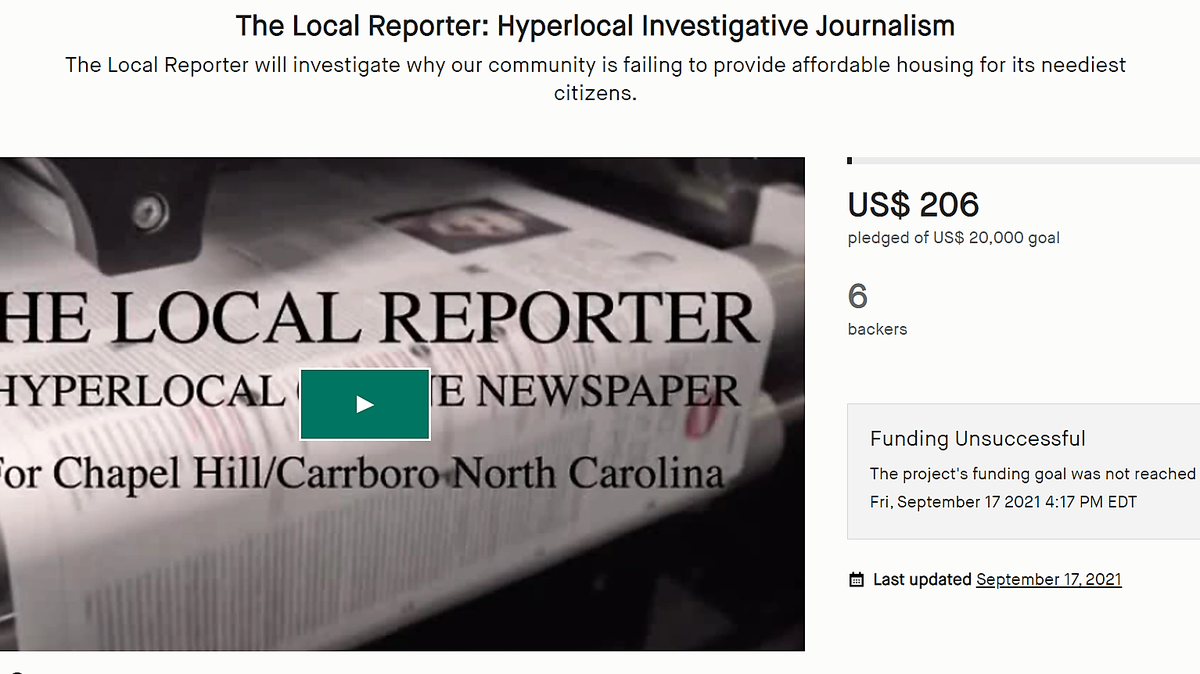
The debate ratcheted when The Local Reporter’s nonprofit arm launched a Kickstarter campaign this summer that offered “access” to a professional journalist hired to write about affordable housing in return for a $1,000 donation.
Citizen volunteers who started the website saw a need for a hyperlocal news source after The Chapel Hill News closed four years ago. Without a local newspaper, studies have found fewer people vote, they’re less informed, and governments spend more money with less accountability.
What happened in Chapel Hill is not unique. As print advertising dried up between 2004 and 2020, over 2,100 U.S. newspapers closed, or roughly 1 in 4. In their place, over 700 local, digital news outlets started in the United States and Canada, UNC-Chapel Hill researchers reported.
The challenge in the shifting media landscape is knowing what’s reliable, said Daniel Kreiss, a professor with the UNC Hussman School of Journalism and Media and the Center for Information, Technology and Public Life.
“I think in the vacuum that is the lack of local news, you’ve seen a lot more ideological or political organizations try to step in and capitalize on those dynamics, and they have different incentives than commercial newspapers do, which adhere to journalistic standards like objectivity and professionalism,” Kreiss said.
The Local Reporter’s three-member board of directors and the site’s editor started the political group Chapel Hill Alliance for a Livable Town (CHALT).
Since 2014, CHALT and its Chapel Hill Leadership Political Action Committee, generally have opposed more urban, dense and taller building projects, especially apartments. The group has backed Mayor Pam Hemminger and five of seven Town Council members.
The Local Reporter does not endorse candidates and is prohibited from doing that as a nonprofit organization, says current editor David Schwartz. Its critics, however, are concerned about its potential to influence the conversation about Chapel Hill’s growth.
The town needs local news, but The Local Reporter “really is a slanted newspaper,” said John Rees, a town Planning Commission member. He also belongs to NEXT Chapel Hill & Carrboro, a political action group that supports taller, dense, transit-oriented growth.
“For The Local Reporter to be taken seriously and to survive as a real source of news in the area, I think that the people in the PAC need to basically just leave it, as hard as that might be for them to do,” Rees said in an interview.
Concern about transparency
CHALT members launched the idea for The Local Reporter in 2018 after McClatchy, which owns The N&O and Herald-Sun, closed The Chapel Hill News. In 2019, They introduced the paper’s fundraising group, Friends of Local Journalism. The site now has 2,800 subscribers to a weekly email and more readers online, its leaders said.
Chapel Hill also gets news from the UNC-student-run The Daily Tar Heel, radio station WCHL and its Chapelboro website, The N&O and The Herald-Sun, as well as handful of TV stations.
Critics interviewed don’t object to most of the stories in The Local Reporter, but said staff-reported development news is written with a subtle bias or buzzwords, such as “luxury” apartments. Political ties are not always identified, they said, and erroneous information appears in guest columns.
Kirk Ross, a veteran Chapel Hill-based reporter and editor, said The Local Reporter does a good job, but its “steady theme about development that really coincides with the whole neighborhood protection attitude” made him wary of volunteering and trusting its coverage.
“It’s really important for those organizations to be credible, to be very transparent, and to honor the community’s trust in them,” Ross said. “Those are some really fundamental things.”
CHALT co-founders and Friends board members Del Snow and Rudy Juliano called the concerns “unwarranted” in an email to The N&O. They invite “constructive criticism,” like the online critics who prompted changes in site’s “About Us” web page this year, they said.
“TLR has published guest opinion columns submitted by people associated with CHALT — as did the Chapel Hill News — but has also published guest opinion columns submitted by persons, such as John Rees, who are staunch critics of CHALT,” they said. “TLR seeks to provide a forum for debate on issues of local concern that reflects the full diversity of views prevalent in the community.”
Independent vs. advocacy news
Today’s media outlets give readers choices, including news that supports the views they may already hold.
The conservative Carolina Journal and Democratic-leaning Cardinal & Pine, which take a state or regional point of view, are up front about their political lens. Others are trying to be traditional community advocates, said Sue Cross, executive director of the Institute for Nonprofit News.
“They’re pretty straightforward in saying we have a point of view on this issue that it’s wrong, and it needs coverage and it needs a look, but they’re not out there lobbying for proposition whatever. That’s the line,” Cross said.
But the lines between The Local Reporter and CHALT overlap.
State records show Friends board member Fred Lampe is CHALT’s former treasurer and donated at least $700 to the Chapel Hill Leadership PAC from 2015 to 2019. Juliano gave $1,050 to the group, and Schwartz gave $50.
Lampe, Schwartz and Snow, a former Chapel Hill Planning Board member and Friends president, also were listed on CHALT’s website as “team” members until June 25, when critics posted the information to Twitter.
The editor controls what The Local Reporter publishes, they said, while the board directs the site’s operation and fundraising, offering “general guidance,” like pushing for more news and fewer guest columns.
The site’s first editor was Neil Offen, a longtime journalist who served until February, when he was replaced by Nancy Oates, a former CHALT-backed Town Council member who served until July. Offen, who still serves on the site’s three-person Advisory Board, declined an N&O interview request.
Oates spent the last week of her tenure embroiled in Twitter battles over the news site’s transparency and CHALT ties.
Looking at the news
The N&O analyzed 40 stories and guest columns published by The Local Reporter under its “Development” tab and searched for other development-related stories on its website between August 2019 and July 2021.
▪ Roughly a third of the stories were labeled “staff reports,” which Schwartz said in an email were written by the editor or by board members as a group with the editor’s input.
▪ Most development stories focused on Estes Drive and northern Chapel Hill, where many CHALT members live. Few reported on Wegmans, the redevelopment of University Place and Rosemary Street downtown. None covered the Blue Hill District near Eastgate Crossing, Glen Lennox, or southern Chapel Hill.
▪ Over 25% of the stories — four news stories and eight guest columns — focused on Aura Chapel Hill, a project that CHALT panned over traffic, stormwater runoff and more apartments, but which the council ultimately approved. CHALT members submitted four of six guest columns against the project. Two columns supported the project, including one from a project team member who was not identified as the town’s Community Design Commission chair.
▪ Roughly a quarter of the stories written by CHALT members, the editor or board members, or that quoted CHALT members, didn’t identify those writers or their affiliations. Snow helped write a “staff reports” story about the Evolve development on MLK Boulevard that did not identify her as a CHALT founder, Friends president, or a neighbor who sued the town over the project, formerly known as Charterwood.
No political agenda, says professor
Schwartz responded to The N&O’s review in emails, saying it “confirms that The Local Reporter’s coverage of local development is factual and unbiased.”
Some stories, including one about Aura’s potential traffic issues, “did include links to detailed documentation,” he noted, but an editor removed the links after deciding “this part of the article was too technical for a lay readership.”
It’s also important to note that much more major development activity is happening in some areas than in others, he said, and that The Local Reporter continues to publish development-related columns representing all views.
“I hope you will point out in the article how corrosive it is to claim that TLR’s coverage is slanted toward CHALT positions and interests, because it can become a self-fulfilling prophecy,” Schwartz said. “Once people get it in their heads that TLR is biased against their views, they may decide to stop submitting articles or guest columns, such that coverage does indeed then become slanted toward the positions of those who engage with it.”
Retired UNC journalism professor Jock Lauterer, a columnist for The Local Reporter, said it is run by inexperienced volunteers and needs more work to become a true community resource. But there is no political agenda, he said, adding that he asked Snow about that when the site started.
“I don’t want to be involved with something that has a political agenda. We just need a community newspaper,” Lauterer said. “I think that’s an absolute legitimate question to post to the board of directors, but my sense in all of the time that I’ve worked with this group is that’s not the case.”
Former Town Council member James Protzman and Orange County resident Tony Blake also serve on The Local Reporter’s advisory board.
Protzman and his wife, Jane Brown, a retired UNC journalism professor and volunteer for the site, said they were hesitant at first about the CHALT connection, but they don’t have concerns about its objectivity.
“I think that most people have no idea what CHALT is or care,” Protzman said. “It’s another one of those tempests in a Chapel Hill teapot that goes on, and it goes on when CHALT gets involved in something that (people are) organizing against.”
Brown said she was “thrilled there was going to be any local news at all” when The Local Reporter formed. She agreed the news site should do more to identify its writers but also noted the staff’s efforts to include different takes on the Aura project, which came out of the advisory board’s first and only meeting about six months ago.
Funding, editorial decisions
Federal tax documents show The Local Reporter earned less than $50,000 in 2020 and 2021. Last year, it received a $15,000 grant from The Miami Foundation, which participates in the Institute for Nonprofit News’ NewsMatch program.
The Local Reporter spent $1,900 to $4,200 a month and paid the editor roughly minimum wage, Snow and Juliano said. The long-term goal is to hire a full-time editor, reporters and a business manager.
Lauterer, Snow and Juliano defended the Kickstarter campaign, which raised only $206 toward a $20,000 goal. The “access” offered for a $1,000 donation was no more or less than the public already has to reporters working on a story, they said, adding that news outlets everywhere are trying to recoup lost subscriber and advertising revenue.
As a member of the trade group LION Publishers, The Local Reporter can have community ties as long as its coverage is objective and can be trusted, executive director Chris Krewson said. They did get a complaint about The Local Reporter, prompting a review and a conversation with its leader, he said, declining to provide details.
“I will say that they made good-faith efforts to improve things when we pointed out that things were deficient — whether that was properly labeling content or having things like disclaimers,” Krewson said.
Schwartz also declined to share details but said he assigns stories that are “important and/or of interest to our readers.”
Asking for transparency
In June, the Institute for Nonprofit News also spoke with The Local Reporter’s leaders after Chapel Hill-based journalist Melody Joy Kramer questioned the CHALT connection on Twitter. Kramer referred The N&O to others when contacted for this story.
The Local Reporter was an INN member for two years but did not renew this year, Cross said, because it didn’t have a professional journalist on staff and lacked required disclosures.
Cross declined to share specifics but said members must post a conflict of interest policy on their website, as well as background information about their leaders and writers. INN also prohibits advocating for a policy or political position, among other standards.
Staff and opinion articles are common, Cross said, but the key is being transparent.
“If it’s a cause publication, say what your cause is, say what you’re promoting, be up front, because what you’re producing will have more impact than if people are like, are they trying to persuade me or do they really represent this group,” Cross said. “There’s a huge benefit to transparency.”
The Local Reporter’s website notes the site still subscribes to INN’s standards.
Update: This story was updated Oct. 11, 2021, to clarify that The N&O analyzed 40 articles and guest columns found under The Local Reporter’s Development tab, in addition to searching for development stories elsewhere on the site, and that CHALT members launched the idea for the news site.
This story was originally published October 6, 2021 at 1:39 PM.
CORRECTION: Orange County resident Tony Blake was incorrectly identified as a CHALT supporter in an earlier version of this story.